Table of Contents
Asmaa is a beautiful and historically significant Arabic name for girls that has been cherished in Muslim communities for over fourteen centuries. Meaning ‘Names’ or ‘Titles’, it carries connotations of honor, distinction, and identity. The name gained particular prominence through Asmaa bint Abu Bakr, one of the earliest and most respected female companions of Prophet Muhammad. Today, it remains a popular choice for parents seeking a name with deep Islamic roots and elegant simplicity.
Meaning of Asmaa
Asmaa (أسماء) is the plural form of the Arabic word ‘ism’ (اسم), which translates directly to ‘name’ or ‘appellation’. In classical Arabic linguistics, the term encompasses not just personal names but also titles, designations, and honorifics. The name carries subtle connotations of high status and distinction, as names in Arab culture traditionally held significant weight in defining identity and social standing. This linguistic root appears throughout Semitic languages, with cognates in Hebrew (shem) and Aramaic, though Asmaa specifically maintains its Arabic plural form. The name’s meaning reflects the Islamic emphasis on meaningful naming and the importance of identity within the community.
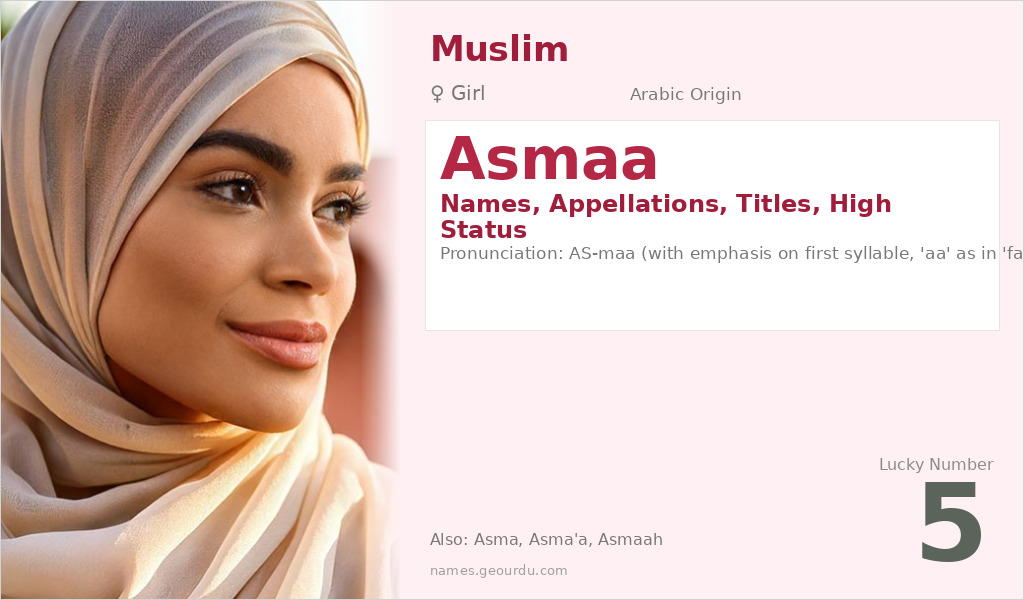
| 📛 Name | Asmaa |
| 💎 Meaning | Names, Appellations, Titles, High Status |
| 👤 Gender | Girl |
| 🕌 Religion | Muslim |
| 🌍 Origin | Arabic |
| 🗣 Pronunciation | AS-maa (with emphasis on first syllable, 'aa' as in 'father') |
| ✍️ Urdu | اسماء |
| ✍️ Arabic | أسماء |
| 🔢 Numerology | 5 |
| ✨ Spellings | Asma, Asma'a, Asmaah, Asma |
Origin & Cultural Significance
Asmaa originates from classical Arabic and has been used since pre-Islamic times, though it gained particular prominence in early Islamic history. The most famous bearer, Asmaa bint Abu Bakr (c. 595-692 CE), was the daughter of the first Caliph and half-sister to Aisha, one of Prophet Muhammad’s wives. Her courage during the Hijra (migration to Medina) and her later role as a transmitter of hadith established the name as one of honor in Islamic tradition. The name spread throughout the Muslim world with Arabic expansion and remains particularly common in Arab countries, though variations exist in Persian, Urdu, Turkish, and other languages influenced by Arabic. Unlike many Arabic names that have religious meanings, Asmaa maintains its purely linguistic origin while being embraced within Islamic naming traditions.
Personality Traits
Those named Asmaa are often associated with qualities of intelligence, eloquence, and dignity. The name’s meaning suggests someone who understands the significance of identity and the power of proper designation. In many cultures, names are believed to influence character, and Asmaa’s connection to ‘names’ implies a person who values tradition, clear communication, and meaningful relationships. These individuals often exhibit leadership qualities tempered with wisdom and respect for heritage.
Similar Names
If you like Asmaa, consider: Aisha, Fatima, Zainab, Mariam, Khadija
Famous People Named Asmaa
- Asmaa bint Abu Bakr — Early Muslim companion, daughter of first Caliph Abu Bakr, known as 'Dhat an-Nitaqayn' (She of the Two Waistbands)
- Asmaa al-Assad — First Lady of Syria
- Asmaa Mahfouz — Egyptian activist and one of the founders of the April 6 Youth Movement
Frequently Asked Questions About Asmaa
What does Asmaa mean?
Asmaa means 'Names', 'Titles', or 'Appellations' in Arabic. It is the plural form of 'ism' (name) and carries connotations of honor and distinction.
Is Asmaa a boy or girl name?
Asmaa is exclusively a girl's name in Arabic and Islamic naming traditions. The feminine form is distinguished from masculine names through its grammatical structure and historical usage.
What is the origin of Asmaa?
Asmaa originates from classical Arabic language and culture. It gained particular prominence in early Islamic history through Asmaa bint Abu Bakr, daughter of the first Caliph and respected companion of Prophet Muhammad.