
Table of Contents
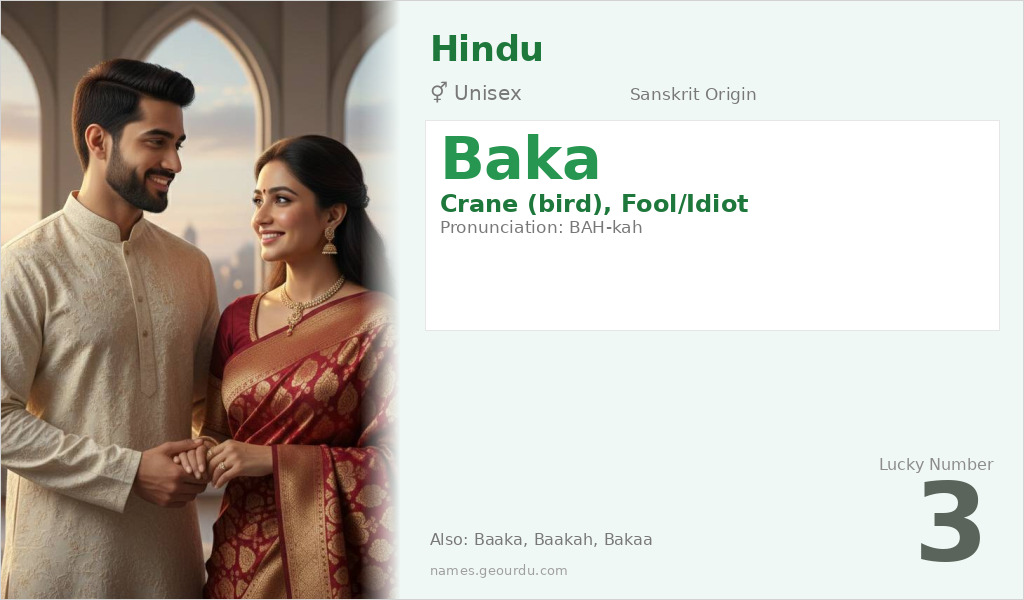
Baka is a name with fascinating dual meanings across different cultures. While in Sanskrit it beautifully means ‘crane’ and carries Hindu significance, in Japanese it has an entirely different meaning of ‘fool’. This linguistic divergence makes Baka a particularly interesting name to explore, with rich mythological connections in Indian tradition.
Meaning of Baka
Baka’s primary meaning in Hindu naming tradition comes from Sanskrit (बक), where it directly translates to ‘crane’, the elegant wading bird known for its long legs and graceful movements. This avian reference appears in ancient Hindu texts, including the Mahabharata where Baka is the name of a crane-demon king. The name’s etymology connects to Proto-Indo-European roots related to bird names. Separately, in Japanese (馬鹿), Baka means ‘fool’ or ‘idiot’, derived from Chinese characters that literally mean ‘horse’ and ‘deer’—a reference to the classical Chinese phrase ‘pointing at a deer and calling it a horse’ symbolizing deliberate confusion. These two meanings developed completely independently in different language families.
| 📛 Name | Baka |
| 💎 Meaning | Crane (bird), Fool/Idiot |
| 👤 Gender | Unisex |
| 🕌 Religion | Hindu |
| 🌍 Origin | Sanskrit |
| 🗣 Pronunciation | BAH-kah |
| ✍️ Urdu | باکا |
| ✍️ Arabic | باكا |
| 🔢 Numerology | 3 |
| ✨ Spellings | Baaka, Baakah, Bakaa |
Origin & Cultural Significance
Baka originates from Sanskrit, one of the oldest Indo-European languages, where it has been used for millennia in Hindu cultural contexts. The name appears in the Mahabharata (approximately 400 BCE-400 CE) as Baka, a demon king in crane form who terrorized a village until defeated by Bhima. In Hindu tradition, cranes symbolize vigilance, longevity, and grace, making Baka a meaningful choice. The Japanese meaning developed separately in East Asia through Chinese character adoption. While used historically in India, Baka is relatively uncommon as a personal name today, though it maintains cultural recognition through mythology.
Personality Traits
Drawing from its Sanskrit meaning as ‘crane’, individuals named Baka are often associated with qualities of observation, patience, and graceful movement through life’s challenges. Like the crane that stands still in water waiting for the right moment, they may exhibit strategic patience. The bird’s migratory nature might suggest adaptability, while its elegant form connects to aesthetic appreciation and poise.
Similar Names
If you like Baka, consider: Bakula, Bakul, Bakshi, Bakht, Bakhtawar
Famous People Named Baka
- Baka (character) — A crane-demon king in Hindu mythology from the Mahabharata, defeated by Bhima
- Baka (rapper) — Japanese hip-hop artist known for experimental music
Frequently Asked Questions About Baka
What does Baka mean?
Baka has two meanings: In Sanskrit it means 'crane' (the bird), while in Japanese it means 'fool' or 'idiot'. The Sanskrit meaning is used in Hindu naming contexts.
Is Baka a boy or girl name?
Baka is historically unisex in Hindu tradition, though it appears more commonly in mythological contexts as a male figure (like the demon king Baka in the Mahabharata).
What is the origin of Baka?
Baka originates from Sanskrit (बक) meaning 'crane'. It also exists in Japanese (馬鹿) with a different meaning, but these developed independently in different language families.