
Table of Contents
Benjy is a charming and friendly diminutive name with deep historical roots stretching back to ancient Hebrew tradition. As a shortened form of Benjamin, this name carries the weight of biblical heritage while maintaining a modern, approachable feel. Popular in English-speaking countries, Benjy offers a casual alternative to its more formal counterpart while preserving the same meaningful origins. Whether you’re drawn to its biblical connections or its cheerful sound, Benjy represents a name with both substance and style.
Meaning of Benjy
The name Benjy derives from the Hebrew name Benjamin (בִּנְיָמִין), which combines ‘ben’ meaning ‘son of’ and ‘yamin’ meaning ‘right hand’ or ‘south.’ In the Book of Genesis, Benjamin was the twelfth and youngest son of Jacob, born to Rachel who died in childbirth. Originally named Ben-Oni (‘son of my sorrow’) by his dying mother, Jacob renamed him Benjamin, interpreted as ‘son of the right hand’—a position of honor and strength in ancient Semitic culture. The ‘right hand’ symbolism extends beyond literal meaning to represent favor, protection, and authority. While ‘son of the south’ is a less common interpretation, it references the Hebrew orientation system where south was associated with the right hand. This rich etymological background gives Benjy a meaningful foundation despite its casual presentation.
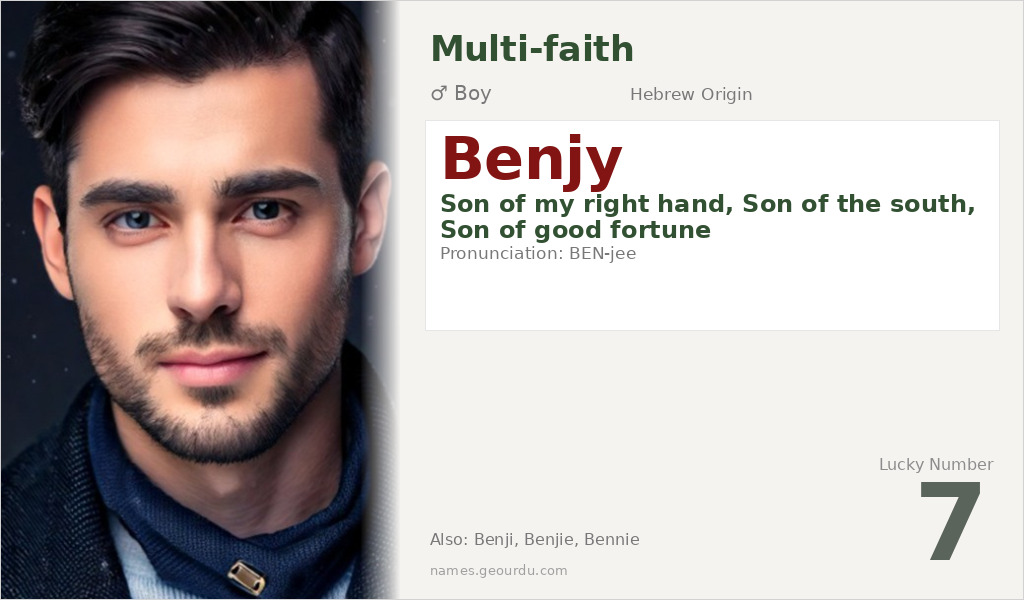
| 📛 Name | Benjy |
| 💎 Meaning | Son of my right hand, Son of the south, Son of good fortune |
| 👤 Gender | Boy |
| 🕌 Religion | Multi-faith |
| 🌍 Origin | Hebrew |
| 🗣 Pronunciation | BEN-jee |
| ✍️ Urdu | بینجی |
| ✍️ Arabic | بنجي |
| 🔢 Numerology | 7 |
| ✨ Spellings | Benji, Benjie, Bennie, Benny |
Origin & Cultural Significance
Benjy originates as an English diminutive of the Hebrew name Benjamin, which first appears in the Torah/Hebrew Bible as the youngest son of the patriarch Jacob. The name entered European languages through Greek (Βενιαμίν) and Latin (Benjamin) translations of biblical texts. As Christianity spread, Benjamin became popular among Christians, while remaining important in Jewish tradition as the name of one of the Twelve Tribes of Israel. The diminutive form Benjy emerged in English-speaking countries as an affectionate nickname, eventually becoming established as a given name in its own right. Today, it’s used across multiple faith traditions including Judaism, Christianity, and secular contexts, particularly in the United States, United Kingdom, and other English-speaking regions where diminutive names are common.
Personality Traits
Those named Benjy often project an image of approachability and warmth, with the diminutive ‘-y’ ending suggesting friendliness and approachability. They may balance thoughtful introspection with social engagement, reflecting the name’s biblical heritage of being both a ‘son of sorrow’ and ‘son of the right hand.’ This duality can manifest as individuals who are both sensitive to others’ feelings and capable of providing strength and support when needed. Their casual name often belies a depth of character and traditional values that might surprise those who only see the surface.
Similar Names
If you like Benjy, consider: Benjamin, Bennett, Benedict, Bentley, Benson
Famous People Named Benjy
- Benjy Bronk — American radio personality and writer for The Howard Stern Show
- Benjy Fish — British poker player and YouTuber known for his online poker content
Frequently Asked Questions About Benjy
What does Benjy mean?
Benjy means 'son of my right hand' or 'son of the south,' originating from the Hebrew name Benjamin. It combines 'ben' (son of) and 'yamin' (right hand/south), with the right hand symbolizing strength and favor in ancient Semitic culture.
Is Benjy a boy or girl name?
Benjy is exclusively a boy's name, as it's a diminutive of the masculine name Benjamin. There are no established feminine variants or traditional usage as a girl's name across any culture or language.
What is the origin of Benjy?
Benjy originates from Hebrew as a diminutive form of Benjamin. It entered European languages through biblical translations and became established as an independent given name in English-speaking countries, particularly in the 20th century.





