
Table of Contents
Bess is a charming and timeless name that has graced many notable women throughout history. As a diminutive of Elizabeth, it carries deep biblical roots while maintaining a friendly, approachable quality. This name has been popular in English-speaking countries for centuries, often associated with strength and devotion. Whether used independently or as a nickname, Bess offers classic elegance with historical significance.
Meaning of Bess
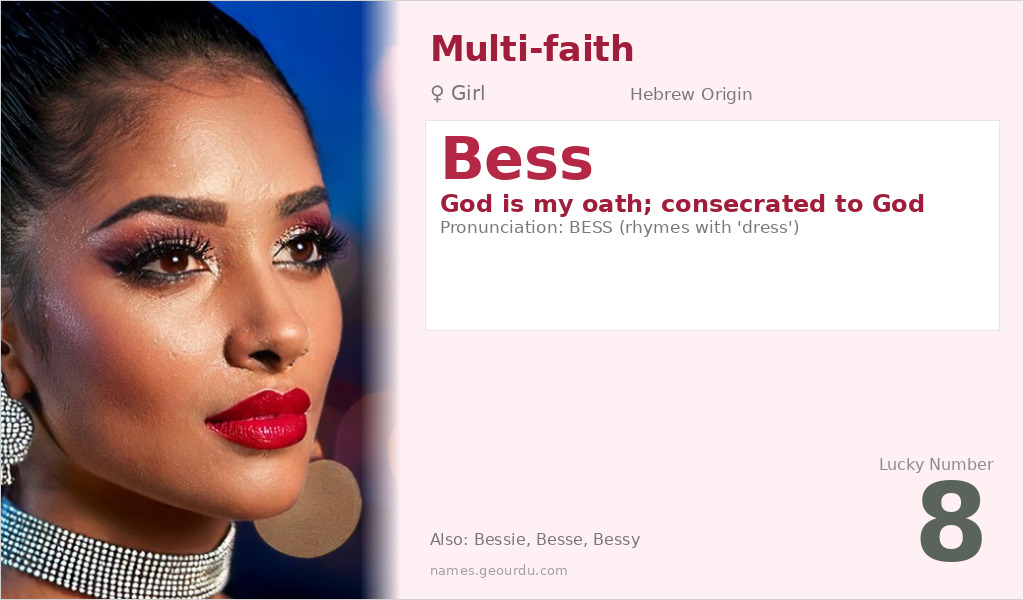
The name Bess derives from the Hebrew name Elisheva (אֱלִישֶׁבַע), meaning ‘God is my oath’ or ‘consecrated to God.’ This Hebrew name combines ‘El’ (אֵל), referring to God, and ‘sheva’ (שֶׁבַע), meaning ‘oath’ or ‘seven’ (a number representing completeness and covenant in Hebrew tradition). Through Greek adaptation as Elisabet and Latin as Elisabeth, the name entered European languages. Bess emerged in medieval England as an affectionate shortening, similar to other Elizabeth diminutives like Bessie, Betty, and Beth. The core meaning has remained consistent across linguistic transformations, maintaining its theological significance while becoming more casual in form.
| 📛 Name | Bess |
| 💎 Meaning | God is my oath; consecrated to God |
| 👤 Gender | Girl |
| 🕌 Religion | Multi-faith |
| 🌍 Origin | Hebrew |
| 🗣 Pronunciation | BESS (rhymes with 'dress') |
| ✍️ Urdu | بیس |
| ✍️ Arabic | بيس |
| 🔢 Numerology | 8 |
| ✨ Spellings | Bessie, Besse, Bessy |
Origin & Cultural Significance
Bess originated as a medieval English diminutive of Elizabeth, which itself comes from the Hebrew Elisheva. In the Bible, Elizabeth was the mother of John the Baptist (Luke 1:5-80), making the name significant in Jewish, Christian, and Islamic traditions. The diminutive Bess gained popularity in England during the Middle Ages and Renaissance, famously borne by Queen Elizabeth I, who was often called ‘Good Queen Bess.’ The name spread through English colonization and literature, appearing in works like Shakespeare’s ‘King Lear’ (as a servant named Bess). While most common in English-speaking cultures, variations exist worldwide due to the global spread of biblical names.
Personality Traits
Those named Bess are often associated with qualities of faithfulness, reliability, and inner strength. The name’s meaning suggests a person who takes commitments seriously and values spiritual or moral principles. Historically, bearers like Bess Truman exemplify practicality combined with quiet dignity. While personality varies individually, the name carries connotations of traditional values, warmth, and steadfastness that have made it enduring across generations.
Similar Names
If you like Bess, consider: Elizabeth, Elisabeth, Eliza, Beth, Betsy, Betty, Lisa, Elsa, Isabella, Isobel
Famous People Named Bess
- Bess Truman — First Lady of the United States (1945-1953), wife of President Harry S. Truman
- Bess Myerson — American television personality and Miss America 1945
- Bess Armstrong — American actress known for 'The Four Seasons' and 'My So-Called Life'
Frequently Asked Questions About Bess
What does Bess mean?
Bess means 'God is my oath' or 'consecrated to God.' It originates from the Hebrew name Elisheva, which was adapted through Greek and Latin before becoming Elizabeth in English, with Bess as a diminutive form.
Is Bess a boy or girl name?
Bess is exclusively a girl's name. It has always been used as a feminine name, both as a standalone name and as a nickname for Elizabeth. There are no documented historical uses as a masculine name.
What is the origin of Bess?
Bess originates from Hebrew via medieval English. It's a diminutive of Elizabeth, which comes from the Hebrew Elisheva. The name entered English through biblical and royal traditions, particularly associated with Queen Elizabeth I ('Good Queen Bess').





