
Table of Contents
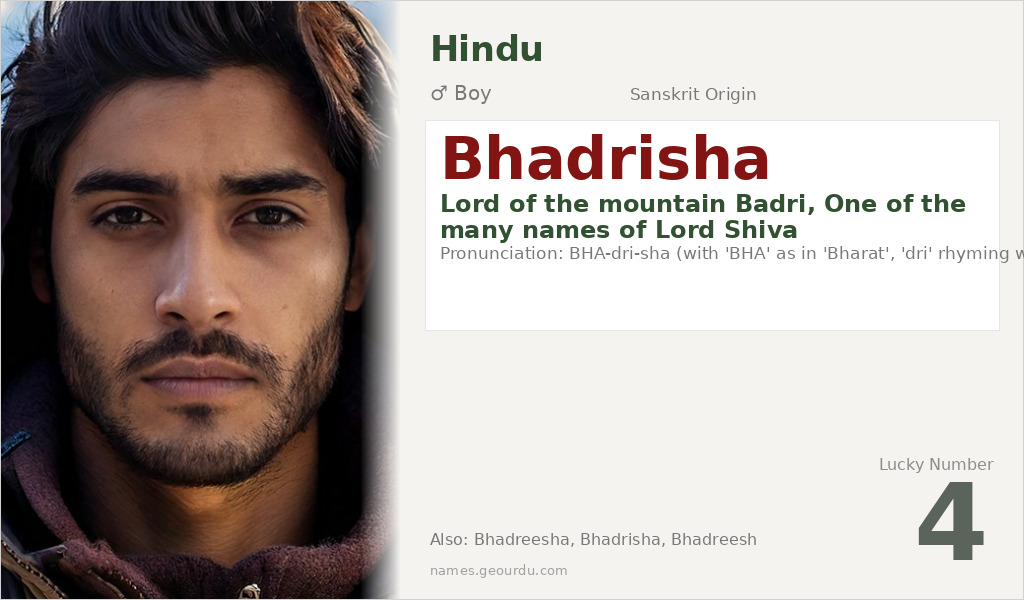
Bhadrisha is a profound Sanskrit name steeped in Hindu tradition, carrying the weight of divine association and geographical sanctity. As one of the many names of Lord Shiva, it connects the bearer to the sacred Himalayas and spiritual lordship. This name embodies both auspiciousness and authority, making it a meaningful choice within Hindu naming conventions. Its rich etymology and cultural significance offer depth beyond mere phonetics.
Meaning of Bhadrisha
Bhadrisha is a compound Sanskrit name with clear etymological roots. The first component, ‘Bhadra’ (भद्र), translates to ‘auspicious,’ ‘fortunate,’ ‘blessed,’ or ‘prosperous’—a term frequently used in Vedic and classical Sanskrit literature to denote positive qualities. The second component, ‘Isha’ (ईश), means ‘lord,’ ‘ruler,’ ‘master,’ or ‘god,’ derived from the Sanskrit root ‘īś’ meaning ‘to own’ or ‘to rule.’ Together, they form ‘Bhadrisha,’ specifically referring to Shiva as the lord of Mount Badri (Badrinath). This connection places the name within the context of Shiva’s role as a mountain-dwelling deity, with Badrinath being one of the Char Dham pilgrimage sites. The name thus signifies ‘auspicious lord’ or more precisely ‘lord of the auspicious mountain Badri,’ highlighting both divine authority and sacred geography.
| 📛 Name | Bhadrisha |
| 💎 Meaning | Lord of the mountain Badri, One of the many names of Lord Shiva |
| 👤 Gender | Boy |
| 🕌 Religion | Hindu |
| 🌍 Origin | Sanskrit |
| 🗣 Pronunciation | BHA-dri-sha (with 'BHA' as in 'Bharat', 'dri' rhyming with 'tree', and 'sha' as in 'shah') |
| ✍️ Urdu | بھدریش |
| ✍️ Arabic | بهادريشا |
| 🔢 Numerology | 4 |
| ✨ Spellings | Bhadreesha, Bhadrisha, Bhadreesh, Bhadrish |
Origin & Cultural Significance
Bhadrisha originates from classical Sanskrit, the liturgical language of Hinduism, and is deeply embedded in Hindu religious and cultural traditions. It appears in various Hindu texts and contexts as an epithet for Lord Shiva, particularly in association with the Badrinath temple in Uttarakhand, India. This temple, dedicated to Vishnu in his Badrinarayan form, also has strong Shaivite connections, with Shiva being revered as the lord of the region. The name reflects the syncretic nature of Hindu pilgrimage sites where multiple deities are honored. Historically, such compound names were created to describe specific attributes or associations of deities, and Bhadrisha serves this purpose by linking Shiva to a specific holy mountain. Its usage as a personal name likely emerged from devotional practices and the desire to invoke divine qualities in a child.
Personality Traits
Those named Bhadrisha are often perceived as having a serene yet authoritative demeanor, influenced by the name’s connection to Shiva and mountains. They may exhibit traits of stability, spiritual depth, and protective instincts, mirroring the steadfastness of a mountain and the auspiciousness implied by ‘Bhadra.’ Their personality might blend calm introspection with natural leadership, making them reliable and respected figures in their communities. The name’s divine association can inspire a sense of purpose and connection to tradition.
Similar Names
If you like Bhadrisha, consider: Bhadra, Bhadresh, Ishwar, Shiva, Badrinath
Famous People Named Bhadrisha
- No widely known contemporary public figures with this name found in records
Frequently Asked Questions About Bhadrisha
What does Bhadrisha mean?
Bhadrisha means 'Lord of the mountain Badri' or 'auspicious lord,' specifically referring to Lord Shiva as the ruler of Mount Badri (Badrinath). It is a Sanskrit compound name from 'Bhadra' (auspicious) and 'Isha' (lord).
Is Bhadrisha a boy or girl name?
Bhadrisha is exclusively a boy's name in Hindu tradition, as it is a masculine epithet for Lord Shiva and follows Sanskrit grammatical gender rules where '-isha' endings typically denote masculine forms.
What is the origin of Bhadrisha?
Bhadrisha originates from Sanskrit, the classical language of Hinduism, and is deeply rooted in Hindu religious texts and culture as a name for Lord Shiva associated with the Badrinath pilgrimage site in the Himalayas.





