
Table of Contents
Bholanath is a profound and spiritually rich name deeply rooted in Hindu tradition, specifically associated with Lord Shiva. This name carries the beautiful meaning of ‘Lord of the Innocent’ or ‘Protector of the Simple-Hearted’, reflecting Shiva’s compassionate and accessible nature. Often chosen for boys in Hindu families, Bholanath symbolizes divine benevolence and the power of sincere devotion. In this guide, we explore the etymology, cultural significance, and personality traits linked to this venerable name.
Meaning of Bholanath
Bholanath derives from Sanskrit, combining ‘Bhola’ (भोला), meaning ‘innocent’, ‘simple’, or ‘guileless’, and ‘Nath’ (नाथ), meaning ‘lord’, ‘master’, or ‘protector’. Thus, the name translates to ‘Lord of the Innocent’, highlighting Shiva’s role as a deity who is easily pleased by pure-hearted devotees. In Hindu scriptures, Shiva is revered as Bholanath because he disregards elaborate rituals in favor of genuine faith, making him accessible to all. This epithet underscores the theological concept that divinity embraces simplicity and honesty over complexity and pretense. The name has been used for centuries in religious texts, prayers, and cultural practices, solidifying its place in Hindu onomastics.
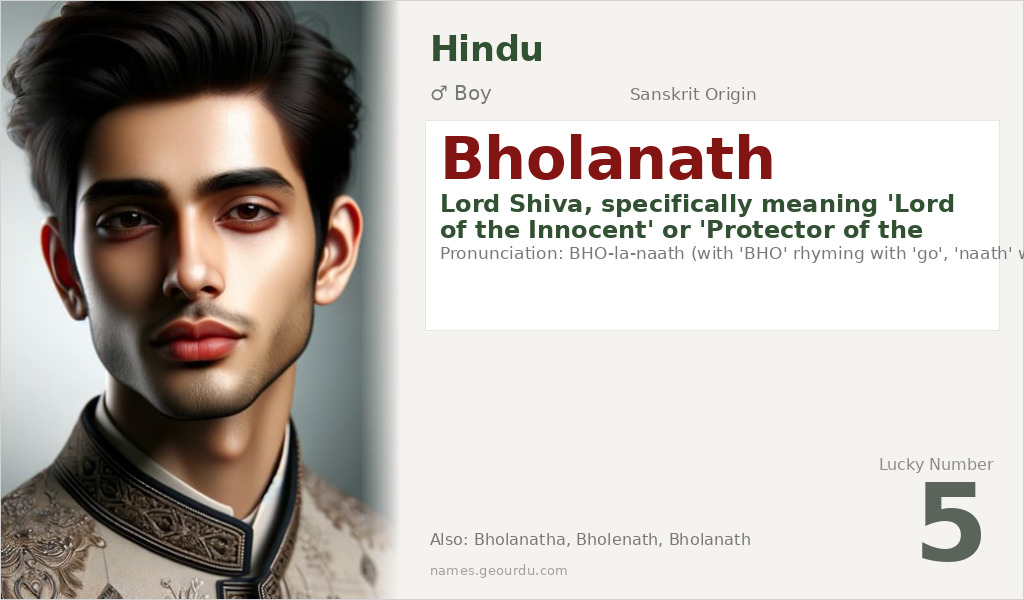
| 📛 Name | Bholanath |
| 💎 Meaning | Lord Shiva, specifically meaning 'Lord of the Innocent' or 'Protector of the Simple-Hearted' |
| 👤 Gender | Boy |
| 🕌 Religion | Hindu |
| 🌍 Origin | Sanskrit |
| 🗣 Pronunciation | BHO-la-naath (with 'BHO' rhyming with 'go', 'naath' with a long 'aa' as in 'father') |
| ✍️ Urdu | بھولاناتھ |
| ✍️ Arabic | بوهلانات |
| 🔢 Numerology | 5 |
| ✨ Spellings | Bholanatha, Bholenath, Bholanath |
Origin & Cultural Significance
Originating from Sanskrit, the classical language of ancient India, Bholanath is intrinsically linked to Hinduism and its pantheon of deities. It emerged as a devotional name reflecting the attributes of Lord Shiva, one of the principal gods in Hinduism known for destruction, regeneration, and asceticism. Culturally, the name is prevalent in India, Nepal, and among Hindu diaspora communities worldwide, often given to boys to invoke Shiva’s blessings and protective qualities. Historically, it appears in Puranic literature and folk traditions, where Shiva’s epithet as Bholanath emphasizes his merciful aspect toward the naive and devout. The name’s usage spans religious ceremonies, artistic depictions, and personal nomenclature, maintaining its relevance in contemporary Hindu naming practices.
Personality Traits
Those named Bholanath are often seen as embodying the traits of their namesake—compassionate, straightforward, and spiritually attuned. They may exhibit a natural innocence and honesty that fosters trust and warmth in relationships. With a protective instinct akin to Shiva’s role as a guardian, individuals with this name might prioritize the well-being of others, especially the vulnerable. Their personality often reflects a balance of simplicity and depth, drawing respect for their genuine and unpretentious approach to life.
Similar Names
If you like Bholanath, consider: Shiva, Mahadev, Nataraj, Bhole, Nath, Bholenath, Shankar, Rudra, Har Har Mahadev, Om Namah Shivaya
Famous People Named Bholanath
- Bholanath — A common given name for Hindu men in India and Nepal, often used by devotees of Shiva
- Bholanath Pandey — A notable Indian classical musician and tabla player
Frequently Asked Questions About Bholanath
What does Bholanath mean?
Bholanath means 'Lord of the Innocent' or 'Protector of the Simple-Hearted' in Sanskrit, and it is an epithet of Lord Shiva in Hinduism.
Is Bholanath a boy or girl name?
Bholanath is exclusively a boy's name in Hindu culture, as it refers to a male deity, Lord Shiva, and is traditionally given to male children.
What is the origin of Bholanath?
Bholanath originates from Sanskrit, the ancient language of India, and is deeply rooted in Hindu religious and cultural traditions as a name for Lord Shiva.





