
Table of Contents
Bimba is a beautiful name with deep roots in Sanskrit literature and Hindu culture. Meaning ‘image, reflection, or mirror,’ it carries philosophical significance about perception and reality. While often associated with feminine usage today, it has historical unisex applications in ancient Indian contexts. This name connects to classical poetry, astronomy, and spiritual metaphors in South Asian tradition.
Meaning of Bimba
Bimba derives directly from Sanskrit ‘bimba’ (बिम्ब), which fundamentally means ‘image, reflection, mirror, or likeness.’ In Vedic and classical Sanskrit, the term specifically describes the disc or orb of celestial bodies—particularly the sun and moon—referencing their circular, shining appearance. The word appears in texts like the Mahabharata and works by Kalidasa, where it’s used both literally (for reflections) and metaphorically (for representations or manifestations). Linguistically, it connects to the root ‘bimb’ meaning ‘to shine, appear,’ relating to concepts of visibility, representation, and the relationship between reality and its reflection.
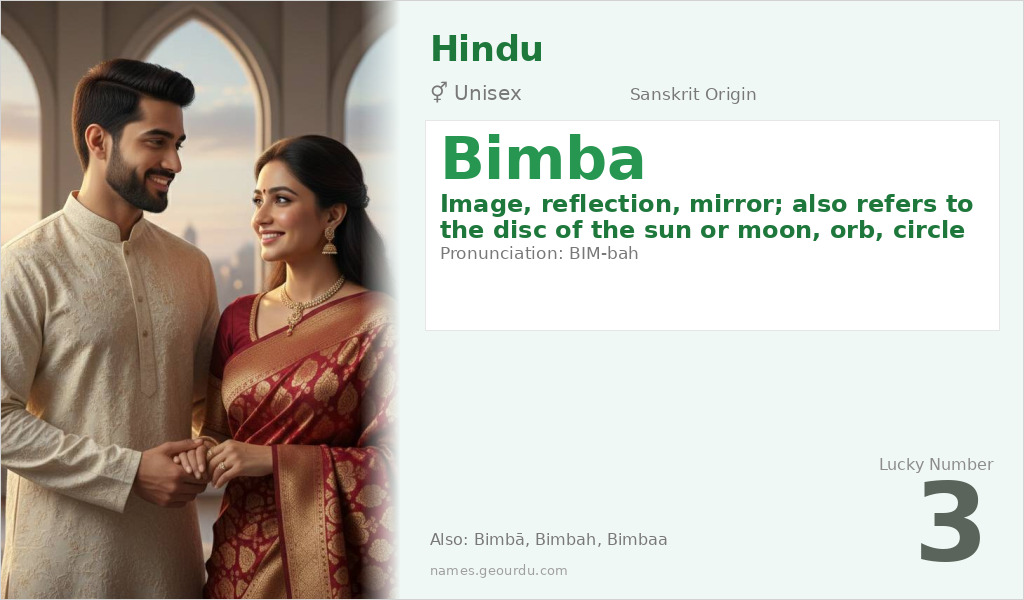
| 📛 Name | Bimba |
| 💎 Meaning | Image, reflection, mirror; also refers to the disc of the sun or moon, orb, circle |
| 👤 Gender | Unisex |
| 🕌 Religion | Hindu |
| 🌍 Origin | Sanskrit |
| 🗣 Pronunciation | BIM-bah |
| ✍️ Urdu | بمبا |
| ✍️ Arabic | بيمبا |
| 🔢 Numerology | 3 |
| ✨ Spellings | Bimbā, Bimbah, Bimbaa |
Origin & Cultural Significance
Bimba originates from classical Sanskrit, the liturgical language of Hinduism, with documented usage dating back over two millennia. It appears in ancient Indian literature, astronomy, and philosophy, where it described both physical reflections and celestial orbs. While commonly used for girls in modern Hindu naming practices, historically it was unisex—evidenced by names like King Bimbisara (6th century BCE). The name carries cultural significance in Hindu tradition through its philosophical connotations about maya (illusion) and reality, though specific lucky colors, days, and stones attributed in modern numerology lack authoritative scriptural basis.
Personality Traits
Those named Bimba are often associated with qualities of reflection, creativity, and perceptiveness. The name’s meaning suggests individuals who are introspective, artistic, and capable of understanding multiple perspectives. They may exhibit intuitive abilities and a natural appreciation for beauty, symmetry, and self-expression, mirroring the name’s connection to images and representations.
Similar Names
If you like Bimba, consider: Bimbika, Bimbisar, Bimbavati, Pratibimba, Chhaya
Famous People Named Bimba
- Bimbisara — Ancient Indian king of Magadha (c. 543–491 BCE) from the Haryanka dynasty
- Bimba Devi — Contemporary Indian classical dancer specializing in Odissi tradition
Frequently Asked Questions About Bimba
What does Bimba mean?
Bimba means 'image, reflection, mirror' in Sanskrit, and also refers to the disc or orb of celestial bodies like the sun and moon.
Is Bimba a boy or girl name?
While commonly used for girls in contemporary Hindu naming, Bimba is historically unisex in Sanskrit tradition, with examples like the ancient king Bimbisara.
What is the origin of Bimba?
Bimba originates from classical Sanskrit, the ancient liturgical language of Hinduism, with documented usage in Indian literature and philosophy for over 2000 years.