
Table of Contents
Bindumadhav is a beautiful and meaningful Sanskrit name for boys that carries deep spiritual significance in Hindu tradition. Combining poetic imagery with divine reverence, this name evokes the luminous qualities of Lord Vishnu. As a compound name with rich etymological roots, Bindumadhav represents both cultural heritage and spiritual aspiration. Parents choosing this name often seek to imbue their child with the gentle, reflective qualities associated with the moon and Vishnu’s benevolent nature.
Meaning of Bindumadhav
Bindumadhav is a Sanskrit compound name with precise linguistic components that create its distinctive meaning. The first element ‘Bindu’ (बिन्दु) means ‘drop, point, spot, or moon’ in Sanskrit, often symbolizing the crescent moon in Hindu iconography. The second element ‘Madhav’ (माधव) is a well-established name for Lord Vishnu, derived from ‘Madhu’ meaning honey or sweetness, and associated with springtime. When combined, Bindumadhav literally translates to ‘Vishnu who is the moon’ or ‘Vishnu adorned with the moon,’ creating a poetic epithet that emphasizes Vishnu’s gentle, illuminating presence. This construction follows classical Sanskrit compounding rules where the first element modifies the second, resulting in a name that appears in Hindu scriptures and literature as a descriptive title for the deity.
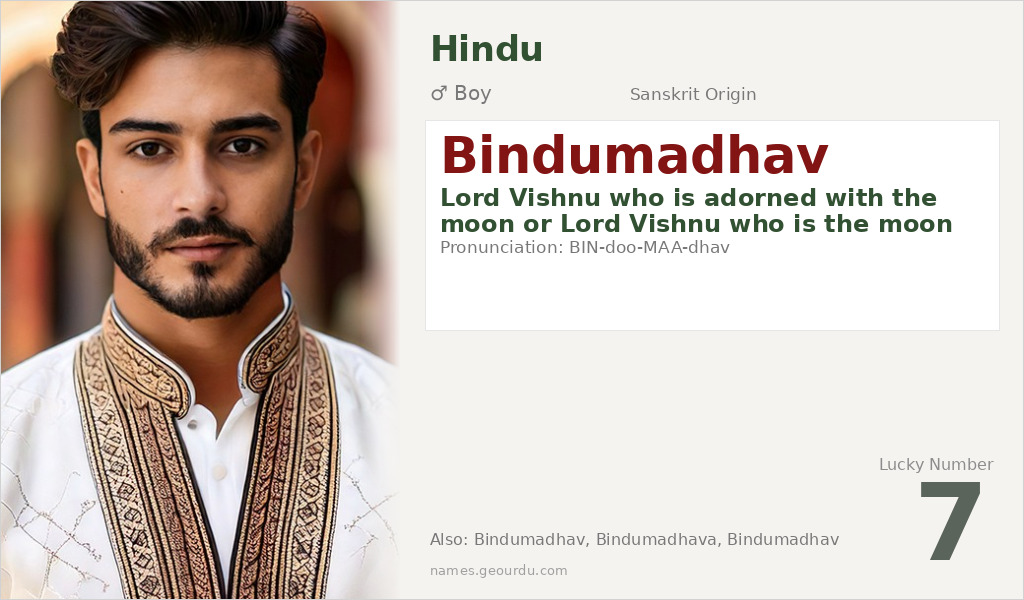
| 📛 Name | Bindumadhav |
| 💎 Meaning | Lord Vishnu who is adorned with the moon or Lord Vishnu who is the moon |
| 👤 Gender | Boy |
| 🕌 Religion | Hindu |
| 🌍 Origin | Sanskrit |
| 🗣 Pronunciation | BIN-doo-MAA-dhav |
| ✍️ Urdu | بندومادھو |
| ✍️ Arabic | بيندومادهاف |
| 🔢 Numerology | 7 |
| ✨ Spellings | Bindumadhav, Bindumadhava, Bindumadhav |
Origin & Cultural Significance
Bindumadhav originates from classical Sanskrit, the ancient liturgical language of Hinduism, and is deeply rooted in Hindu religious and cultural traditions. The name emerges from the rich tapestry of Hindu mythology where Vishnu, one of the principal deities, has numerous names and epithets describing his various attributes and forms. As a compound name, Bindumadhav reflects the sophisticated naming conventions of Sanskrit literature, where descriptive compounds create nuanced meanings. Historically, such names were used both as devotional references to deities and as given names for children, particularly in Brahmin and other Hindu communities across India. The name continues to be used primarily in Hindu families, especially in regions with strong Sanskrit traditions like Maharashtra, Karnataka, and other parts of India.
Personality Traits
Those named Bindumadhav are often associated with calm, reflective personalities that mirror the moon’s serene influence. They may exhibit thoughtful, philosophical tendencies and a natural inclination toward spirituality or artistic expression. The name’s connection to Vishnu suggests qualities of protection, compassion, and stability, while the lunar association implies intuition, emotional depth, and gentle leadership. These individuals typically approach life with measured contemplation rather than impulsive action.
Similar Names
If you like Bindumadhav, consider: Madhav, Madhava, Bindusar, Bindu, Madhusudan, Hari, Vishnu, Krishna, Govind
Famous People Named Bindumadhav
- Bindumadhav Joshi — Indian classical vocalist of the Gwalior gharana tradition
- Bindumadhav Khire — Indian social activist and LGBTQ+ rights advocate from Maharashtra
Frequently Asked Questions About Bindumadhav
What does Bindumadhav mean?
Bindumadhav means 'Lord Vishnu who is the moon' or 'Vishnu adorned with the moon' in Sanskrit. It's a compound name where 'Bindu' means moon and 'Madhav' refers to Vishnu.
Is Bindumadhav a boy or girl name?
Bindumadhav is exclusively a boy's name in Hindu naming tradition. Sanskrit compound names ending with masculine elements like 'Madhav' are traditionally masculine.
What is the origin of Bindumadhav?
Bindumadhav originates from Sanskrit, the classical language of Hinduism. It's a compound name from Hindu mythology, specifically referring to an epithet of Lord Vishnu.





