
Table of Contents
Chaturmukha is a profound Sanskrit name that carries deep religious significance in Hinduism. Unlike typical personal names, this term specifically describes the four-faced depiction of Brahma, the creator god in Hindu cosmology. Understanding Chaturmukha requires exploring ancient Sanskrit linguistics and Hindu iconography, where the name represents divine omniscience and creative power. This epithet appears in sacred texts and temple sculptures across the Indian subcontinent.
Meaning of Chaturmukha
Chaturmukha derives from two Sanskrit words: ‘chatur’ (चतुर्) meaning ‘four’ and ‘mukha’ (मुख) meaning ‘face,’ ‘mouth,’ or ‘front.’ The compound literally translates to ‘having four faces’ or ‘four-headed.’ In Hindu theology, this specifically refers to Brahma’s unique iconography where he faces all four cardinal directions simultaneously. Each face represents different aspects: the four Vedas (Rig, Yajur, Sama, Atharva), the four stages of life (ashramas), or the four functions of consciousness. The term appears in texts like the Vishnu Purana and Shiva Purana, where Brahma is described as Chaturmukha to symbolize his all-seeing, all-knowing nature as creator of the universe.
| 📛 Name | Chaturmukha |
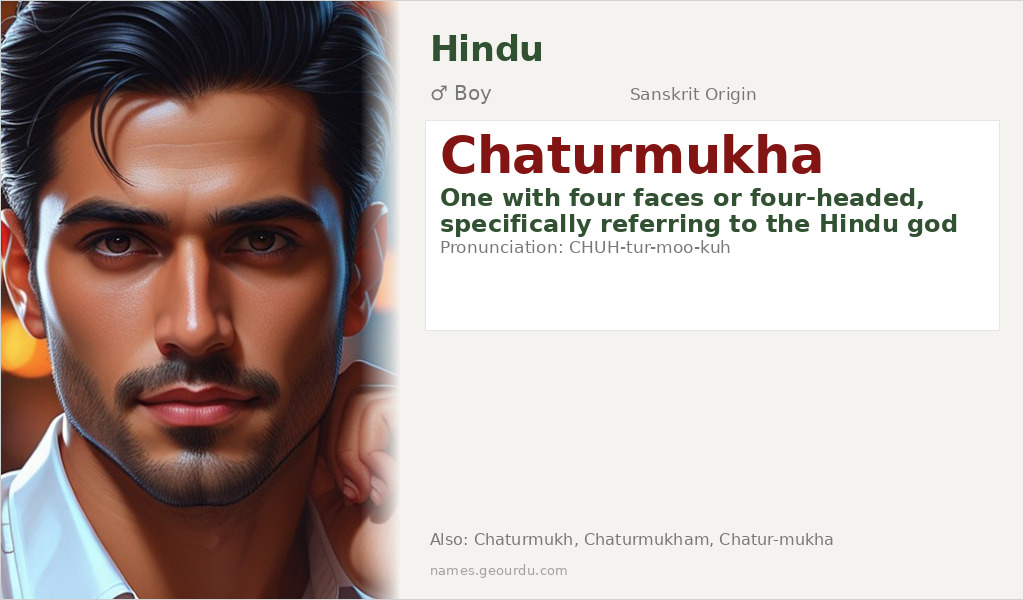
| 💎 Meaning | One with four faces or four-headed, specifically referring to the Hindu god Brahma |
| 👤 Gender | Boy |
| 🕌 Religion | Hindu |
| 🌍 Origin | Sanskrit |
| 🗣 Pronunciation | CHUH-tur-moo-kuh |
| ✍️ Urdu | چتر مکھ |
| ✍️ Arabic | شاتورمخا |
| 🔢 Numerology | |
| ✨ Spellings | Chaturmukh, Chaturmukham, Chatur-mukha |
Origin & Cultural Significance
Chaturmukha originates from classical Sanskrit, the liturgical language of Hinduism, with roots tracing back to Vedic Sanskrit. The concept emerges from Hindu cosmogony where Brahma creates the universe through his four faces, each reciting one of the four Vedas. This iconography developed during the Gupta period (4th-6th centuries CE) and became standardized in Hindu temple architecture across India and Southeast Asia. While occasionally used as a given name in some Hindu communities, it remains primarily a religious and descriptive term rather than a common personal name. The epithet reflects the philosophical concept of divine omniscience in Hindu thought, where the four faces represent comprehensive knowledge of past, present, future, and transcendence.
Personality Traits
As a name referring to Brahma, Chaturmukha carries symbolic associations rather than personality traits for individuals. In Hindu tradition, Brahma represents creativity, wisdom, and the source of all knowledge. The four faces symbolize comprehensive understanding, the ability to perceive multiple perspectives simultaneously, and cosmic consciousness. While not typically given as a personal name today, if used, it might suggest parents’ aspirations for their child to embody intellectual breadth, creative potential, and spiritual awareness.
Similar Names
If you like Chaturmukha, consider: Brahma, Chaturanga, Chaturbhuja, Chaturdasha, Mukunda
Famous People Named Chaturmukha
- No notable historical or contemporary figures bear this as a personal name, as it is primarily a descriptive term for the Hindu god Brahma in religious texts and iconography
Frequently Asked Questions About Chaturmukha
What does Chaturmukha mean?
Chaturmukha means 'four-faced' or 'having four faces' in Sanskrit. It specifically refers to the Hindu creator god Brahma, who is traditionally depicted with four faces representing omniscience and the four Vedas.
Is Chaturmukha a boy or girl name?
Chaturmukha is exclusively a masculine name as it refers to the male deity Brahma in Hindu tradition. It is not used for girls and has no feminine equivalent in Sanskrit naming conventions.
What is the origin of Chaturmukha?
Chaturmukha originates from Sanskrit, the ancient liturgical language of Hinduism. It is a compound of 'chatur' (four) and 'mukha' (face), appearing in Hindu religious texts and iconography to describe Brahma's four-faced representation.





