
Table of Contents
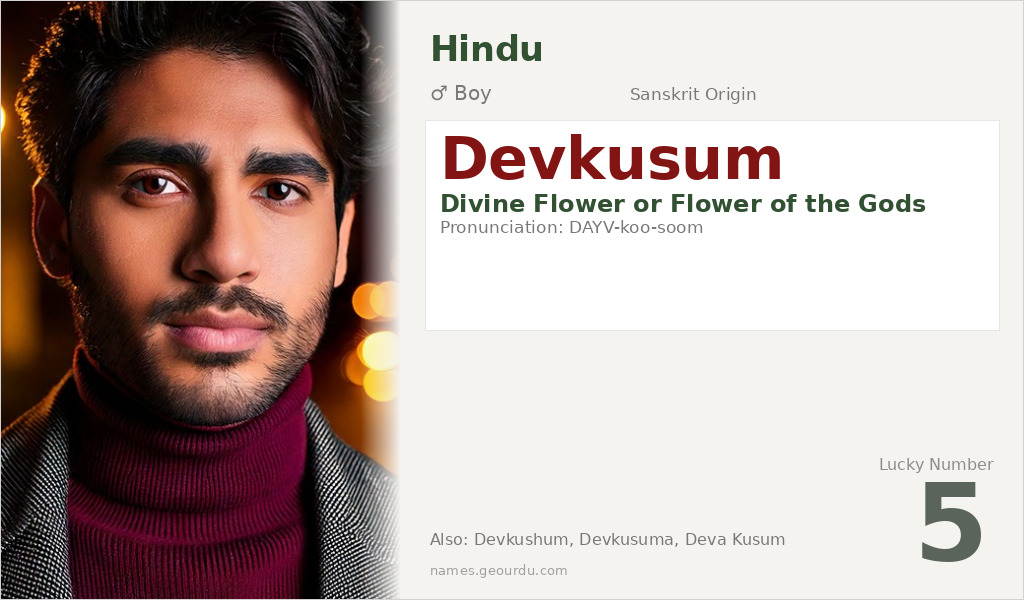
Devkusum is a beautiful and meaningful Sanskrit name that carries the poetic essence of ‘Divine Flower’ or ‘Flower of the Gods’. Primarily used in Hindu communities, this name combines spiritual depth with natural imagery, making it a distinctive choice for parents seeking a name with cultural resonance. While not extremely common, it reflects classical Indian naming traditions that value both phonetic elegance and symbolic significance.
Meaning of Devkusum
Devkusum derives from Sanskrit, one of the world’s oldest languages and the liturgical language of Hinduism. The name is a compound of ‘Dev’ (देव), meaning ‘god, deity, or divine’, and ‘Kusum’ (कुसुम), meaning ‘flower or blossom’. In Sanskrit literature, ‘Kusum’ is frequently used in poetry and religious texts to denote flowers in a metaphorical sense, often representing beauty, fragility, and purity. ‘Dev’ as a prefix appears in many Sanskrit names (e.g., Devendra, Devika) to indicate divine qualities. Thus, Devkusum literally translates to ‘divine flower’, symbolizing something both spiritually elevated and naturally beautiful—a concept cherished in Hindu philosophy where nature and divinity are often intertwined.
| 📛 Name | Devkusum |
| 💎 Meaning | Divine Flower or Flower of the Gods |
| 👤 Gender | Boy |
| 🕌 Religion | Hindu |
| 🌍 Origin | Sanskrit |
| 🗣 Pronunciation | DAYV-koo-soom |
| ✍️ Urdu | دیوکسم |
| ✍️ Arabic | ديفكوسوم |
| 🔢 Numerology | 5 |
| ✨ Spellings | Devkushum, Devkusuma, Deva Kusum |
Origin & Cultural Significance
Devkusum originates from Sanskrit, the classical language of ancient India, and is deeply rooted in Hindu culture. Sanskrit names like Devkusum often draw from religious texts, poetry, and philosophical concepts, reflecting values such as spirituality, purity, and harmony with nature. While the name is not among the most common Sanskrit names today, it follows traditional naming patterns seen in Hindu communities across India and the diaspora. Unlike names from Islamic traditions (e.g., Arabic or Persian), Devkusum has no verified usage or meaning in languages like Pashto, Balochi, or Urdu—it remains specifically a Sanskrit-derived Hindu name. Its usage is primarily cultural rather than tied to astrological systems like numerology or gemology, contrary to some modern invented associations.
Personality Traits
Names often carry implicit expectations, and Devkusum, meaning ‘Divine Flower’, suggests a personality that blends spiritual depth with aesthetic sensitivity. Those named Devkusum might be seen as calm, reflective individuals who appreciate art, nature, or philosophical pursuits. The floral element implies gentleness and creativity, while the divine prefix could indicate a strong moral or ethical foundation. In social contexts, they may be perceived as harmonious and principled, with a quiet confidence that draws respect.
Similar Names
If you like Devkusum, consider: Devendra, Devansh, Kusumakar, Pushkar, Kamal
Famous People Named Devkusum
- No widely known historical or contemporary figures with this exact name were found in verifiable records
Frequently Asked Questions About Devkusum
What does Devkusum mean?
Devkusum means 'Divine Flower' or 'Flower of the Gods'. It is a compound Sanskrit name from 'Dev' (divine) and 'Kusum' (flower).
Is Devkusum a boy or girl name?
Devkusum is traditionally a boy's name in Hindu naming conventions, though Sanskrit compound names can sometimes be adapted; it is predominantly masculine in recorded usage.
What is the origin of Devkusum?
Devkusum originates from Sanskrit, the classical language of ancient India, and is used in Hindu communities. It is not found in Arabic, Persian, or other regional languages with verified meanings.





