
Table of Contents
Dhyaan is a profound Sanskrit name that carries centuries of spiritual wisdom within its syllables. Meaning ‘meditation’ or ‘contemplation,’ this name connects directly to the ancient practice of focused attention that forms the heart of Hindu and yogic traditions. Unlike many modern names, Dhyaan isn’t just a label but embodies an entire philosophy of mindful living. Parents choosing this name often seek to instill values of introspection and spiritual awareness in their child.
Meaning of Dhyaan
Dhyaan originates from the Sanskrit root ‘dhyai,’ which means to contemplate, meditate, or think deeply. In classical Sanskrit grammar, it’s formed as a verbal noun (kṛdanta) from the root √dhyā, creating a word that signifies the act or state of meditation. This term holds particular importance in Hindu philosophy, where it appears in foundational texts like Patanjali’s Yoga Sutras as the seventh limb of Ashtanga Yoga, preceding samadhi (enlightenment). In the Bhagavad Gita and Upanishads, dhyaan refers to sustained spiritual contemplation that leads to self-realization. The word has been adopted into many modern Indian languages with the same core meaning, though in everyday usage it can also mean general concentration or attention.
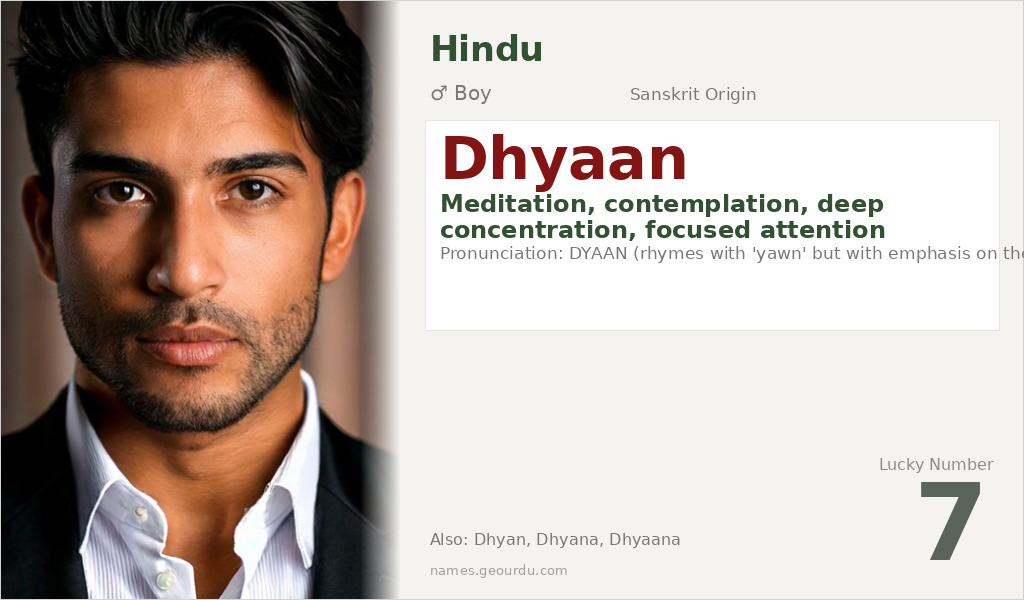
| 📛 Name | Dhyaan |
| 💎 Meaning | Meditation, contemplation, deep concentration, focused attention |
| 👤 Gender | Boy |
| 🕌 Religion | Hindu |
| 🌍 Origin | Sanskrit |
| 🗣 Pronunciation | DYAAN (rhymes with 'yawn' but with emphasis on the first syllable) |
| ✍️ Urdu | دھیان |
| ✍️ Arabic | ديان |
| 🔢 Numerology | 7 |
| ✨ Spellings | Dhyan, Dhyana, Dhyaana |
Origin & Cultural Significance
Dhyaan has its roots exclusively in Sanskrit, the ancient liturgical language of Hinduism, Buddhism, and Jainism. Unlike many Indian names that have cross-cultural variations, Dhyaan remains distinctly tied to Indic spiritual traditions. The concept of dhyaan is central to multiple South Asian religions—in Hinduism as part of yoga practice, in Buddhism where it evolved into various meditation techniques (dhyāna became Chan in Chinese and Zen in Japanese), and in Jainism as a spiritual discipline. Historically, the name gained popularity in India during the 20th century as part of a broader revival of Sanskrit names, though it remains less common than many other Sanskrit-derived names. It’s primarily used in Hindu communities across India, Nepal, and the diaspora.
Personality Traits
Those named Dhyaan are often associated with calm, thoughtful personalities. They tend to be introspective individuals who value depth over breadth in their pursuits and relationships. This name suggests someone who approaches life with mindfulness and consideration, potentially excelling in fields requiring concentration and analytical thinking. While not necessarily overtly spiritual, they often possess an innate curiosity about life’s deeper questions and meaning.
Similar Names
If you like Dhyaan, consider: Dhyanesh, Dhyanendra, Dhyanashree, Dhyanika, Dhyanidhi
Famous People Named Dhyaan
- Dhyan Chand — Legendary Indian field hockey player (1905-1979), considered one of the greatest hockey players in history
- Dhyan Sreenivasan — Indian film actor and director in Malayalam cinema
Frequently Asked Questions About Dhyaan
What does Dhyaan mean?
Dhyaan means 'meditation,' 'contemplation,' or 'deep concentration' in Sanskrit. It comes from the root word 'dhyai' meaning to think deeply or meditate.
Is Dhyaan a boy or girl name?
Dhyaan is traditionally and almost exclusively a masculine name in Indian naming conventions, though the concept of dhyaan (meditation) itself is gender-neutral in spiritual practice.
What is the origin of Dhyaan?
Dhyaan originates from Sanskrit, the ancient language of Hindu scriptures. It's specifically tied to yogic and Hindu philosophical traditions where it denotes the practice of meditation.





