
Table of Contents
Eadmund is a name that carries the weight of centuries, echoing from Anglo-Saxon England to modern times. This ancient name combines elements meaning ‘wealth’ and ‘protection,’ creating a powerful designation for leaders and guardians. As the original form of the familiar Edmund, it represents a direct connection to pre-Norman English history and nobility. Today, it remains a distinctive choice with deep historical roots and enduring significance.
Meaning of Eadmund
The name Eadmund has a clear and well-documented meaning derived from its Old English components. The first element ‘ead’ (also spelled ‘ēad’) means ‘wealth, fortune, prosperity, happiness’ in Old English, related to the German ‘Glück’ (luck/fortune). The second element ‘mund’ means ‘protection, guardian, hand’ (literally ‘hand’ as a symbol of protection). This combination creates the meaning ‘wealthy protector’ or ‘prosperous guardian.’ The name appears in numerous historical records, including the Anglo-Saxon Chronicle, and was particularly popular among the royal houses of Wessex and East Anglia. Its linguistic roots extend back to Proto-Germanic *audaz (wealth, prosperity) and *mundō (protection, hand).
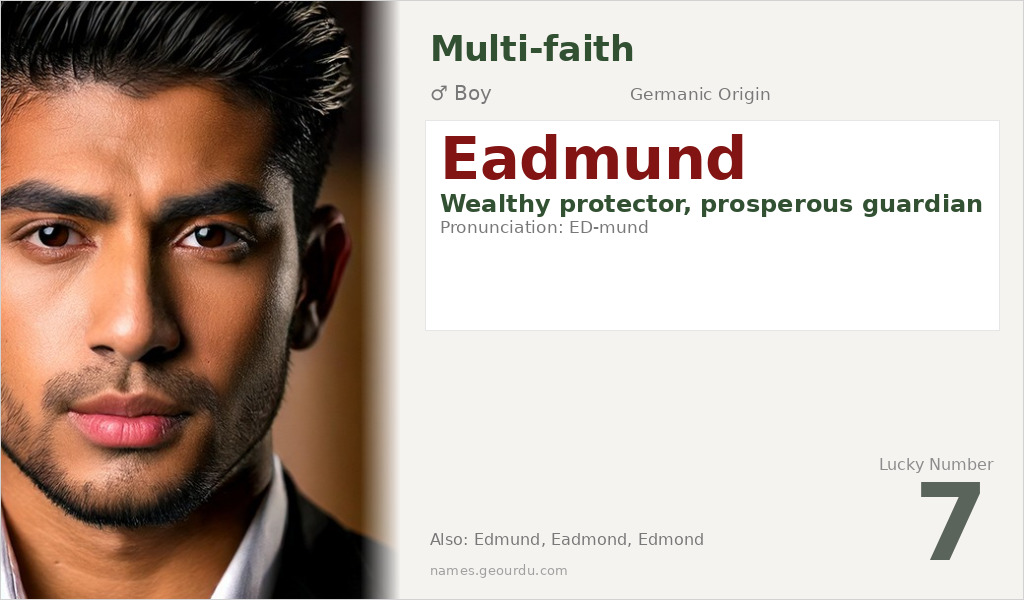
| 📛 Name | Eadmund |
| 💎 Meaning | Wealthy protector, prosperous guardian |
| 👤 Gender | Boy |
| 🕌 Religion | Multi-faith |
| 🌍 Origin | Germanic |
| 🗣 Pronunciation | ED-mund |
| ✍️ Urdu | ایڈمنڈ |
| ✍️ Arabic | إدموند |
| 🔢 Numerology | 7 |
| ✨ Spellings | Edmund, Eadmond, Edmond, Eadmundus |
Origin & Cultural Significance
Eadmund originates from the Germanic languages spoken by the Anglo-Saxon settlers of England between the 5th and 11th centuries. It was particularly prominent during the period of the Heptarchy (seven Anglo-Saxon kingdoms) and appears in historical records from the 9th century onward. The name gained significant cultural importance through Saint Edmund, King of East Anglia, who was martyred by Vikings in 869 and became one of England’s most important medieval saints. After the Norman Conquest in 1066, the name evolved into the Norman-French influenced ‘Edmund’ but retained its original meaning. While historically associated with Anglo-Saxon England, variations of the name exist in other Germanic languages, including German (Edmund) and Scandinavian languages.
Personality Traits
Those bearing the name Eadmund often embody characteristics suggested by its meaning: a combination of prosperity-mindedness and protective instincts. Historically, individuals with this name were frequently leaders, kings, and saints who balanced material responsibility with guardianship of their people. In modern contexts, the name suggests someone who values security, tradition, and practical care for others. The dual elements of wealth and protection create a personality profile of someone who is both resource-conscious and devoted to safeguarding what matters most.
Similar Names
If you like Eadmund, consider: Edmund, Edward, Edgar, Edwin, Eamon
Famous People Named Eadmund
- Saint Edmund the Martyr — King of East Anglia (841-869 AD), patron saint of England before Saint George
- Edmund Ironside — King of England in 1016, known for his resistance against Danish invasion
Frequently Asked Questions About Eadmund
What does Eadmund mean?
Eadmund means 'wealthy protector' or 'prosperous guardian,' derived from the Old English elements 'ead' (wealth, fortune) and 'mund' (protection, guardian).
Is Eadmund a boy or girl name?
Eadmund is exclusively a masculine name with historical usage only for males. The feminine equivalent would be Edmunda, though this is much rarer.
What is the origin of Eadmund?
Eadmund originates from Old English (Anglo-Saxon) and has Germanic roots. It was common in England before the Norman Conquest and is the original form of the modern name Edmund.





