Table of Contents
Edmond is a classic English name with deep historical roots and a powerful meaning that has endured for centuries. Derived from Old English elements meaning ‘wealth’ and ‘protection,’ this name carries connotations of prosperity and guardianship. From medieval kings to modern scientists, bearers of this name have left significant marks on history. Let’s explore the rich linguistic heritage and cultural journey of the name Edmond.
Meaning of Edmond
The name Edmond originates from the Old English name Eadmund, which combines two meaningful elements: ‘ēad’ meaning ‘wealth, fortune, or prosperity’ and ‘mund’ meaning ‘protection, guardian, or hand.’ This compound construction was common in Anglo-Saxon naming traditions, where names often conveyed desirable qualities or blessings. The ‘ēad’ element appears in many Old English names like Edward (wealthy guardian) and Edgar (wealthy spear). The ‘mund’ element similarly appears in names like Raymond (wise protection). This etymological structure reflects the values of early Germanic societies, where both material prosperity and physical protection were highly prized. The name has remained remarkably consistent in meaning throughout its evolution from Eadmund to Edmund to Edmond.
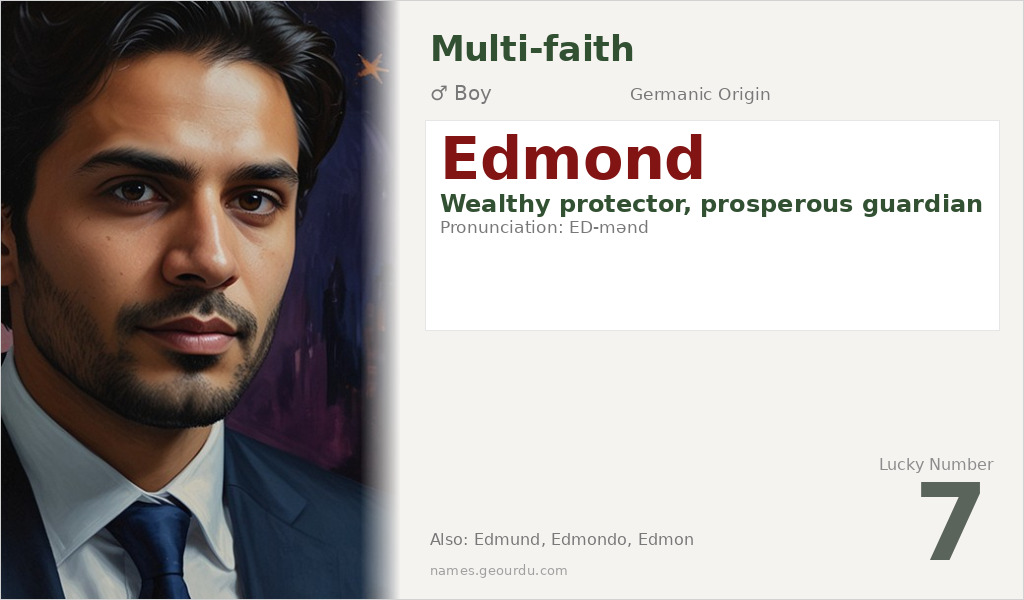
| 📛 Name | Edmond |
| 💎 Meaning | Wealthy protector, prosperous guardian |
| 👤 Gender | Boy |
| 🕌 Religion | Multi-faith |
| 🌍 Origin | Germanic |
| 🗣 Pronunciation | ED-mənd |
| ✍️ Urdu | ایڈمنڈ |
| ✍️ Arabic | إدموند |
| 🔢 Numerology | 7 |
| ✨ Spellings | Edmund, Edmondo, Edmon, Eadmund |
Origin & Cultural Significance
Edmond has its origins in pre-Norman Conquest England, specifically from the Anglo-Saxon name Eadmund. The name gained prominence through Saint Edmund the Martyr, the King of East Anglia who was killed by Vikings in 869 AD and later venerated as a saint. After the Norman Conquest, the name continued in use and evolved into its modern forms. While the name has Christian associations through Saint Edmund, it is not exclusively Christian and has been used across various cultural and religious contexts in English-speaking countries. The name spread throughout Europe in various forms, including Edmondo in Italian and Edmundo in Spanish and Portuguese, though the English Edmond remains closest to the original Old English pronunciation and spelling.
Personality Traits
Those named Edmond often exhibit characteristics aligned with their name’s meaning of ‘wealthy protector.’ They tend to be responsible individuals who naturally assume protective roles in their families and communities. Their connection to the ‘wealth’ element of their name often manifests as practical wisdom regarding resources and stability. Many Edmonds demonstrate a balanced combination of ambition for prosperity and commitment to safeguarding what matters most to them.
Similar Names
If you like Edmond, consider: Edward, Edgar, Edwin, Edison, Edric
Famous People Named Edmond
- Edmond Halley — English astronomer and mathematician who calculated the orbit of Halley's Comet
- Edmond Rostand — French poet and dramatist best known for Cyrano de Bergerac
Frequently Asked Questions About Edmond
What does Edmond mean?
Edmond means 'wealthy protector' or 'prosperous guardian.' It comes from the Old English elements 'ēad' (wealth, prosperity) and 'mund' (protection, guardian).
Is Edmond a boy or girl name?
Edmond is traditionally and almost exclusively a masculine name. While names can evolve, historical and contemporary usage strongly identifies Edmond as a boy's name.
What is the origin of Edmond?
Edmond originates from Old English (Germanic language family), specifically from the name Eadmund used in Anglo-Saxon England before the Norman Conquest. It gained popularity through Saint Edmund the Martyr in the 9th century.