Table of Contents
Emil is a classic boy’s name with deep historical roots stretching back to ancient Rome. Carrying meanings of ‘industrious’ and ‘striving,’ this name has traveled across continents and cultures while maintaining its core essence. From European nobility to modern global usage, Emil represents diligence and ambition in many societies.
Meaning of Emil
The name Emil derives from the Latin family name Aemilius, which itself comes from the Latin word ‘aemulus’ meaning ‘rival’ or ‘one who strives to equal or excel.’ This root conveys competitive spirit and ambition. Through Gothic influence, the name incorporated the meaning ‘work’ or ‘industrious’ from the Germanic element ‘amal.’ Over centuries, Emil evolved through various European languages including German, Scandinavian, and Slavic tongues, consistently maintaining connotations of diligence, effort, and purposeful striving. The name’s etymological journey reflects its enduring association with productivity and achievement.
| 📛 Name | Emil |
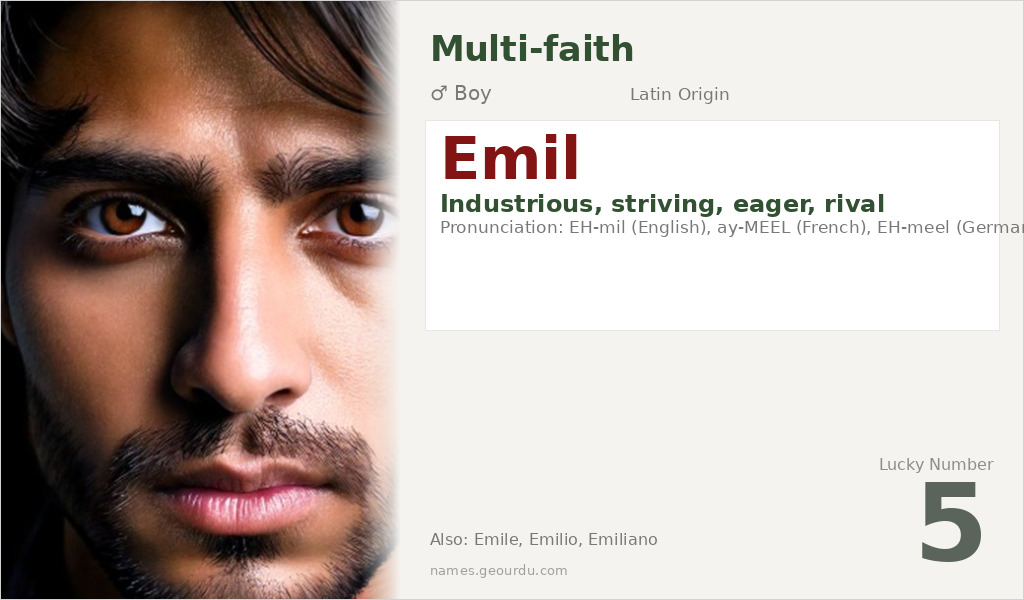
| 💎 Meaning | Industrious, striving, eager, rival |
| 👤 Gender | Boy |
| 🕌 Religion | Multi-faith |
| 🌍 Origin | Latin |
| 🗣 Pronunciation | EH-mil (English), ay-MEEL (French), EH-meel (German) |
| ✍️ Urdu | ایمل |
| ✍️ Arabic | إميل |
| 🔢 Numerology | 5 |
| ✨ Spellings | Emile, Emilio, Emiliano, Emilian, Emilij |
Origin & Cultural Significance
Emil originated as a Roman family name (Aemilius) in ancient Latin culture, with notable historical figures including Marcus Aemilius Lepidus, a member of the Second Triumvirate. The name spread throughout Europe during the Roman Empire and was later reinforced through Gothic and Germanic influences. It became particularly popular in German-speaking countries, Scandinavia, and Slavic nations during the 19th century. While primarily associated with European Christian cultures historically, Emil has been adopted globally across various religious communities in modern times, including by some Hindu families, though this represents contemporary cross-cultural adoption rather than historical Hindu origin.
Personality Traits
Those named Emil are often characterized by their strong work ethic and competitive nature. They typically approach life with determination and focus, valuing achievement and excellence in their endeavors. Their industrious disposition makes them reliable partners and dedicated professionals who pursue their goals with consistent effort. While competitive, they often channel this energy into self-improvement rather than confrontation with others.
Similar Names
If you like Emil, consider: Emilio, Emiliano, Amelia, Emily, Emmanuel
Famous People Named Emil
- Emil Zátopek — Czech long-distance runner, Olympic gold medalist
- Emil Nolde — German-Danish painter and printmaker
Frequently Asked Questions About Emil
What does Emil mean?
Emil means 'industrious,' 'striving,' or 'rival.' It originates from the Latin word 'aemulus' (rival) and the Germanic element 'amal' (work).
Is Emil a boy or girl name?
Emil is traditionally and predominantly a boy's name across European cultures where it originated, though feminine forms like Emilia and Emily exist.
What is the origin of Emil?
Emil has Latin origins from the Roman family name Aemilius, with subsequent Germanic influences. It is fundamentally European rather than South Asian or Hindu in origin.