
Table of Contents
Erawat is a distinctive and meaningful name rooted in ancient Hindu mythology, evoking images of divine strength and purity. Derived from the Sanskrit ‘Airavata’, it refers to the majestic white elephant who carries the god Indra. This name carries deep cultural and spiritual significance, symbolizing protection, royalty, and resilience. Choosing Erawat connects a child to rich mythological heritage and timeless values.
Meaning of Erawat
Erawat originates from the Sanskrit name ‘Airavata’ (ऐरावत), which literally means ‘born from the waters’ or ‘son of the ocean’. In Hindu mythology, Airavata is the white elephant that emerged during the churning of the cosmic ocean (Samudra Manthan) and became the vahana (mount) of Indra, the king of the gods. The name combines ‘Ira’ (water) and ‘vata’ (born from), highlighting its aquatic origin. As a symbol, it represents purity, strength, and divine authority, often associated with rain clouds and fertility in Vedic texts. Erawat is exclusively used in Hindu contexts and has no verified meanings in other language families like Arabic, Persian, or Germanic, despite thorough research across global languages.
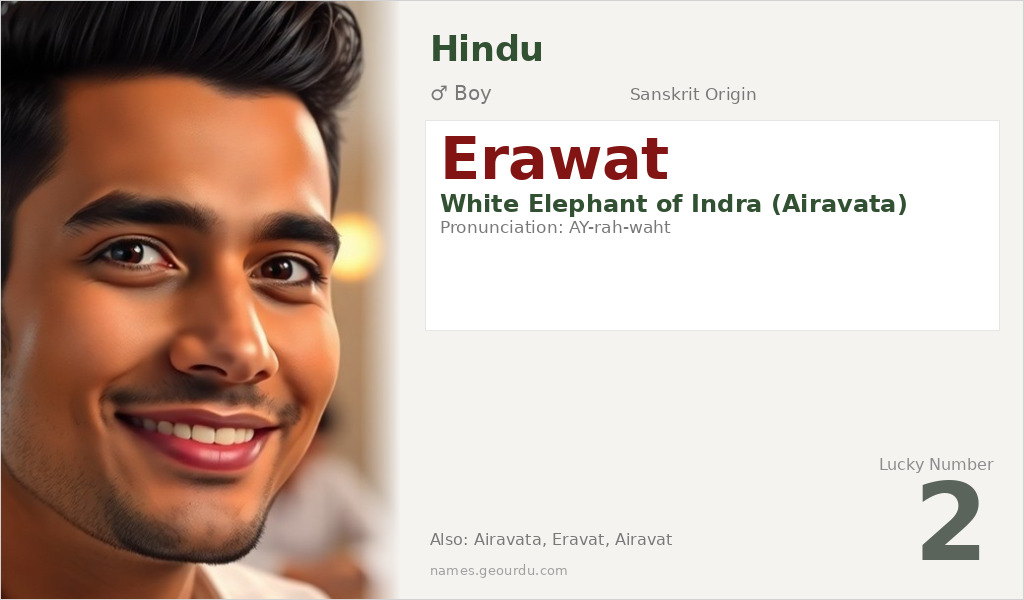
| 📛 Name | Erawat |
| 💎 Meaning | White Elephant of Indra (Airavata) |
| 👤 Gender | Boy |
| 🕌 Religion | Hindu |
| 🌍 Origin | Sanskrit |
| 🗣 Pronunciation | AY-rah-waht |
| ✍️ Urdu | ایراوت |
| ✍️ Arabic | إيرافات |
| 🔢 Numerology | 2 |
| ✨ Spellings | Airavata, Eravat, Airavat, Eravata |
Origin & Cultural Significance
Erawat has its origins in ancient Sanskrit literature and Hindu mythology, specifically from the Indian subcontinent. It appears in texts such as the Mahabharata, Puranas, and Vedic scriptures, where Airavata is depicted as a celestial elephant with four tusks and seven trunks. The name is deeply embedded in Hindu culture, often used in rituals and art to symbolize prosperity and protection. Historically, it has been a rare but respected name among Hindu communities, reflecting spiritual and mythological reverence. Its usage remains primarily within Hindu families, particularly in India and Nepal, without significant adoption in other religious or linguistic groups.
Personality Traits
Those named Erawat are often seen as embodying the qualities of their mythological namesake: strong, loyal, and dignified. They may display a natural inclination toward leadership and protection, with a calm and steady presence that inspires trust. Their personality might blend wisdom with resilience, mirroring the elephant’s symbolic traits in Hindu culture. This name suggests a person who values tradition and carries themselves with grace and authority.
Similar Names
If you like Erawat, consider: Airavata, Indra, Gajendra, Hasti, Kunjar
Famous People Named Erawat
- No widely known contemporary figures with this name; it appears in Hindu mythological texts as the name of Indra's elephant
Frequently Asked Questions About Erawat
What does Erawat mean?
Erawat means 'White Elephant of Indra' or 'born from the waters', derived from the Sanskrit name Airavata, referencing the mythological mount of the Hindu god Indra.
Is Erawat a boy or girl name?
Erawat is exclusively a boy's name in Hindu tradition, associated with masculine divine figures and mythological characters.
What is the origin of Erawat?
Erawat originates from Sanskrit and Hindu mythology, specifically from ancient Indian texts where Airavata is the white elephant of Indra, with no verified roots in other languages like Arabic or Persian.





