
Table of Contents
Filip is a timeless masculine name with ancient Greek roots that has traveled across continents and centuries. Meaning ‘lover of horses’ or ‘friend of horses,’ this name carries historical weight from Macedonian kings to Christian apostles. Today, it remains popular in many European countries and beyond, offering a classic yet distinctive choice for parents. Its rich etymology and cultural heritage make Filip a name with both strength and tradition.
Meaning of Filip
The name Filip originates from the Greek Φίλιππος (Philippos), which combines two elements: φίλος (philos) meaning ‘friend’ or ‘lover’ and ἵππος (hippos) meaning ‘horse.’ This creates the literal meaning ‘lover of horses’ or ‘friend of horses.’ In ancient Greece, horses were symbols of wealth, status, and military power, making this name particularly significant among nobility. The name was notably borne by Philip II of Macedon, who revolutionized cavalry warfare. Through Latin as Philippus, it entered Christian tradition via Saint Philip the Apostle. The name’s meaning reflects both affection and strength, combining personal loyalty with the noble qualities associated with horses.
| 📛 Name | Filip |
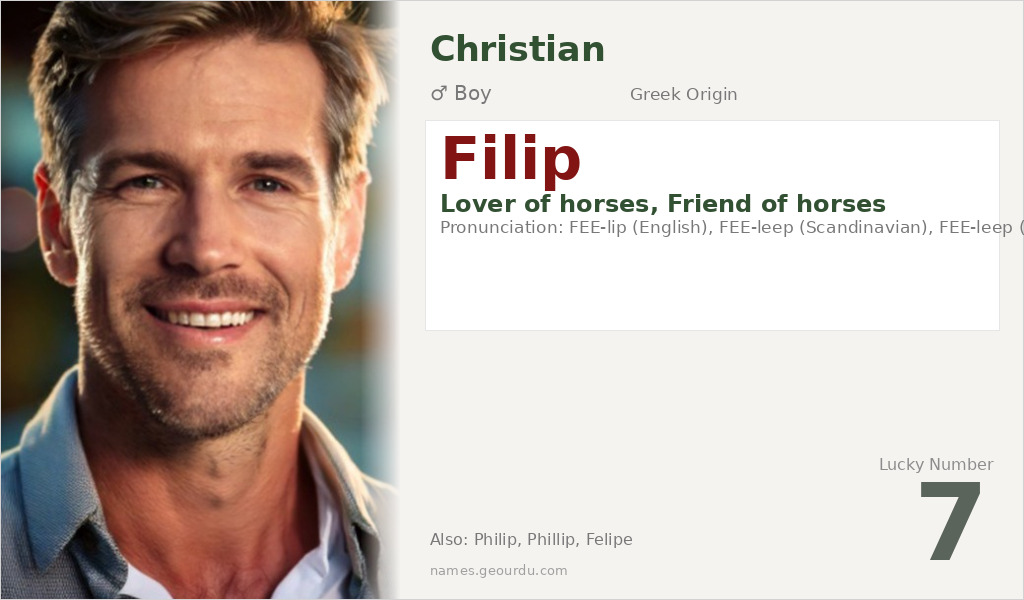
| 💎 Meaning | Lover of horses, Friend of horses |
| 👤 Gender | Boy |
| 🕌 Religion | Christian |
| 🌍 Origin | Greek |
| 🗣 Pronunciation | FEE-lip (English), FEE-leep (Scandinavian), FEE-leep (Polish/Czech) |
| ✍️ Urdu | فلپ |
| ✍️ Arabic | فيليب |
| 🔢 Numerology | 7 |
| ✨ Spellings | Philip, Phillip, Felipe, Filippo, Philipp, Filipos |
Origin & Cultural Significance
Filip has its origins in ancient Greece, where it was used among Macedonian royalty before spreading throughout the Hellenistic world. The name gained Christian significance through Saint Philip, one of Jesus’s twelve apostles who is mentioned in the New Testament. During the Middle Ages, the name spread across Europe in various forms, becoming particularly popular among royalty and nobility in countries like France, Spain, and England. Today, Filip is the standard form in many Slavic languages (Polish, Czech, Slovak, Croatian, Serbian) and Scandinavian languages, while Philip is more common in English-speaking countries. The name’s journey from ancient Greece to global usage demonstrates its enduring appeal across different cultures and historical periods.
Personality Traits
People named Filip are often associated with intelligence, curiosity, and analytical thinking. The name’s Greek roots suggest qualities of friendship, loyalty, and philosophical depth. Historically, bearers of this name have been leaders, thinkers, and explorers, from ancient kings to modern innovators. While personality traits vary by individual, the name’s etymology and historical associations point toward someone who values knowledge, relationships, and noble pursuits.
Similar Names
If you like Filip, consider: Philip, Phillip, Felipe, Filippo, Philipp, Philemon, Hippolytus, Xanthippe, Phillipa, Pippin
Famous People Named Filip
- Philip II of Macedon — King of Macedon and father of Alexander the Great
- Saint Philip the Apostle — One of the twelve apostles of Jesus Christ
- Prince Philip, Duke of Edinburgh — Husband of Queen Elizabeth II of the United Kingdom
- Filip Mișea — Romanian footballer
- Filip Hrgović — Croatian professional boxer
Frequently Asked Questions About Filip
What does Filip mean?
Filip means 'lover of horses' or 'friend of horses,' derived from the Greek words philos (friend/lover) and hippos (horse).
Is Filip a boy or girl name?
Filip is exclusively a masculine name across all cultures where it's used, with feminine forms like Philippa or Filipa existing separately.
What is the origin of Filip?
Filip originates from ancient Greek (Φίλιππος) and entered Christian tradition through Saint Philip the Apostle, spreading throughout Europe in various forms.





