Table of Contents
Gajamukha is a profound Sanskrit name with deep roots in Hindu tradition and mythology. Meaning ‘elephant-faced,’ this name is most famously associated with Lord Ganesha, the beloved deity who removes obstacles and brings wisdom. While uncommon as a personal name today, it carries significant religious and cultural weight in Hindu communities. Understanding Gajamukha offers insight into the rich symbolic language of Hindu nomenclature.
Meaning of Gajamukha
Gajamukha is a compound Sanskrit name formed from two distinct elements: ‘gaja’ (गज), which means ‘elephant,’ and ‘mukha’ (मुख), meaning ‘face, mouth, or countenance.’ Together, they create the literal translation ‘elephant-faced.’ In Hindu religious context, this is not merely descriptive but carries theological significance as one of the many names and attributes of Lord Ganesha. The elephant symbolizes wisdom, memory, strength, and royal authority in Indian tradition, making this name particularly auspicious. Linguistically, it follows classical Sanskrit compounding rules (samāsa) and appears in texts like the Ganesha Purana and various stotras (hymns) dedicated to Ganesha.
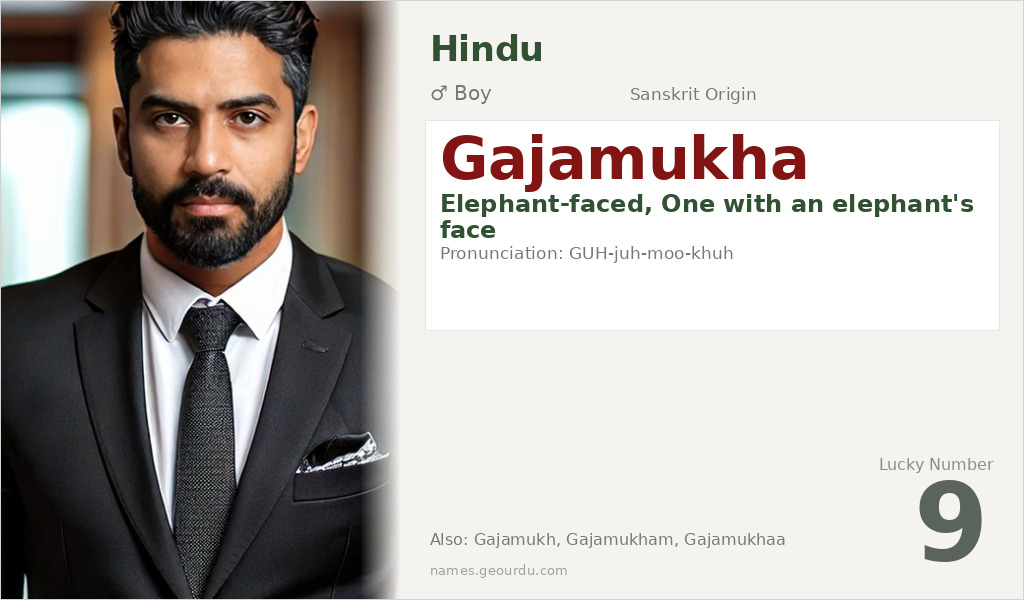
| 📛 Name | Gajamukha |
| 💎 Meaning | Elephant-faced, One with an elephant's face |
| 👤 Gender | Boy |
| 🕌 Religion | Hindu |
| 🌍 Origin | Sanskrit |
| 🗣 Pronunciation | GUH-juh-moo-khuh |
| ✍️ Urdu | گج مکھ |
| ✍️ Arabic | غاجاموخا |
| 🔢 Numerology | 9 |
| ✨ Spellings | Gajamukh, Gajamukham, Gajamukhaa |
Origin & Cultural Significance
Gajamukha originates from classical Sanskrit, the ancient liturgical language of Hinduism. Its usage is primarily theological and mythological rather than as a common personal name. The name appears in Hindu scriptures as an epithet for Ganesha, emphasizing his distinctive elephant-headed form. In Hindu tradition, Ganesha’s elephant head represents wisdom, understanding, and a discriminating intellect that can distinguish between truth and illusion. While the name is authentically Hindu in origin and usage, it’s important to note that it’s rarely given as a personal name in contemporary times, functioning more as a descriptive title within religious contexts.
Personality Traits
The symbolic associations of Gajamukha suggest personality traits aligned with elephant symbolism in Hindu culture. Those connected to this name might exhibit great memory, patience, and steady determination. Like Ganesha, they could be perceived as wise problem-solvers who approach challenges with calm intelligence. The name carries connotations of protection, auspicious beginnings, and the ability to overcome obstacles through thoughtful consideration rather than brute force.
Similar Names
If you like Gajamukha, consider: Gajanana, Gajavadana, Gajakarna, Gajendra, Mukesh
Famous People Named Gajamukha
- No widely known contemporary figures with this name — it is primarily used as a religious/theological name in Hindu contexts
- In Hindu mythology: Gajamukha is an epithet of Lord Ganesha, appearing in various scriptures and texts
Frequently Asked Questions About Gajamukha
What does Gajamukha mean?
Gajamukha means 'elephant-faced' in Sanskrit. It is a compound name from 'gaja' (elephant) and 'mukha' (face), and is primarily known as an epithet of Lord Ganesha in Hinduism.
Is Gajamukha a boy or girl name?
Gajamukha is exclusively a boy name in Hindu tradition, as it refers to Lord Ganesha, who is male. There is no feminine usage of this name in any cultural context.
What is the origin of Gajamukha?
Gajamukha originates from Sanskrit, the classical language of Hinduism. It is a religious/theological name rather than a common personal name, used as one of the many descriptive names for Lord Ganesha in Hindu scriptures.