Table of Contents
Hajveri is a name steeped in spiritual heritage and regional history, primarily known as an honorific title rather than a common given name. It carries the legacy of one of South Asia’s most revered Sufi saints, Hazrat Ali Hajveri, making it a choice rich in cultural and religious significance. While uncommon as a first name, it is cherished in Muslim communities for its connection to piety and wisdom. This guide explores the true meaning, origin, and cultural context of Hajveri beyond common misconceptions.
Meaning of Hajveri
Hajveri derives from the Persian language, where it functions as a demonym or nisba, meaning ‘from Hajver’ or ‘of Hajver.’ Hajver (also spelled Hajwer or Hajwar) is a town in the Punjab region, now part of Pakistan. The name is most famously associated with Hazrat Ali Hajveri, an 11th-century Persian Sufi saint and scholar who authored ‘Kashf al-Mahjub,’ a foundational text in Islamic mysticism. The suffix ‘-i’ is a common Persian grammatical element indicating origin or belonging, similar to English ‘-ian’ or ‘-ite.’ Thus, Hajveri literally translates to ‘one from Hajver,’ but its cultural weight comes from its link to the saint, often symbolizing spirituality and learning.
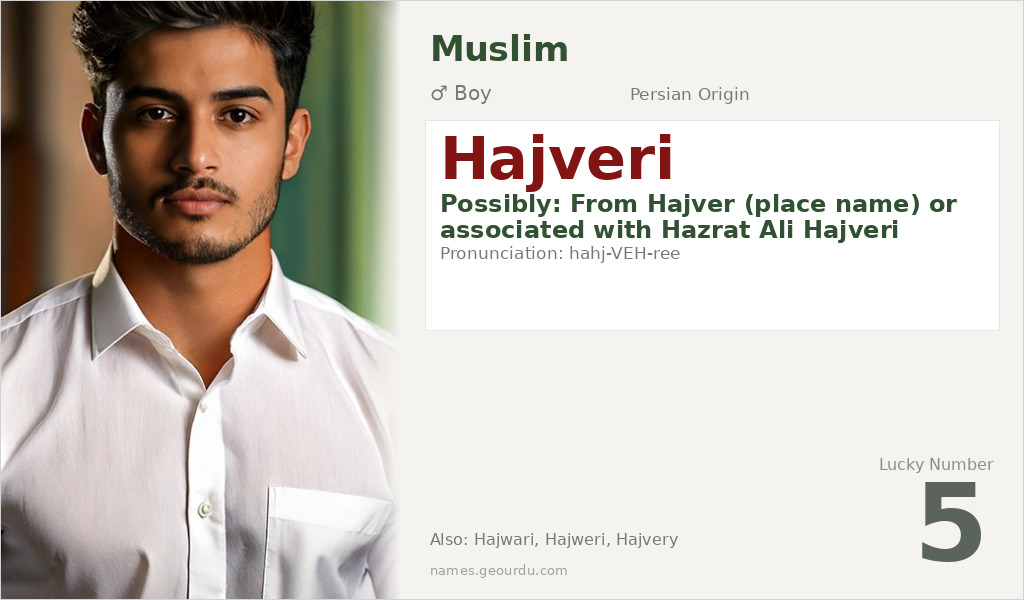
| 📛 Name | Hajveri |
| 💎 Meaning | Possibly: From Hajver (place name) or associated with Hazrat Ali Hajveri (saint) |
| 👤 Gender | Boy |
| 🕌 Religion | Muslim |
| 🌍 Origin | Persian |
| 🗣 Pronunciation | hahj-VEH-ree |
| ✍️ Urdu | حاجوری |
| ✍️ Arabic | الحاجوري |
| 🔢 Numerology | 5 |
| ✨ Spellings | Hajwari, Hajweri, Hajvery, Hajvari |
Origin & Cultural Significance
The origin of Hajveri traces back to Persian and South Asian Islamic traditions, specifically the medieval period when Sufi saints traveled and settled across the region. Hazrat Ali Hajveri, born in Ghazni (modern-day Afghanistan), later moved to Lahore (in present-day Pakistan), where he became known as Data Ganj Bakhsh (‘bestower of treasures’). His tomb in Lahore is a major pilgrimage site. Over centuries, ‘Hajveri’ evolved from a geographic identifier to an honorific surname for his descendants and followers, and occasionally as a given name in his memory. It is primarily used in Muslim communities in Pakistan, India, and the diaspora, reflecting Persian linguistic influence on South Asian culture.
Personality Traits
Those named Hajveri are often perceived as embodying the virtues of the saint they are named after—spiritual depth, wisdom, and a compassionate nature. They may be seen as natural mentors or guides, with a calm and reflective demeanor. In cultural contexts, the name suggests a person who values tradition, knowledge, and community service, drawing inspiration from Hazrat Ali Hajveri’s legacy of mystical teaching and humanitarianism.
Similar Names
If you like Hajveri, consider: Hajver, Hajwar, Ganj Bakhsh, Data, Ali
Famous People Named Hajveri
- Hazrat Ali Hajveri (Data Ganj Bakhsh) — 11th-century Persian Sufi saint, author of 'Kashf al-Mahjub,' buried in Lahore, Pakistan
- Hajveri family — descendants or followers of Hazrat Ali Hajveri in South Asia
Frequently Asked Questions About Hajveri
What does Hajveri mean?
Hajveri means 'from Hajver' in Persian, referring to the town of Hajver in Punjab. It is most famously associated with the 11th-century Sufi saint Hazrat Ali Hajveri (Data Ganj Bakhsh).
Is Hajveri a boy or girl name?
Hajveri is traditionally a boy's name, used in Muslim cultures, particularly in South Asia. It is derived from a male saint's title and is rarely, if ever, used for girls.
What is the origin of Hajveri?
Hajveri originates from Persian, specifically as a demonym from the town Hajver in Punjab. It gained prominence through Hazrat Ali Hajveri, a Persian Sufi saint who settled in Lahore, Pakistan, in the 11th century.