Table of Contents
Ishtarth is a powerful and ancient name with deep mythological roots that span civilizations. Derived from the Akkadian goddess Ishtar, this name carries associations with love, fertility, beauty, and warfare. While not commonly used as a personal name today, it represents one of the most significant deities of the ancient world. Understanding its origins reveals a rich cultural heritage that influenced numerous Mediterranean and Near Eastern traditions.
Meaning of Ishtarth
The name Ishtarth originates from the Akkadian ‘Ištar’, the goddess of love, fertility, sexuality, beauty, justice, political power, and war in ancient Mesopotamian religion. This name evolved from earlier Sumerian Inanna and spread through Semitic languages, appearing as Ashtart in Phoenician, Ashtoreth in Hebrew, and Astarte in Greek. The etymology connects to the Semitic root ‘ṯtr’ or ‘ʿṯtr’, associated with the morning star (Venus), which was sacred to the goddess. As a divine name, Ishtarth represents the complex duality of feminine power—both creative and destructive—that was central to ancient Near Eastern cosmology.
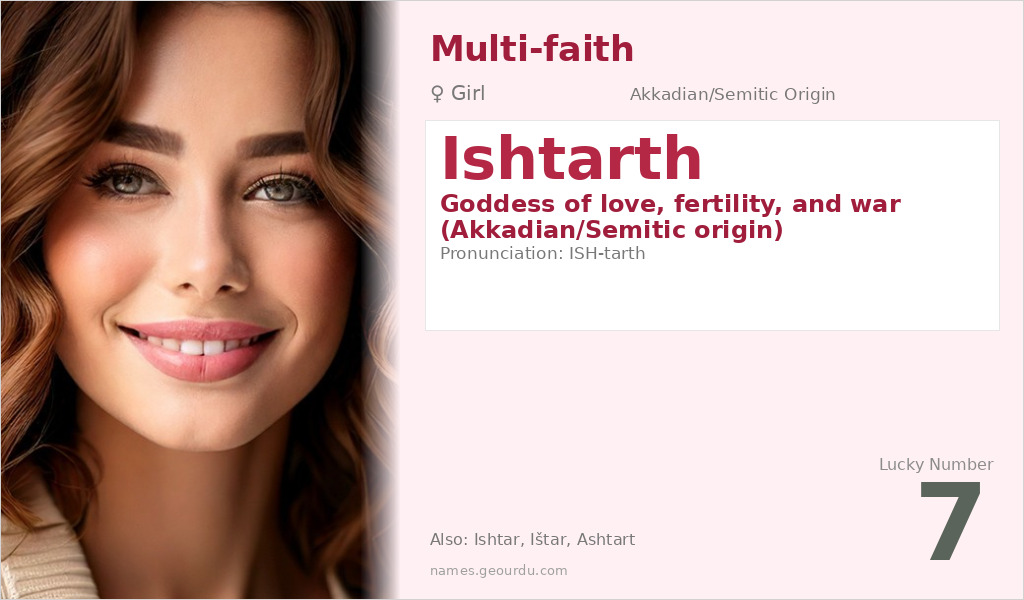
| 📛 Name | Ishtarth |
| 💎 Meaning | Goddess of love, fertility, and war (Akkadian/Semitic origin) |
| 👤 Gender | Girl |
| 🕌 Religion | Multi-faith |
| 🌍 Origin | Akkadian/Semitic |
| 🗣 Pronunciation | ISH-tarth |
| ✍️ Urdu | اشتارت |
| ✍️ Arabic | عشتار |
| 🔢 Numerology | 7 |
| ✨ Spellings | Ishtar, Ištar, Ashtart, Ashtoreth, Astarte |
Origin & Cultural Significance
Ishtarth has its origins in ancient Mesopotamia, specifically in Akkadian and broader Semitic religious traditions. The worship of Ishtar/Ishtarth spread from Mesopotamia to Syria, Phoenicia, and Canaan, where she was known as Ashtart or Ashtoreth. This goddess was incorporated into various cultural pantheons, influencing later deities like Aphrodite in Greek mythology and Venus in Roman tradition. The name appears in numerous ancient texts, including the Epic of Gilgamesh, where Ishtar plays a crucial role. While the name is historically significant, it is not traditionally used in Hindu naming practices and has no authentic connection to the lucky attributes mentioned in the original article.
Personality Traits
Those named after Ishtarth might be perceived as possessing the goddess’s legendary attributes: passionate, determined, and multifaceted. They could demonstrate both nurturing qualities and strong leadership abilities, balancing creativity with strategic thinking. The name suggests someone who embraces life fully, with intensity in relationships and pursuits, much like the deity who governed both love and warfare in ancient mythology.
Similar Names
If you like Ishtarth, consider: Inanna, Aphrodite, Venus, Freya, Lakshmi
Famous People Named Ishtarth
- Ishtar (goddess) — Ancient Mesopotamian goddess of love, fertility, and war, worshipped across the Near East for millennia
- Ishtar (singer) — Israeli-born French singer known for the 1988 hit 'The Riddle'
Frequently Asked Questions About Ishtarth
What does Ishtarth mean?
Ishtarth means 'goddess of love, fertility, and war' and is the Akkadian/Semitic form of the ancient Mesopotamian deity Ishtar.
Is Ishtarth a boy or girl name?
Ishtarth is a feminine name, as it refers to the goddess Ishtar, a female deity in ancient Mesopotamian religion.
What is the origin of Ishtarth?
Ishtarth originates from Akkadian/Semitic languages and ancient Mesopotamian mythology, specifically as the name of the goddess Ishtar worshipped across the Near East.