
Table of Contents
Issabela is an elegant and timeless name variant that carries centuries of history and spiritual significance. As a form of the classic name Isabella, it connects modern bearers to ancient Hebrew roots while maintaining contemporary appeal. This name has graced queens, saints, and artists throughout history, making it a choice rich with cultural heritage. Whether spelled Issabela, Isabella, or Isabela, this name continues to captivate parents seeking a name with depth and beauty.
Meaning of Issabela
The name Issabela derives from the Hebrew name Elisheva (אֱלִישֶׁבַע), composed of two elements: ‘El’ meaning ‘God’ and ‘sheva’ meaning ‘oath’ or ‘seven’. This gives the core meaning ‘God is my oath’ or ‘Devoted to God’. Through linguistic evolution, the name traveled from Hebrew to Greek as Elisabet, to Latin as Elisabeth, and eventually to Romance languages where Isabella emerged as a medieval variant. The ‘bella’ element in Isabella/Issabela comes from Latin ‘bella’ meaning ‘beautiful’, though this is a later folk etymology addition. The name’s profound religious meaning has made it enduringly popular across Christian, Jewish, and secular contexts for centuries.
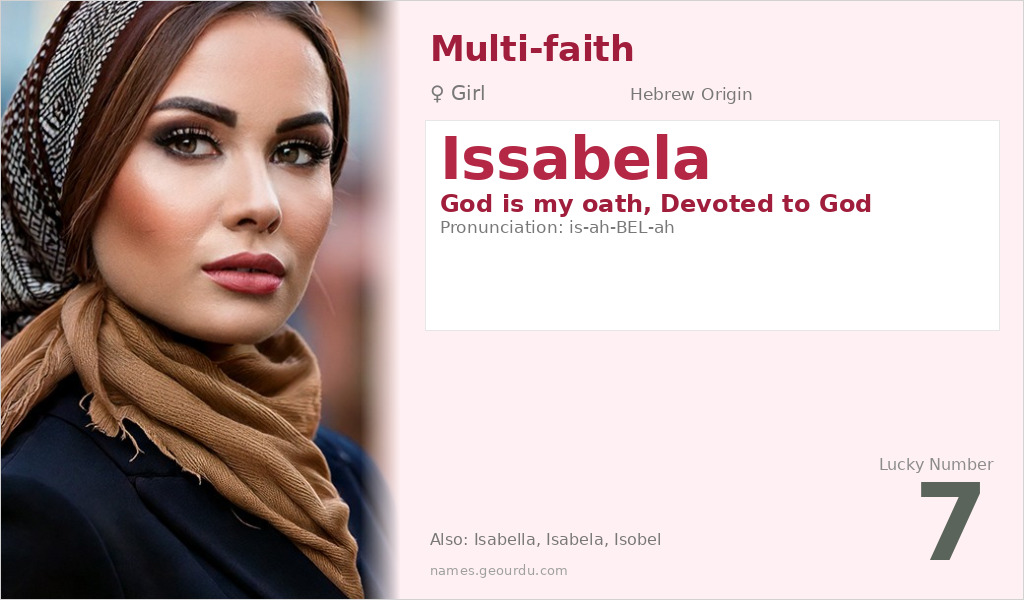
| 📛 Name | Issabela |
| 💎 Meaning | God is my oath, Devoted to God |
| 👤 Gender | Girl |
| 🕌 Religion | Multi-faith |
| 🌍 Origin | Hebrew |
| 🗣 Pronunciation | is-ah-BEL-ah |
| ✍️ Urdu | ایزابیلا |
| ✍️ Arabic | إيزابيلا |
| 🔢 Numerology | 7 |
| ✨ Spellings | Isabella, Isabela, Isobel, Ysabel, Izabella |
Origin & Cultural Significance
Issabela originates from the Hebrew name Elisheva, which appears in the Torah as the name of Aaron’s wife. The name gained prominence in Christianity through Elizabeth, mother of John the Baptist in the New Testament. During the Middle Ages, the Provençal form ‘Isabeau’ evolved into Isabella in Spanish and Italian courts. Royal bearers like Isabella I of Castile (1451-1504) cemented its popularity across Europe. Today, Issabela represents a spelling variation that maintains the name’s historical roots while offering a distinctive form. The name has transcended its original religious context to become a multicultural choice appreciated for its melodic sound and meaningful heritage.
Personality Traits
Those named Issabela often embody qualities of devotion, integrity, and spiritual depth suggested by their name’s meaning. They tend to be thoughtful individuals who value promises and commitments, reflecting the ‘oath’ element in their name’s etymology. Many Issabelas display a natural elegance and strength, perhaps influenced by the name’s royal associations throughout history. Their analytical nature and intuitive understanding often make them excellent problem-solvers and trusted confidants.
Similar Names
If you like Issabela, consider: Elizabeth, Isabelle, Elisabeth, Eliza, Isabel
Famous People Named Issabela
- Isabella I of Castile — Queen of Castile and León who sponsored Christopher Columbus' voyages
- Isabella Rossellini — Italian actress and model, daughter of Ingrid Bergman
Frequently Asked Questions About Issabela
What does Issabela mean?
Issabela means 'God is my oath' or 'Devoted to God'. It originates from the Hebrew name Elisheva, combining 'El' (God) and 'sheva' (oath).
Is Issabela a boy or girl name?
Issabela is exclusively a girl's name. It is a feminine variant of the name Elizabeth/Isabella used across multiple cultures for girls only.
What is the origin of Issabela?
Issabela has Hebrew origins, deriving from Elisheva. It evolved through Greek, Latin, and Romance languages, with Isabella becoming popular in medieval Spanish and Italian courts before the Issabela spelling variation emerged.





