
Table of Contents
Jacobina is an elegant feminine name with deep biblical roots, serving as the female counterpart to the classic name Jacob. With origins tracing back to ancient Hebrew, this name carries centuries of history while maintaining contemporary appeal. Whether you’re drawn to its strong meaning or its melodic sound, Jacobina offers a distinctive choice with international recognition. Discover the rich heritage and modern relevance of this timeless name.
Meaning of Jacobina
Jacobina derives from the Hebrew name Jacob (Ya’aqov), which comes from the root word עקב (‘aqab’) meaning ‘to supplant’ or ‘to take by the heel.’ This references the biblical story where Jacob was born grasping his twin brother Esau’s heel and later supplanted him by obtaining his birthright. The feminine suffix ‘-ina’ was added in various European languages to create the female form. Through Latin (Jacobus) and Greek (Iakobos) adaptations, the name spread across Europe, with Jacobina emerging particularly in Dutch, German, and Scandinavian naming traditions. The core meaning remains consistent across cultures: one who follows closely or supplants another.
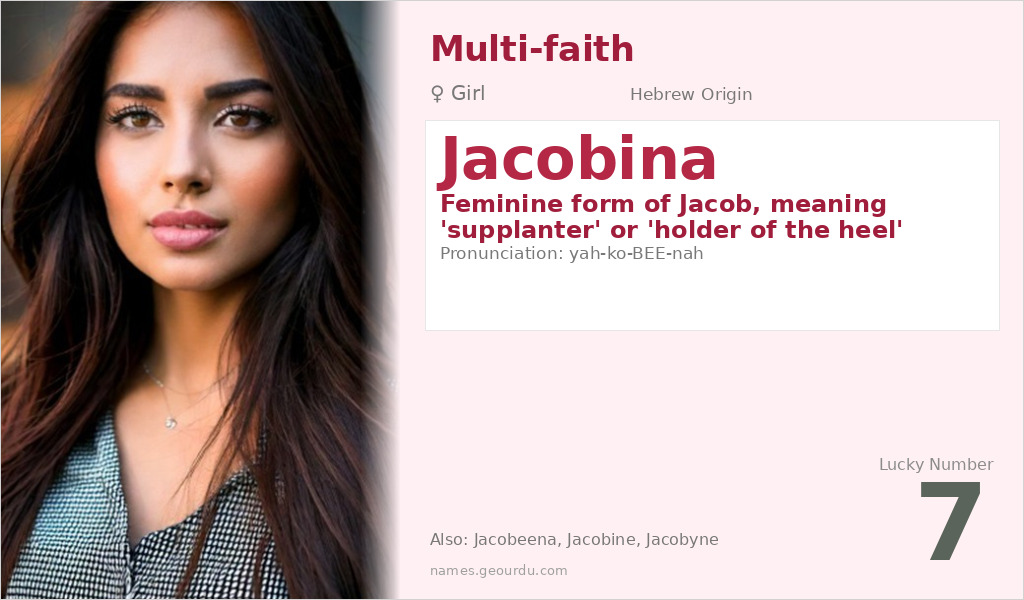
| 📛 Name | Jacobina |
| 💎 Meaning | Feminine form of Jacob, meaning 'supplanter' or 'holder of the heel' |
| 👤 Gender | Girl |
| 🕌 Religion | Multi-faith |
| 🌍 Origin | Hebrew |
| 🗣 Pronunciation | yah-ko-BEE-nah |
| ✍️ Urdu | جیکوبینا |
| ✍️ Arabic | جاكوبينا |
| 🔢 Numerology | 7 |
| ✨ Spellings | Jacobeena, Jacobine, Jacobyne, Jakobina |
Origin & Cultural Significance
Jacobina originated as a feminine form of the Hebrew name Jacob, which entered European languages through biblical translations and Christian tradition. While the masculine Jacob has been used across Jewish, Christian, and Muslim communities for millennia, feminine forms like Jacobina developed primarily in Western Europe from the Middle Ages onward. The name gained particular popularity in the Netherlands and Germany, where feminine ‘-ina’ endings are common. Unlike many names that evolved independently in different regions, Jacobina maintains a clear linguistic lineage from its Hebrew source through Latin and Greek intermediaries to modern European vernaculars.
Personality Traits
Those named Jacobina often inherit qualities associated with their name’s meaning—determination, strategic thinking, and the ability to navigate challenges with grace. The ‘supplanter’ aspect suggests someone who achieves goals through persistence rather than force, while the feminine form adds qualities of intuition and emotional intelligence. Many Jacobinas are described as thoughtful observers who carefully consider situations before acting, reflecting the name’s biblical origins of careful planning and foresight.
Similar Names
If you like Jacobina, consider: Jacoba, Jacinda, Jacqueline, Jacobine, Jacoba
Famous People Named Jacobina
- Jacobina van der Gucht — 18th-century Dutch actress and singer
- Jacobina Campbell — New Zealand actress known for 'The Lord of the Rings: The Rings of Power'
Frequently Asked Questions About Jacobina
What does Jacobina mean?
Jacobina means 'supplanter' or 'holder of the heel'—it's the feminine form of the Hebrew name Jacob, derived from the root meaning to follow closely or replace.
Is Jacobina a boy or girl name?
Jacobina is exclusively a feminine name, created as the female counterpart to the masculine name Jacob in various European languages.
What is the origin of Jacobina?
Jacobina originates from Hebrew through the name Jacob, with the feminine '-ina' suffix added in European languages like Dutch, German, and Scandinavian tongues.





