Table of Contents
Jehoiachin is a name steeped in Biblical history and Hebrew etymology, carrying profound religious significance across multiple faith traditions. As the name of a Judahite king mentioned in both the Hebrew Bible and Christian Old Testament, it represents a tangible link to ancient Near Eastern history. This name’s meaning—’Yahweh Establishes’—speaks to divine faithfulness and sovereignty. While relatively uncommon today, it remains an important historical and religious name with rich linguistic roots.
Meaning of Jehoiachin
Jehoiachin derives from the Hebrew name יְהוֹיָכִין (Yehoyakhin), which combines two elements: ‘Yeho’ (יהו), a contraction of Yahweh (the personal name of God in the Hebrew Bible), and ‘yakin’ (יכין), meaning ‘he establishes’ or ‘he will establish’. Thus, the complete meaning is ‘Yahweh Establishes’ or ‘Yahweh Will Establish’. This follows a common pattern in Hebrew theophoric names where divine names are combined with verbs describing God’s actions. The name appears in the Books of Kings, Chronicles, and Jeremiah, referring to the penultimate king of Judah before the Babylonian exile. In the Masoretic Text, the name is vocalized as Yehoyakhin, while in the Septuagint it appears as Ιεχονιας (Iechonias), from which the English variant ‘Jeconiah’ derives.
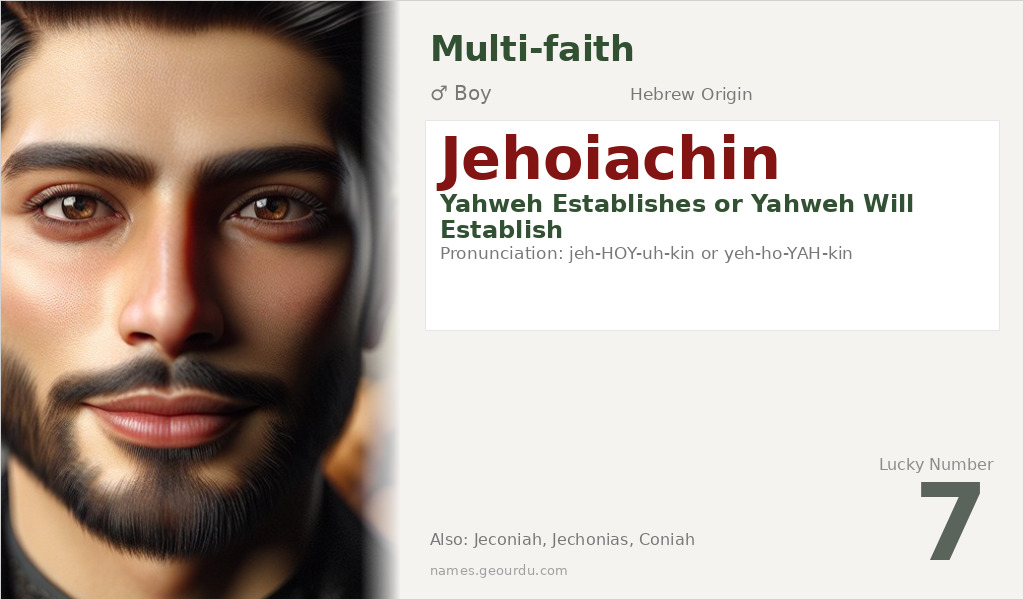
| 📛 Name | Jehoiachin |
| 💎 Meaning | Yahweh Establishes or Yahweh Will Establish |
| 👤 Gender | Boy |
| 🕌 Religion | Multi-faith |
| 🌍 Origin | Hebrew |
| 🗣 Pronunciation | jeh-HOY-uh-kin or yeh-ho-YAH-kin |
| ✍️ Urdu | یحویاکن |
| ✍️ Arabic | يهوياكين |
| 🔢 Numerology | 7 |
| ✨ Spellings | Jeconiah, Jechonias, Coniah, Yekhonyahu |
Origin & Cultural Significance
Jehoiachin originates from ancient Hebrew culture and appears in the Hebrew Bible/Old Testament as the name of King Jehoiachin of Judah (also called Jeconiah or Coniah). He reigned for only three months and ten days in 598-597 BCE before being deposed by Nebuchadnezzar II of Babylon and taken into captivity. The name is specifically Judahite (from the Kingdom of Judah) rather than Israelite (from the northern Kingdom of Israel). While the name has Hebrew origins, it holds significance in multiple religious traditions: Judaism recognizes it as a historical royal name, Christianity includes it in Biblical genealogies (particularly in Matthew’s genealogy of Jesus), and Islamic tradition references the Babylonian captivity period though not specifically this name. The name is not commonly used in modern naming practices but remains important for historical and religious study.
Personality Traits
While personality traits associated with names are largely cultural constructions rather than deterministic, names like Jehoiachin that carry historical and religious weight often suggest certain characteristics. Those bearing this name might be perceived as having a strong connection to tradition and history, with potential leadership qualities reflecting its royal Biblical association. The name’s meaning—’Yahweh Establishes’—could imply stability, faithfulness, and a sense of divine purpose. However, like all names, individual personality is shaped by far more than etymology alone.
Similar Names
If you like Jehoiachin, consider: Jehoiakim, Jehoram, Jehoshaphat, Hezekiah, Josiah
Famous People Named Jehoiachin
- Jehoiachin of Judah — Biblical king of Judah (reigned 598-597 BCE), son of Jehoiakim, taken captive to Babylon by Nebuchadnezzar
- Jeconiah — Alternative Biblical name for the same king, mentioned in the genealogy of Jesus in Matthew 1:11-12
Frequently Asked Questions About Jehoiachin
What does Jehoiachin mean?
Jehoiachin means 'Yahweh Establishes' or 'Yahweh Will Establish' in Hebrew, combining 'Yeho' (short for Yahweh) and 'yakin' (he establishes).
Is Jehoiachin a boy or girl name?
Jehoiachin is exclusively a masculine name, as it refers to a male Biblical king and follows Hebrew masculine naming patterns.
What is the origin of Jehoiachin?
Jehoiachin originates from ancient Hebrew language and culture, specifically as the name of a king of Judah recorded in the Hebrew Bible/Old Testament in the 6th century BCE.