
Table of Contents
Juliet is one of literature’s most iconic names, immortalized by Shakespeare’s tragic heroine. But beyond Romeo’s beloved, this name carries ancient roots and a beautiful meaning that transcends its dramatic associations. With Latin origins meaning ‘youthful’ or ‘soft-haired’, Juliet has evolved into a timeless choice for parents worldwide.
Meaning of Juliet
The name Juliet originates from the Latin ‘Julius’, a Roman family name that traces back to Greek ‘ioulos’ (ἴουλος), meaning ‘downy-bearded’ or ‘soft-haired’. This referred to the first facial hair of youth, symbolizing youthful vitality. Through Latin, it evolved to mean ‘youthful’ more broadly. Shakespeare popularized the Italian form ‘Giulietta’ in his 1597 play ‘Romeo and Juliet’, though the story existed in earlier Italian versions. The name’s core meaning thus connects to youth, softness, and new beginnings.
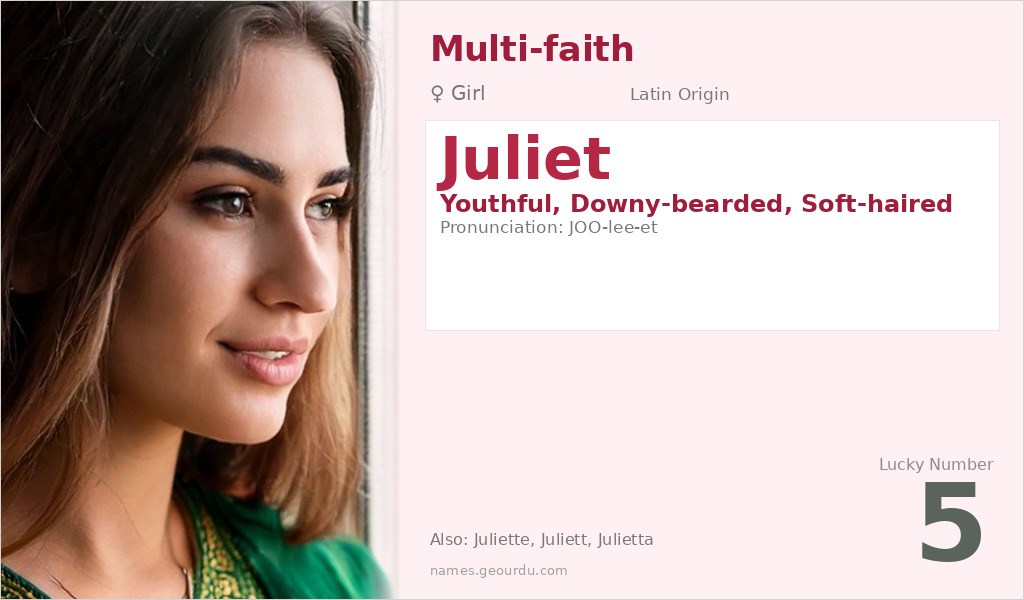
| 📛 Name | Juliet |
| 💎 Meaning | Youthful, Downy-bearded, Soft-haired |
| 👤 Gender | Girl |
| 🕌 Religion | Multi-faith |
| 🌍 Origin | Latin |
| 🗣 Pronunciation | JOO-lee-et |
| ✍️ Urdu | جولیٹ |
| ✍️ Arabic | جولييت |
| 🔢 Numerology | 5 |
| ✨ Spellings | Juliette, Juliett, Julietta, Giulietta |
Origin & Cultural Significance
Juliet has a rich historical journey from ancient Rome to Renaissance Italy and global literature. The Roman gens Julia (including Julius Caesar) made the name prominent in Latin culture. During the Renaissance, Italian writers like Luigi da Porto and Matteo Bandello created early versions of the Romeo and Juliet story using ‘Giulietta’. Shakespeare’s adaptation in 1597 cemented the name in English literature. Today, Juliet is used across cultures and religions, not limited to Christianity, with variations like Juliette (French), Giulietta (Italian), and Yuliya (Russian).
Personality Traits
Namesakes like Shakespeare’s Juliet contribute to associations with romance, passion, and tragic beauty. However, the name’s Latin roots in ‘youthful’ suggest vitality, freshness, and optimism. Modern bearers often embody creativity, emotional depth, and strong relational bonds. The name carries both literary weight and a timeless appeal that suggests both tradition and individuality.
Similar Names
If you like Juliet, consider: Julia, Juliana, Juliette, Julissa, Julietta
Famous People Named Juliet
- Juliet Capulet — Shakespeare's tragic heroine from 'Romeo and Juliet'
- Juliette Binoche — French actress and Oscar winner
- Juliet Stevenson — British stage and screen actress
Frequently Asked Questions About Juliet
What does Juliet mean?
Juliet means 'youthful', 'downy-bearded', or 'soft-haired'. It originates from Latin 'Julius', which comes from Greek 'ioulos' referring to the first soft facial hair of youth.
Is Juliet a boy or girl name?
Juliet is exclusively a girl's name in modern usage. The masculine forms are Julius or Julian. Shakespeare's character solidified its feminine association in English.
What is the origin of Juliet?
Juliet has Latin origins from the Roman name Julius, with deeper roots in Greek. It was popularized through Italian literature and Shakespeare's 'Romeo and Juliet' in 1597.





