
Table of Contents
Kahn is a powerful name with deep historical roots, evoking images of leadership and authority. Often associated with Central Asian and South Asian cultures, it carries a legacy of nobility and command. While commonly seen as a surname or title, Kahn has gained popularity as a first name in modern times. Its strong, concise sound makes it memorable and impactful across languages.
Meaning of Kahn
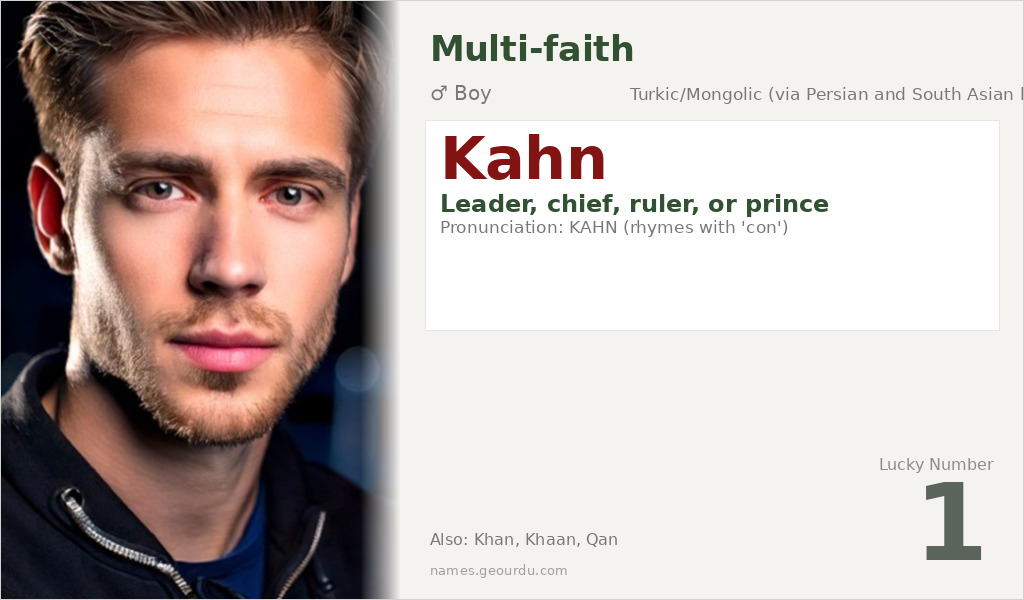
Kahn derives from the Turkic and Mongolic title ‘Khan,’ meaning ‘leader,’ ‘chief,’ ‘ruler,’ or ‘prince.’ Historically, it was used by nomadic empires like the Mongols and later adopted into Persian as ‘خان’ (khān). In South Asia, it spread through Persian influence into Urdu, Pashto, Hindi, and other languages, often denoting a tribal chief, landlord, or noble. The name is linguistically unrelated to Hindu deities or Sanskrit—its core meaning consistently revolves around leadership and high social status. In Pashto and Balochi communities, ‘Khan’ remains a common hereditary title for tribal leaders.
| 📛 Name | Kahn |
| 💎 Meaning | Leader, chief, ruler, or prince |
| 👤 Gender | Boy |
| 🕌 Religion | Multi-faith |
| 🌍 Origin | Turkic/Mongolic (via Persian and South Asian languages) |
| 🗣 Pronunciation | KAHN (rhymes with 'con') |
| ✍️ Urdu | خان |
| ✍️ Arabic | خان |
| 🔢 Numerology | 1 |
| ✨ Spellings | Khan, Khaan, Qan, Xan |
Origin & Cultural Significance
Kahn originates from Central Asia, where ‘Khan’ was a royal title among Turkic and Mongolic peoples, famously used by Genghis Khan. Through Persianate culture, it entered South Asia during the Mughal era and became widespread in regions like Afghanistan, Pakistan, and India. It is used across religious groups—including Muslims, Sikhs, and some Christians—primarily as a surname or honorific, though as a first name it is multi-faith. In contemporary times, Kahn is globally recognized due to famous bearers in politics, entertainment, and sports, transcending its original cultural boundaries.
Personality Traits
Named after a title of command, Kahns are often seen as born leaders with a natural aura of authority. They may exhibit traits like confidence, strategic thinking, and a protective instinct toward their community. While they can be ambitious and goal-oriented, many also carry a sense of duty and tradition, reflecting the name’s noble heritage.
Similar Names
If you like Kahn, consider: Khan, Kaivan, Karan, Kian, Kiran
Famous People Named Kahn
- Genghis Khan — Mongol emperor and founder of the Mongol Empire
- Salman Khan — Indian actor and film producer
- Shah Rukh Khan — Indian actor known as 'King of Bollywood'
- Imran Khan — former Prime Minister of Pakistan and cricketer
- Aga Khan — hereditary title of Ismaili Muslim spiritual leaders
Frequently Asked Questions About Kahn
What does Kahn mean?
Kahn means 'leader,' 'chief,' 'ruler,' or 'prince.' It comes from the Turkic/Mongolic title 'Khan,' which spread to South Asian languages via Persian.
Is Kahn a boy or girl name?
Kahn is almost exclusively a boy's name, given its historical use as a masculine title for rulers and nobles across Central and South Asia.
What is the origin of Kahn?
Kahn originates from Turkic and Mongolic languages in Central Asia, where 'Khan' was a royal title. It later entered Persian and South Asian languages like Urdu, Pashto, and Hindi.





