
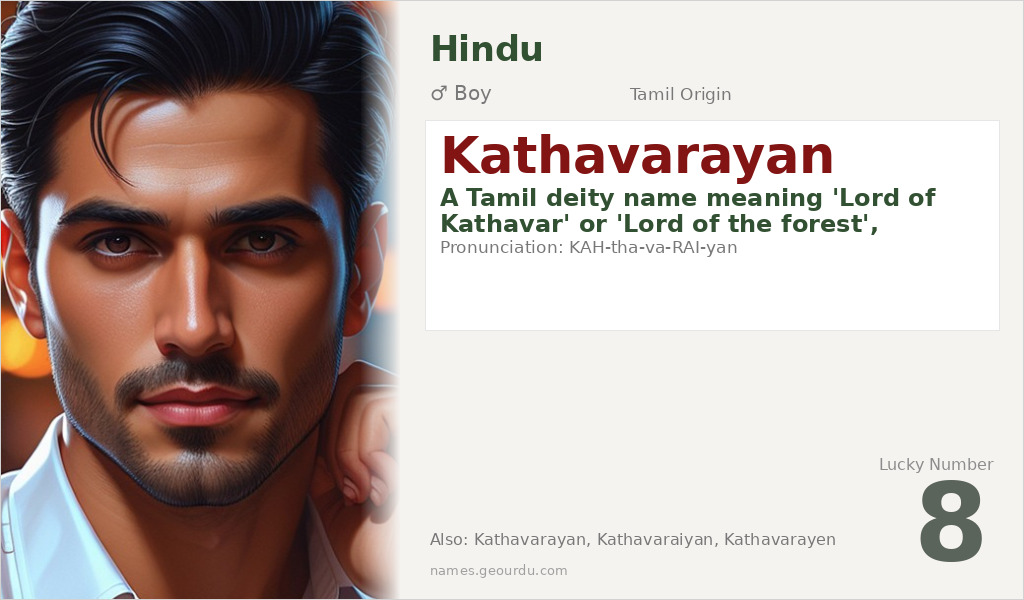
Table of Contents
Kathavarayan is a distinctive Tamil deity name with deep roots in South Indian Hindu tradition. Unlike common personal names, this name refers specifically to a regional form of the god Murugan worshipped as a protector of forests and wilderness. With its evocative meaning and cultural significance, Kathavarayan represents an important aspect of Tamil religious heritage that connects spirituality with nature.
Meaning of Kathavarayan
Kathavarayan is a Tamil compound name with clear linguistic components. The first part, ‘Kathavar’, derives from the Tamil word for forest or wilderness, reflecting the deity’s association with natural spaces. The suffix ‘Ayan’ (or ‘Aiyan’) is a common Tamil honorific meaning lord, master, or protector. Together, the name literally translates to ‘Lord of Kathavar’ or ‘Lord of the Forest’. This specific form of Murugan is documented in Tamil religious folklore as a guardian deity who protects villages bordering forests and wilderness areas. The name appears in regional temple inscriptions and oral traditions, particularly in southern Tamil Nadu where this deity form is venerated.
| 📛 Name | Kathavarayan |
| 💎 Meaning | A Tamil deity name meaning 'Lord of Kathavar' or 'Lord of the forest', referring to a specific form of the Hindu god Murugan/Kartikeya worshipped in Tamil Nadu |
| 👤 Gender | Boy |
| 🕌 Religion | Hindu |
| 🌍 Origin | Tamil |
| 🗣 Pronunciation | KAH-tha-va-RAI-yan |
| ✍️ Urdu | کٹھاورائن |
| ✍️ Arabic | كاتافارايان |
| 🔢 Numerology | 8 |
| ✨ Spellings | Kathavarayan, Kathavaraiyan, Kathavarayen, Kathavaraiyen |
Origin & Cultural Significance
Kathavarayan originates exclusively from Tamil Hindu tradition in South India, specifically the Tamil Nadu region. This deity form represents a localized manifestation of Murugan (also known as Kartikeya or Skanda), the Hindu god of war and victory. The worship of Kathavarayan is particularly prominent in rural areas of Tirunelveli and Thoothukudi districts, where temples dedicated to this forest-protecting deity can be found. Unlike pan-Indian Hindu deities, Kathavarayan represents the rich tradition of grama devatas (village deities) in Tamil culture, where gods take specific forms to address local needs and environments. This name reflects the syncretic nature of Tamil Hinduism, blending mainstream Puranic traditions with indigenous folk worship practices.
Personality Traits
While primarily a deity name rather than a common personal name, those named after Kathavarayan in Tamil tradition are believed to embody qualities of protection and resilience. The forest association suggests someone grounded, connected to nature, and potentially possessing inner strength. In cultural context, this name might indicate spiritual inclinations or a protective nature, reflecting the deity’s role as a guardian. The connection to Murugan also implies qualities of leadership, courage, and victory over obstacles.
Similar Names
If you like Kathavarayan, consider: Murugan, Kartikeya, Skanda, Subramanian, Kumaran, Saravanan, Arumugam, Velan
Famous People Named Kathavarayan
- No widely known contemporary individuals with this name as it is primarily a deity name
- Kathavarayan is worshipped as a deity in specific temples in Tamil Nadu, particularly in the Tirunelveli and Thoothukudi districts
Frequently Asked Questions About Kathavarayan
What does Kathavarayan mean?
Kathavarayan means 'Lord of the Forest' or 'Lord of Kathavar' in Tamil. It is a compound name where 'Kathavar' means forest/wilderness and 'Ayan' means lord/master, referring specifically to a regional form of the Hindu god Murugan.
Is Kathavarayan a boy or girl name?
Kathavarayan is exclusively a boy name as it refers to a male deity (a form of Murugan/Kartikeya) in Tamil Hindu tradition. The name is not used for girls in any cultural context.
What is the origin of Kathavarayan?
Kathavarayan originates from Tamil language and Hindu tradition in South India, specifically Tamil Nadu. It represents a localized deity form worshipped as a protector of forests and wilderness areas, with documented presence in temple traditions and folklore of the region.





