
Table of Contents
Lisbet is a charming and timeless name with deep historical roots. As a Scandinavian diminutive of Elizabeth, it carries centuries of cultural heritage while maintaining a fresh, approachable sound. This name has traveled from ancient Hebrew through Greek and Latin to become a beloved choice across Northern Europe. Whether you’re drawn to its spiritual meaning or its melodic quality, Lisbet offers both tradition and individuality.
Meaning of Lisbet
The name Lisbet fundamentally means ‘God is my oath’, deriving from the Hebrew name Elisheva. This original Hebrew name combines ‘El’ (אֵל), meaning God, and ‘sheva’ (שֶׁבַע), meaning oath or seven. Through Greek adaptation as Elisabet and Latin as Elisabeth, the name spread across Europe. In Scandinavian and Germanic languages, the affectionate diminutive Lisbet emerged, preserving the core meaning while creating a distinct, shorter form. The name’s meaning reflects a solemn promise or covenant with the divine, making it significant in religious contexts while also appealing for its lyrical quality.
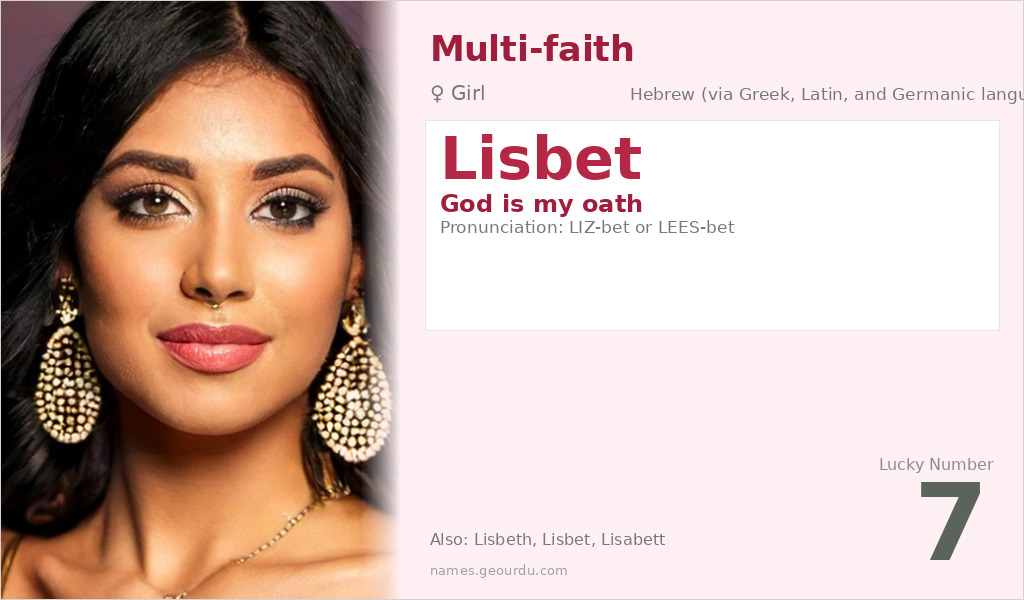
| 📛 Name | Lisbet |
| 💎 Meaning | God is my oath |
| 👤 Gender | Girl |
| 🕌 Religion | Multi-faith |
| 🌍 Origin | Hebrew (via Greek, Latin, and Germanic languages) |
| 🗣 Pronunciation | LIZ-bet or LEES-bet |
| ✍️ Urdu | لسبیت |
| ✍️ Arabic | ليسبيت |
| 🔢 Numerology | 7 |
| ✨ Spellings | Lisbeth, Lisbet, Lisabett, Lizbet, Lysbet |
Origin & Cultural Significance
Lisbet originated as a Scandinavian and Germanic diminutive of Elizabeth, which itself traces back to the Hebrew Elisheva. The name entered European cultures through the New Testament figure Elizabeth, mother of John the Baptist. While the full form Elizabeth became popular across Europe, regional variations like Lisbet developed particularly in Sweden, Norway, Denmark, and Germany. The name gained royal associations through Scandinavian nobility and has remained consistently used in these regions. Unlike some diminutives that become independent names, Lisbet maintains clear recognition as a variation of Elizabeth while developing its own cultural identity in Northern Europe.
Personality Traits
People named Lisbet are often described as thoughtful, reliable, and spiritually aware. The name’s meaning suggests someone who values commitments and integrity. Many Lisbets exhibit a calm, analytical approach to life, combined with strong intuition. These traits make them trusted friends and conscientious individuals who approach challenges with determination.
Similar Names
If you like Lisbet, consider: Elizabeth, Elisabeth, Eliza, Lisa, Beth, Liesel, Lisette, Elspeth
Famous People Named Lisbet
- Lisbet Palme — Swedish psychologist and former First Lady of Sweden
- Lisbet Koerner — German historian of science
Frequently Asked Questions About Lisbet
What does Lisbet mean?
Lisbet means 'God is my oath'. It's a diminutive of Elizabeth, which originates from the Hebrew name Elisheva, combining 'El' (God) and 'sheva' (oath).
Is Lisbet a boy or girl name?
Lisbet is exclusively a girl's name. It developed as a feminine diminutive of Elizabeth and has never been used for boys in any cultural context.
What is the origin of Lisbet?
Lisbet originated as a Scandinavian and Germanic diminutive of Elizabeth. The ultimate origin is Hebrew (Elisheva), which passed through Greek and Latin before developing regional variations like Lisbet in Northern Europe.





