
Table of Contents
Lisbeth is a charming and timeless name that has captivated parents across Scandinavia, Germany, and beyond. As a diminutive of Elizabeth, it carries profound biblical heritage while offering a more modern, streamlined alternative. This name combines traditional roots with contemporary appeal, making it a versatile choice for girls today.
Meaning of Lisbeth
Lisbeth derives from the Hebrew name Elisheva (אֱלִישֶׁבַע), meaning ‘God is my oath.’ The Hebrew components are ‘El’ (אֵל), referring to God, and ‘sheva’ (שֶׁבַע), meaning oath or seven (often symbolizing completeness or abundance). Through Greek (Elisabet) and Latin (Elisabeth), the name entered European languages. Lisbeth specifically developed as a contraction in Germanic and Scandinavian languages, particularly in Danish, Norwegian, Swedish, and German. Unlike some diminutives that lose their original meaning, Lisbeth retains the full theological significance of its parent name Elizabeth.
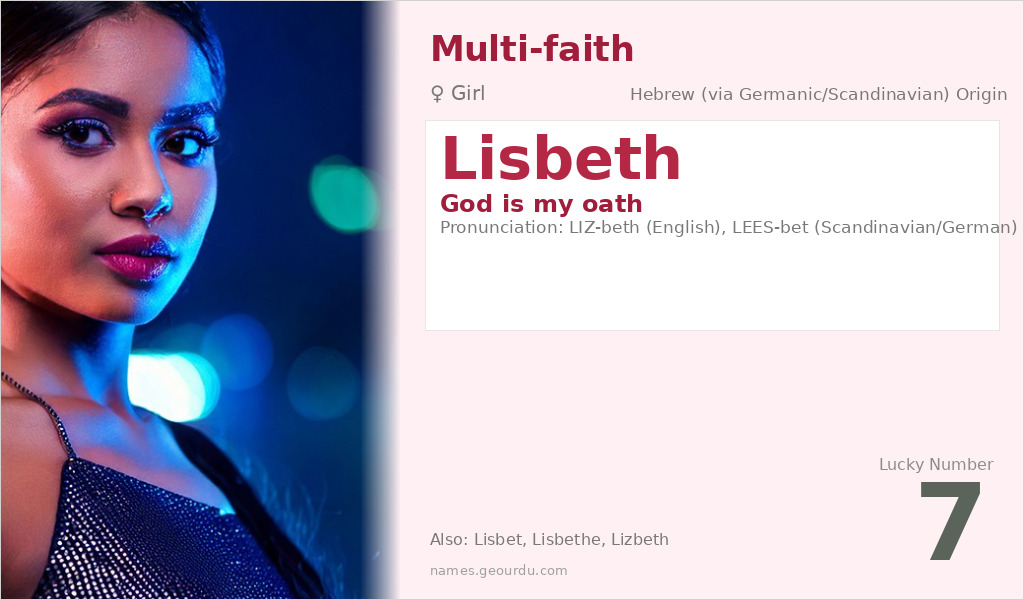
| 📛 Name | Lisbeth |
| 💎 Meaning | God is my oath |
| 👤 Gender | Girl |
| 🕌 Religion | Multi-faith |
| 🌍 Origin | Hebrew (via Germanic/Scandinavian) |
| 🗣 Pronunciation | LIZ-beth (English), LEES-bet (Scandinavian/German) |
| ✍️ Urdu | لسبیتھ |
| ✍️ Arabic | ليزبيث |
| 🔢 Numerology | 7 |
| ✨ Spellings | Lisbet, Lisbethe, Lizbeth, Lysbeth |
Origin & Cultural Significance
Lisbeth originated as a pet form of Elizabeth in Germanic and Scandinavian cultures. It gained popularity in medieval Europe through the veneration of Saint Elizabeth of Hungary and biblical Elizabeth, mother of John the Baptist. The name became particularly established in Denmark, Norway, Sweden, and German-speaking regions, where shorter, affectionate forms like Lisbeth were common. While rooted in Hebrew via Christianity, Lisbeth is used across various cultural and religious contexts today, reflecting its adaptation into secular naming traditions. Its usage spread globally through literature and immigration.
Personality Traits
Those named Lisbeth are often associated with qualities of intelligence, independence, and depth. The name’s meaning ‘God is my oath’ suggests a person of strong principles and reliability. In cultural depictions, like Stieg Larsson’s Lisbeth Salander, the name conveys resilience and analytical prowess. Parents choosing this name may appreciate its blend of traditional strength and modern individuality.
Similar Names
If you like Lisbeth, consider: Elizabeth, Elisabeth, Elise, Liselotte, Lisbet
Famous People Named Lisbeth
- Lisbeth Zwerger — Austrian illustrator known for watercolor illustrations of children's books
- Lisbeth Lenton — Australian former swimmer, Olympic gold medalist
- Lisbeth Salander — Fictional character from Stieg Larsson's Millennium series
Frequently Asked Questions About Lisbeth
What does Lisbeth mean?
Lisbeth means 'God is my oath.' It is a diminutive of Elizabeth, originating from the Hebrew name Elisheva, combining 'El' (God) and 'sheva' (oath).
Is Lisbeth a boy or girl name?
Lisbeth is exclusively a girl's name. It is a feminine diminutive of Elizabeth and has never been used traditionally for boys.
What is the origin of Lisbeth?
Lisbeth originates from Hebrew via Germanic and Scandinavian languages. It developed as a pet form of Elizabeth in Denmark, Norway, Sweden, and German-speaking regions, with ultimate roots in the Hebrew Elisheva.





