
Table of Contents
Litton is a distinctive name with deep English roots that evokes images of hillside settlements and pastoral landscapes. Originally a surname derived from geographical features, it has transitioned into use as a given name with a strong, earthy character. This name carries the weight of centuries of English history while maintaining a modern, approachable sound. Whether you’re drawn to its topographic origins or its crisp two-syllable rhythm, Litton offers a unique choice with historical depth.
Meaning of Litton
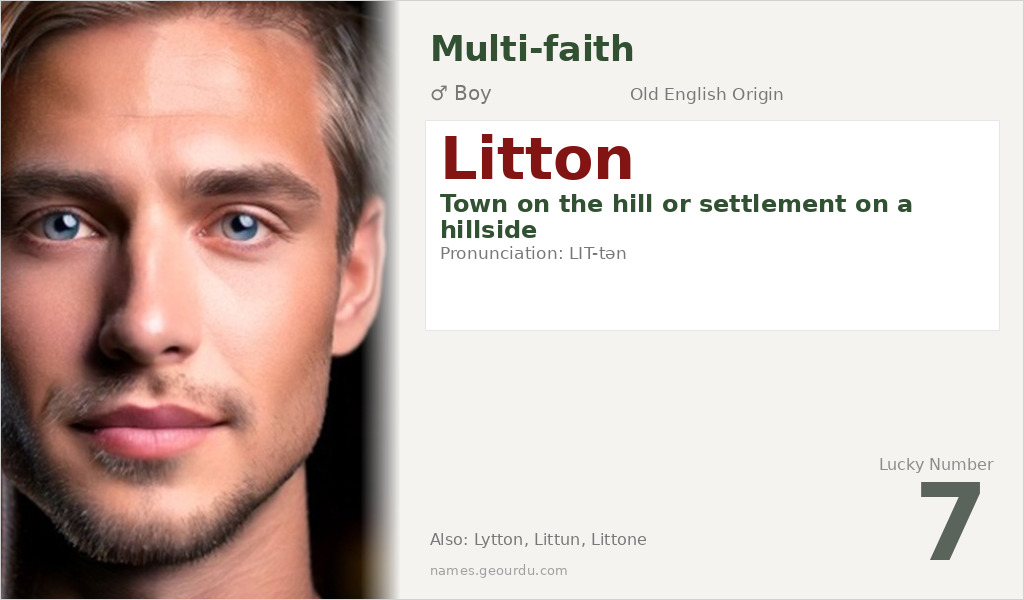
Litton derives from Old English elements that paint a vivid picture of medieval English geography. The first component ‘hlith’ (modern ‘lith’) means ‘slope,’ ‘hillside,’ or ‘incline,’ while the second element ‘tun’ (modern ‘ton’) means ‘enclosure,’ ‘settlement,’ or ‘town.’ Combined, they create the meaning ‘settlement on a hillside’ or ‘town on the hill.’ This toponymic construction was common in Old English naming practices, where locations were described by their physical features. The name first appears in historical records in the 11th century Domesday Book, documenting settlements in various English counties. As a given name, Litton carries this geographical heritage forward, connecting bearers to England’s landscape and history.
| 📛 Name | Litton |
| 💎 Meaning | Town on the hill or settlement on a hillside |
| 👤 Gender | Boy |
| 🕌 Religion | Multi-faith |
| 🌍 Origin | Old English |
| 🗣 Pronunciation | LIT-tən |
| ✍️ Urdu | لٹن |
| ✍️ Arabic | ليتون |
| 🔢 Numerology | 7 |
| ✨ Spellings | Lytton, Littun, Littone |
Origin & Cultural Significance
Litton originated as a locational surname in England, referring to people who hailed from places named Litton in Derbyshire, Dorset, Somerset, or Yorkshire. These settlements were typically situated on hillsides, giving rise to the descriptive name. The transition from surname to given name occurred primarily in English-speaking countries during the 20th century, following broader trends of surname adoption as first names. Unlike many names with specific religious connotations, Litton is secular in origin and can be used by families of any faith background. Its usage has been documented in various English-speaking regions including the United Kingdom, United States, Canada, and Australia, with notable bearers in sports and politics.
Personality Traits
While personality associations with names are subjective, the etymology of Litton suggests certain symbolic qualities. The ‘hilltop settlement’ meaning implies someone who values perspective, strategic positioning, and perhaps a certain detachment for clearer observation. This could translate to thoughtful, analytical tendencies in personality. The name’s English heritage might also suggest traditional values combined with practical adaptability. Ultimately, like all names, Litton provides a foundation upon which individual personality builds unique characteristics.
Similar Names
If you like Litton, consider: Lytton, Linton, Milton, Clifton, Burton
Famous People Named Litton
- Litton Das — Bangladeshi cricketer who plays as a wicket-keeper batsman
- Litton K. Dey — Indian politician from West Bengal
Frequently Asked Questions About Litton
What does Litton mean?
Litton means 'town on the hill' or 'settlement on a hillside,' derived from Old English elements 'hlith' (slope/hillside) and 'tun' (town/settlement).
Is Litton a boy or girl name?
Litton is primarily used as a boy's name, though as with many surname-derived names, it could theoretically be used for any gender. Historical and contemporary usage overwhelmingly favors male bearers.
What is the origin of Litton?
Litton originates from Old English as a locational surname referring to settlements on hillsides in England. It transitioned to use as a given name in English-speaking countries.





