
Table of Contents
The name Lord carries immediate associations of authority and nobility. While commonly recognized as an English title rather than a traditional given name, some parents choose it for its powerful connotations. This analysis explores the true origins and meaning of Lord, separating fact from common misconceptions about its cultural associations.
Meaning of Lord
Lord derives from Old English ‘hlāford’, which originally meant ‘bread-keeper’ or ‘loaf-ward’ — referring to someone who provided food and protection. The term evolved through Middle English to denote a ruler, master, or nobleman. Linguistically, it combines Proto-Germanic elements: *hlaiƀaz (bread) and *wardaz (keeper, guardian). Unlike traditional Muslim names that typically derive from Arabic, Persian, or other Islamic languages with religious or virtuous meanings, ‘Lord’ is fundamentally an English title with secular, hierarchical connotations. It has no established meaning in Arabic or Islamic naming traditions.
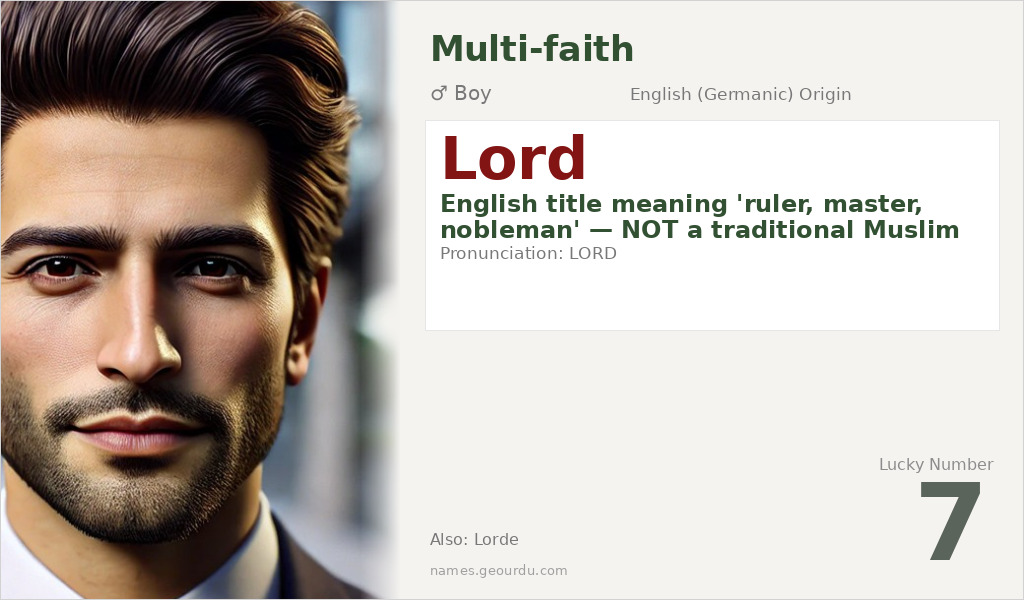
| 📛 Name | Lord |
| 💎 Meaning | English title meaning 'ruler, master, nobleman' — NOT a traditional Muslim name |
| 👤 Gender | Boy |
| 🕌 Religion | Multi-faith |
| 🌍 Origin | English (Germanic) |
| 🗣 Pronunciation | LORD |
| ✍️ Urdu | لارڈ (transliteration, not traditional) |
| ✍️ Arabic | لورد (transliteration, not traditional) |
| 🔢 Numerology | 7 |
| ✨ Spellings | Lorde |
Origin & Cultural Significance
Lord originates from Anglo-Saxon England as a title of nobility and authority within the feudal system. The name emerged from practical social roles (providing sustenance and protection) that evolved into titles of rank. While English names have been adopted globally, ‘Lord’ remains primarily a title rather than a conventional given name in any culture. It has no historical connection to Arabian tribes, Islamic traditions, or South Asian naming practices. The name’s usage as a personal name is modern and unconventional, particularly within Muslim communities where names typically have Arabic roots or virtuous meanings.
Personality Traits
The name Lord inherently suggests leadership qualities and authority. Those bearing this name may feel compelled to live up to its commanding presence, often developing strong organizational skills and natural confidence. The name’s association with nobility can inspire a sense of responsibility and high standards, though it may also create expectations of traditional masculinity and command.
Similar Names
If you like Lord, consider: Rex, Duke, Earl, King, Prince
Famous People Named Lord
- Lord Byron — Famous English Romantic poet
- Lord Kitchener — British Field Marshal and colonial administrator
Frequently Asked Questions About Lord
What does Lord mean?
Lord is an English name meaning 'ruler', 'master', or 'nobleman'. It originates from Old English 'hlāford' (bread-keeper) and has Germanic roots.
Is Lord a boy or girl name?
Lord is exclusively a boy's name, reflecting its origins as a masculine title of authority in English nobility traditions.
What is the origin of Lord?
Lord originates from Old English and has Germanic linguistic roots. It is not derived from Arabic, Persian, or any Islamic language, contrary to some online misinformation.





