
Table of Contents
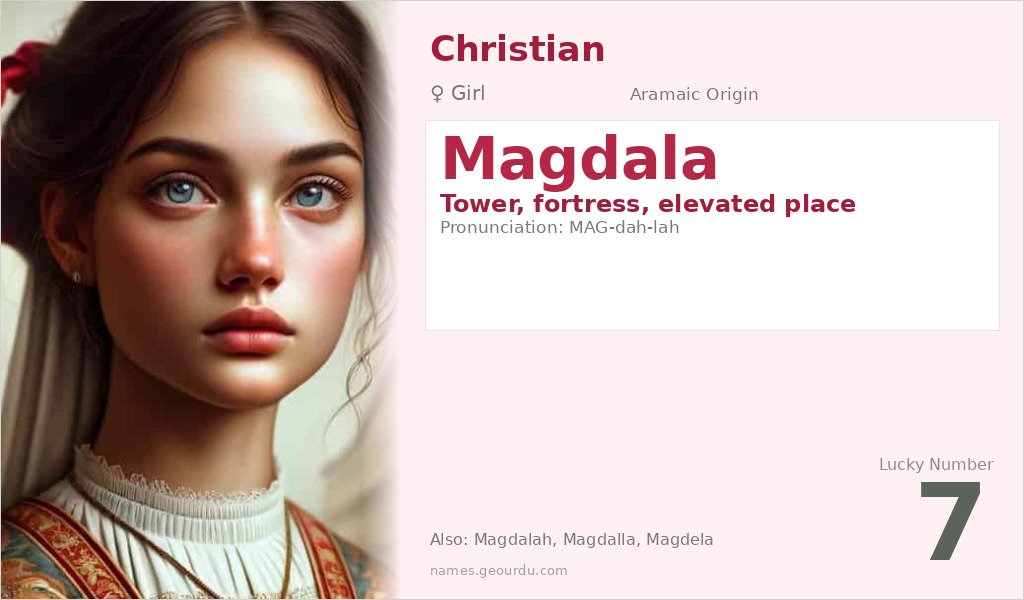
Magdala is a name steeped in ancient history and spiritual significance. Originating from the Aramaic language, this name carries the powerful meaning of ‘tower’ or ‘fortress’. Best known as the hometown of Mary Magdalene in the New Testament, Magdala connects modern bearers to a rich Biblical heritage. Its strong, protective connotations make it a meaningful choice for parents seeking a name with both historical depth and spiritual resonance.
Meaning of Magdala
Magdala derives from the Aramaic word ‘Magdala’ (מגדלא), which literally translates to ‘tower’, ‘fortress’, or ‘elevated place’. The name comes from the Semitic root ‘gdl’ (גדל), meaning ‘to be great’, ‘to grow’, or ‘to magnify’, combined with the locative prefix ‘ma-‘, indicating a place characterized by greatness or elevation. In its original context, it referred to a specific geographical location – the ancient fishing town of Magdala on the Sea of Galilee. This etymological construction is common in Semitic languages, where place names often describe physical characteristics of the location. The name’s meaning reflects both physical elevation and metaphorical strength or prominence.
| 📛 Name | Magdala |
| 💎 Meaning | Tower, fortress, elevated place |
| 👤 Gender | Girl |
| 🕌 Religion | Christian |
| 🌍 Origin | Aramaic |
| 🗣 Pronunciation | MAG-dah-lah |
| ✍️ Urdu | مگدالا |
| ✍️ Arabic | مجدلا |
| 🔢 Numerology | 7 |
| ✨ Spellings | Magdalah, Magdalla, Magdela, Migdal |
Origin & Cultural Significance
Magdala originates from ancient Aramaic, the lingua franca of the Near East during the time of Jesus. Historically, it referred to the town of Magdala (also called Migdal or Magadan) located on the western shore of the Sea of Galilee in modern-day Israel. The town gained significance in Christian tradition as the hometown of Mary Magdalene, one of Jesus’ most prominent female followers mentioned in all four Gospels. Archaeological excavations at the site have revealed a first-century synagogue and other structures, confirming its existence during the Biblical period. While the name is primarily associated with Christianity due to its New Testament appearance, its linguistic roots are firmly in the Aramaic language spoken across various communities in the ancient Levant.
Personality Traits
The name Magdala suggests personality traits of strength, protection, and spiritual depth. Like a tower that provides vantage and security, individuals with this name often exhibit natural leadership qualities and a protective nature toward loved ones. They tend to be resilient in facing challenges, with an inner fortitude that helps them weather life’s storms. The name’s Biblical associations may also indicate a person with strong spiritual or moral convictions, and a capacity to support others during difficult times.
Similar Names
If you like Magdala, consider: Magdalena, Magdalen, Madeleine, Magda, Migdal
Famous People Named Magdala
- Mary Magdalene — Biblical figure, one of Jesus' followers mentioned in the New Testament
- Magdala — Ancient town in Galilee, archaeological site in modern-day Israel
Frequently Asked Questions About Magdala
What does Magdala mean?
Magdala means 'tower', 'fortress', or 'elevated place' in Aramaic, the ancient Semitic language spoken in the Near East during Biblical times.
Is Magdala a boy or girl name?
Magdala is primarily used as a girl's name, particularly in Christian contexts where it's associated with Mary Magdalene. However, as a place name, it's gender-neutral in its original form.
What is the origin of Magdala?
Magdala originates from Aramaic, specifically referring to the ancient town of Magdala on the Sea of Galilee. It gained prominence through its mention in the New Testament as the hometown of Mary Magdalene.





