
Table of Contents
Malhari is a powerful Sanskrit name with deep roots in Hindu mythology, specifically referring to Lord Shiva in his aspect as the vanquisher of evil. This traditional boy’s name carries spiritual significance and cultural heritage, particularly in regions of India where Shiva worship is prominent. Unlike many modern names, Malhari has a clear, documented meaning and religious context that connects directly to ancient texts and traditions.
Meaning of Malhari
Malhari is a Sanskrit compound name with precise etymological roots. It combines ‘Mala’ (मल), meaning impurity, dirt, sin, or evil, with ‘Hari’ (हरि), meaning one who takes away, removes, or destroys. Thus, Malhari literally translates to ‘the remover of evil’ or ‘destroyer of impurities.’ In Hindu religious context, this specifically refers to Lord Shiva, who in this form destroys negative forces and spiritual obstacles. The name appears in regional Hindu traditions, particularly in Maharashtra where ‘Malhari Martand’ is worshipped. This isn’t a general reference to Shiva but specifically to his aspect focused on eliminating evil, making it a name with protective connotations.
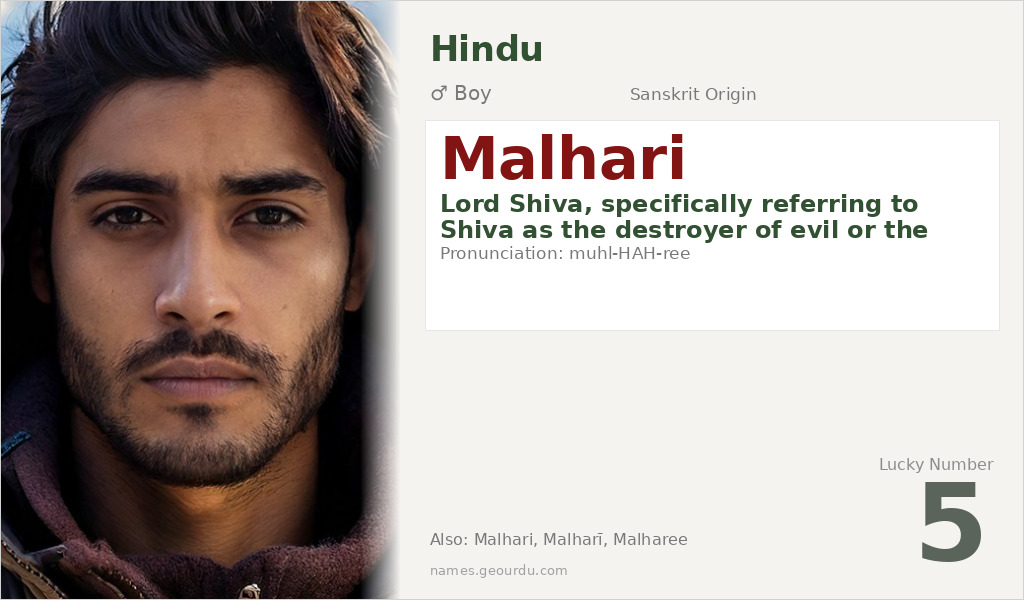
| 📛 Name | Malhari |
| 💎 Meaning | Lord Shiva, specifically referring to Shiva as the destroyer of evil or the one who dances in battle |
| 👤 Gender | Boy |
| 🕌 Religion | Hindu |
| 🌍 Origin | Sanskrit |
| 🗣 Pronunciation | muhl-HAH-ree |
| ✍️ Urdu | ملہری |
| ✍️ Arabic | مالهاري |
| 🔢 Numerology | 5 |
| ✨ Spellings | Malhari, Malharī, Malharee |
Origin & Cultural Significance
Malhari originates from classical Sanskrit language and Hindu religious texts. The name is particularly significant in Shaivism (worship of Shiva) traditions across India, with special prominence in Maharashtra. Historical temples like the Malhari Martand temple in Satara district demonstrate the name’s regional importance. Unlike many names that have evolved across cultures, Malhari has remained primarily within its original religious and linguistic context. The name reflects the philosophical concept in Hinduism of divine intervention to remove spiritual impurities, connecting it to broader themes of purification and protection in Hindu thought.
Personality Traits
Those named Malhari are often associated with strength, protection, and spiritual depth. The name’s connection to Shiva as destroyer of evil suggests personality traits like determination, courage in facing challenges, and a protective nature toward others. There may also be creative or artistic tendencies, reflecting Shiva’s role as Nataraja (lord of dance). The name carries expectations of moral integrity and leadership, as it references a deity who confronts and eliminates negative forces.
Similar Names
If you like Malhari, consider: Mahadev, Shiva, Harish, Malhar, Hari, Mallikarjun, Bholenath, Rudra
Famous People Named Malhari
- Malhari Martand — A form of Lord Shiva worshipped in Maharashtra, particularly at the Malhari Martand temple in Satara district
- Various historical and religious figures in Maharashtra have been named after this form of Shiva, though no widely known contemporary public figures bear this name
Frequently Asked Questions About Malhari
What does Malhari mean?
Malhari means 'Lord Shiva as the destroyer of evil' in Sanskrit. It's a compound of 'Mala' (evil/impurity) and 'Hari' (remover/destroyer), specifically referring to Shiva's aspect that eliminates negative forces.
Is Malhari a boy or girl name?
Malhari is exclusively a boy's name in Hindu naming traditions. It refers to a masculine deity (Lord Shiva) and follows Sanskrit grammatical gender rules for male names.
What is the origin of Malhari?
Malhari originates from Sanskrit language and Hindu religious tradition. It specifically comes from Shaivism (Shiva worship) and has particular cultural significance in Maharashtra, India, where it appears in temple names and regional worship practices.





