
Table of Contents
Nagpati is a powerful Sanskrit name steeped in Hindu mythology and ancient Indian tradition. Meaning ‘lord of serpents’ or ‘king of snakes’, this name carries deep spiritual significance and connects to the rich tapestry of naga (serpent deity) lore in Hinduism. Traditionally given to boys, Nagpati evokes images of wisdom, protection, and divine authority. Discover the fascinating etymology, cultural context, and modern relevance of this distinctive name.
Meaning of Nagpati
Nagpati derives from classical Sanskrit, combining ‘nāga’ (नाग) and ‘pati’ (पति). ‘Nāga’ primarily means ‘serpent’ or ‘snake’, though it can also signify ‘elephant’ in certain contexts, reflecting the complexity of Sanskrit vocabulary. ‘Pati’ translates to ‘lord, master, ruler, or husband’, indicating authority and guardianship. Together, they form ‘nāgapati’ (later simplified to Nagpati), literally ‘lord of serpents’. This title appears in Hindu scriptures like the Mahabharata and Puranas, where it refers to Vasuki, the king of the nagas who plays a crucial role in the Samudra Manthan (churning of the ocean). The name embodies the serpent’s dual symbolism in Hinduism—both as a protective deity and a symbol of hidden knowledge.
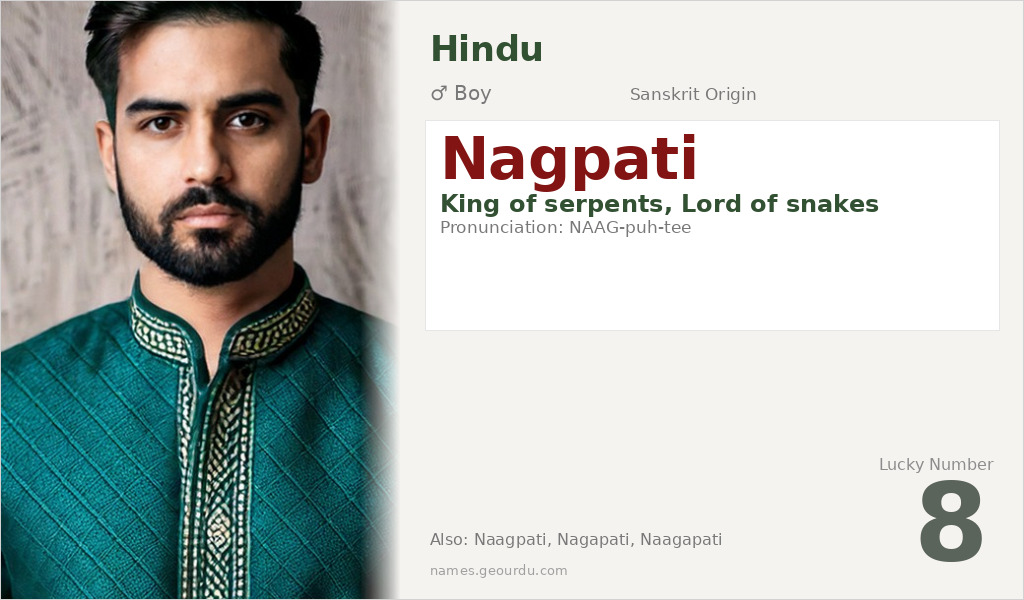
| 📛 Name | Nagpati |
| 💎 Meaning | King of serpents, Lord of snakes |
| 👤 Gender | Boy |
| 🕌 Religion | Hindu |
| 🌍 Origin | Sanskrit |
| 🗣 Pronunciation | NAAG-puh-tee |
| ✍️ Urdu | ناگپتی |
| ✍️ Arabic | ناغباتي |
| 🔢 Numerology | 8 |
| ✨ Spellings | Naagpati, Nagapati, Naagapati |
Origin & Cultural Significance
Nagpati originates from ancient Sanskrit literature and Hindu religious texts, with its earliest documented usage in Indian epics and Puranic narratives. In Hindu culture, nagas (serpent beings) are considered semi-divine creatures associated with water, fertility, and protection, often serving as guardians of treasures and sacred knowledge. The name reflects the veneration of serpent deities in pre-Vedic and Vedic traditions, which continued into classical Hinduism. While primarily used in Hindu communities, the name has regional variations across India but remains most common among Sanskrit-influenced naming traditions. Unlike many names that cross linguistic boundaries, Nagpati is specifically rooted in Sanskrit and Hindu cosmology without verified equivalents in Arabic, Persian, or other major language families.
Personality Traits
Those named Nagpati are often perceived as possessing serpent-like qualities—wise, intuitive, and protective of their loved ones. They may exhibit natural leadership abilities and a calm, composed demeanor that masks inner strength. In Hindu astrology, names with serpent associations are thought to confer spiritual insight and resilience. The connection to Vasuki, the loyal serpent king, suggests qualities of devotion, service, and ancient wisdom. Parents choosing this name often hope to instill these noble characteristics in their child.
Similar Names
If you like Nagpati, consider: Nagendra, Nagabhushan, Nagaditya, Nagraj, Vasuki
Famous People Named Nagpati
- Nagpati (mythological) — The serpent king in Hindu scriptures, often identified with Vasuki
- Historical figures with this name are rare, but it appears in some regional Indian records as a given name
Frequently Asked Questions About Nagpati
What does Nagpati mean?
Nagpati means 'king of serpents' or 'lord of snakes' in Sanskrit, derived from 'nāga' (serpent) and 'pati' (lord).
Is Nagpati a boy or girl name?
Nagpati is exclusively a boy's name in Hindu naming tradition, reflecting masculine titles like 'pati' (lord) and mythological associations with male serpent deities.
What is the origin of Nagpati?
Nagpati originates from Sanskrit and Hindu mythology, specifically from ancient Indian texts where it refers to Vasuki, the king of the nagas (serpent deities).





