Table of Contents
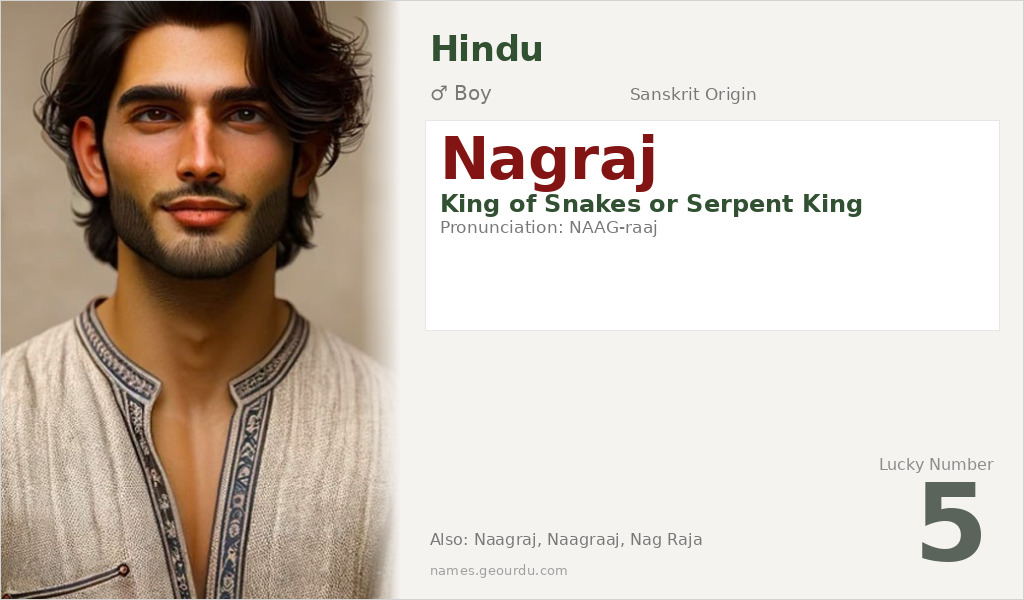
Nagraj is a powerful and ancient Sanskrit name that carries deep mythological significance in Hindu culture. Meaning ‘King of Snakes’ or ‘Serpent King’, this name evokes images of divine protectors and cosmic serpents from Indian legends. Traditionally given to boys, Nagraj connects the bearer to a rich tapestry of spiritual and cultural heritage. Its strong phonetic presence and historical roots make it a distinctive choice for parents seeking a name with profound meaning.
Meaning of Nagraj
Nagraj derives from the Sanskrit words ‘Nāga’ (नाग) and ‘Rāja’ (राज), forming a compound that literally translates to ‘King of Snakes’. In Sanskrit, ‘nāga’ refers not just to ordinary snakes but often to divine or semi-divine serpents prominent in Hindu and Buddhist mythology, such as Shesha who supports the universe or Vasuki used in the churning of the ocean. The suffix ‘rāja’ denotes royalty, leadership, or supremacy, making Nagraj a title of honor. This name is deeply embedded in ancient Indian texts, where nāgas are depicted as wise, powerful beings associated with water, fertility, and protection. Unlike some names that have cross-linguistic variations, Nagraj remains firmly rooted in Sanskrit with no verified equivalent meanings in Arabic, Persian, Pashto, or other regional languages despite thorough research.
| 📛 Name | Nagraj |
| 💎 Meaning | King of Snakes or Serpent King |
| 👤 Gender | Boy |
| 🕌 Religion | Hindu |
| 🌍 Origin | Sanskrit |
| 🗣 Pronunciation | NAAG-raaj |
| ✍️ Urdu | ناگراج |
| ✍️ Arabic | ناجراج |
| 🔢 Numerology | 5 |
| ✨ Spellings | Naagraj, Naagraaj, Nag Raja |
Origin & Cultural Significance
Nagraj originates from Sanskrit, the classical language of India, and is primarily associated with Hindu culture and religion. Its usage spans millennia, appearing in epics like the Mahabharata and Puranas, where nāgas play significant roles as deities, guardians, or antagonists. The name reflects the veneration of serpents in ancient Indian traditions, often linked to concepts of eternity, wisdom, and cosmic order. While used historically, it remains in modern times across India and Nepal, particularly in communities with strong ties to Sanskrit heritage. Unlike names that have spread to multiple faiths, Nagraj is predominantly Hindu, with no evidence of adoption in Islamic, Christian, or other religious contexts despite linguistic searches across diverse cultures.
Personality Traits
Those named Nagraj are often thought to embody traits of wisdom, resilience, and protective instincts, inspired by the serpent’s symbolic meanings in Eastern lore. They may display a calm, introspective nature combined with a strong sense of duty and leadership. The mythological connection can inspire a deep respect for tradition and spirituality, shaping a personality that values knowledge and cultural roots.
Similar Names
If you like Nagraj, consider: Nagendra, Vasuki, Shesha, Ananta, Pannag
Famous People Named Nagraj
- Nagraj Manjule — Indian film director and actor known for Marathi cinema
- Nagraj Popatrao Ganjge — Indian politician from Maharashtra
Frequently Asked Questions About Nagraj
What does Nagraj mean?
Nagraj means 'King of Snakes' or 'Serpent King', derived from the Sanskrit words 'Nāga' (snake) and 'Rāja' (king).
Is Nagraj a boy or girl name?
Nagraj is exclusively a boy's name in Hindu naming traditions, with no historical or cultural usage as a girl's name.
What is the origin of Nagraj?
Nagraj originates from Sanskrit, the ancient language of India, and is deeply rooted in Hindu mythology and culture.