
Table of Contents
Neelkant is a profound Sanskrit name steeped in Hindu mythology, carrying the powerful imagery of sacrifice and divine protection. This name directly references Lord Shiva’s act of consuming poison to save creation, which turned his throat blue. As a boy’s name, it embodies resilience and spiritual significance within Hindu tradition. Parents choosing this name often seek to instill values of courage and selflessness.
Meaning of Neelkant
Neelkant is a compound Sanskrit name with clear etymological roots. ‘Neela’ (नील) translates to ‘blue’ or ‘sapphire-colored,’ while ‘Kanta’ (कण्ठ) means ‘throat’ or ‘neck.’ Together, they form ‘blue-throated,’ specifically describing Lord Shiva after he drank the poison Halahala during the Samudra Manthan (churning of the ocean). This mythological event is central to Hindu cosmology, where Shiva’s act prevented universal destruction. The name has no alternative meaning as ‘jewel’ or connection to Vishnu—these are common misinterpretations. In linguistic context, similar constructions appear in other Sanskrit epithets like ‘Shwetakanta’ (white-throated) or ‘Raktakanta’ (red-throated), but Neelkant remains uniquely tied to Shiva’s mythology.
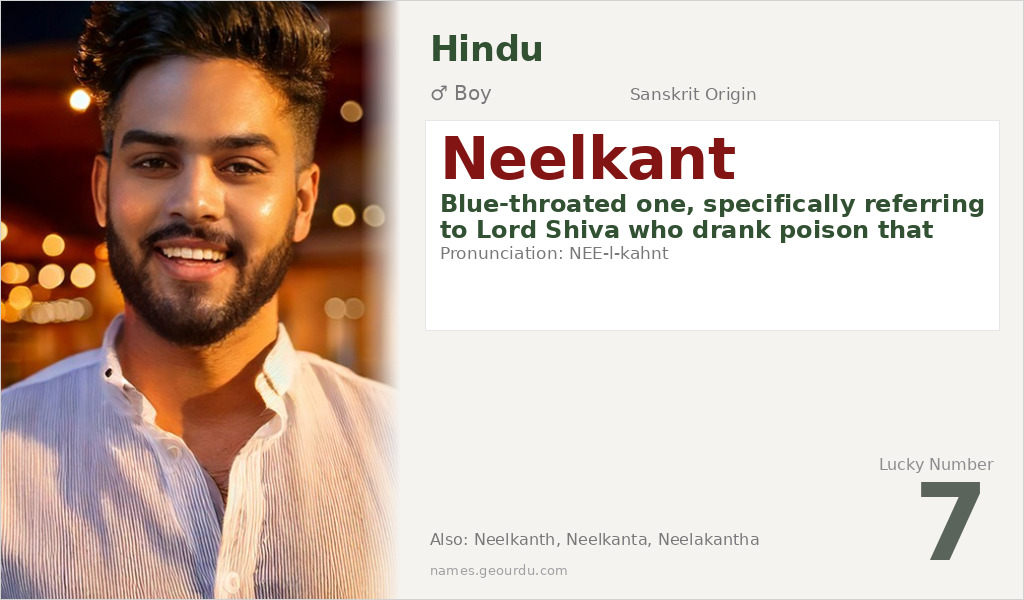
| 📛 Name | Neelkant |
| 💎 Meaning | Blue-throated one, specifically referring to Lord Shiva who drank poison that turned his throat blue |
| 👤 Gender | Boy |
| 🕌 Religion | Hindu |
| 🌍 Origin | Sanskrit |
| 🗣 Pronunciation | NEE-l-kahnt |
| ✍️ Urdu | نیل کنٹھ |
| ✍️ Arabic | نيل كانث |
| 🔢 Numerology | 7 |
| ✨ Spellings | Neelkanth, Neelkanta, Neelakantha, Nilakantha |
Origin & Cultural Significance
Neelkant originates exclusively from Sanskrit and Hindu religious texts, particularly the Puranas and the epic Mahabharata where Shiva is described as Neelakantha. The name has been used for centuries in India, especially among Hindu communities, as both a given name and a title for Shiva. It reflects the deep cultural reverence for Shiva’s protective role in Hindu cosmology. Unlike some names that cross religious boundaries, Neelkant remains firmly within Hindu tradition due to its specific mythological reference. Regional variations like Neelkanth are common in Hindi-speaking areas, while South Indian languages use forms like Neelakanta.
Personality Traits
Those named Neelkant are often associated with traits of resilience and calm strength, mirroring Shiva’s composed demeanor after consuming poison. They may be seen as protective figures in their families or communities, with a spiritual depth that draws from the name’s religious roots. The mythological connection suggests an ability to transform challenges into strengths, embodying the idea of turning poison into a mark of honor.
Similar Names
If you like Neelkant, consider: Shiva, Harish, Vishwanath, Rudra, Mahadev
Famous People Named Neelkant
- Neelkanth Singh — Indian politician from Madhya Pradesh
- Neelkanth — Character in Indian television series 'Devon Ke Dev…Mahadev' portraying Lord Shiva
Frequently Asked Questions About Neelkant
What does Neelkant mean?
Neelkant means 'blue-throated one' in Sanskrit, specifically referring to Lord Shiva who drank poison that turned his throat blue during Hindu mythology's Samudra Manthan.
Is Neelkant a boy or girl name?
Neelkant is exclusively a boy's name in Hindu tradition, as it refers to the male deity Lord Shiva and has no feminine usage in historical or cultural records.
What is the origin of Neelkant?
Neelkant originates from Sanskrit and Hindu mythology, with its earliest references in texts like the Puranas describing Shiva as Neelakantha after he consumed poison to save the universe.





