
Table of Contents
Ole is a classic Scandinavian name with deep roots in Norse history and mythology. Carrying the powerful meaning of ‘ancestor’s descendant’, this name connects modern bearers to their Viking heritage. From medieval kings to contemporary athletes and entrepreneurs, the name Ole has been borne by notable figures across centuries. Its enduring popularity in Norway, Denmark, and Sweden speaks to its cultural significance and timeless appeal.
Meaning of Ole
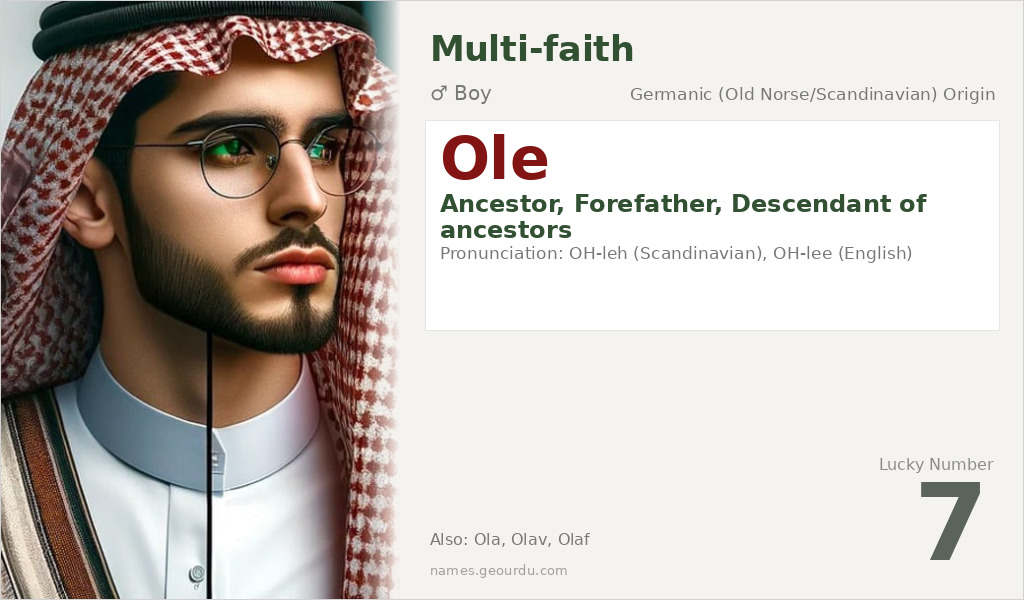
The name Ole originates from the Old Norse name ‘Óláfr’ or ‘Óleifr’, composed of two Proto-Norse elements: ‘anu’ meaning ‘ancestor, forefather’ and ‘leifr’ meaning ‘heir, descendant’. This creates the literal meaning ‘ancestor’s descendant’ or ‘heir of the forefathers’. The name reflects the importance of lineage and heritage in Norse culture, where connection to ancestors was deeply valued. It evolved through various forms including Olaf, Olav, and Ola before settling on Ole as a common Scandinavian diminutive. The name’s etymology demonstrates how Norse naming traditions often celebrated familial continuity and ancestral honor.
| 📛 Name | Ole |
| 💎 Meaning | Ancestor, Forefather, Descendant of ancestors |
| 👤 Gender | Boy |
| 🕌 Religion | Multi-faith |
| 🌍 Origin | Germanic (Old Norse/Scandinavian) |
| 🗣 Pronunciation | OH-leh (Scandinavian), OH-lee (English) |
| ✍️ Urdu | اولے |
| ✍️ Arabic | أولي |
| 🔢 Numerology | 7 |
| ✨ Spellings | Ola, Olav, Olaf, Oluf, Olle |
Origin & Cultural Significance
Ole has its origins in medieval Scandinavia, first appearing during the Viking Age. The most famous historical bearer was Óláfr Haraldsson, who ruled Norway from 1015 to 1028 and was later canonized as Saint Olaf, becoming Norway’s patron saint. This Christian association helped spread the name throughout Scandinavia, but its roots predate Christianity. The name remains particularly popular in Norway and Denmark, where it’s considered a traditional masculine name. In the 19th and 20th centuries, Scandinavian immigrants brought the name to North America, where it continues to be used in Scandinavian-American communities.
Personality Traits
Those named Ole often embody characteristics associated with their Norse heritage: resilience, practicality, and a strong sense of tradition. They tend to be dependable individuals who value family connections and historical continuity. While grounded in their roots, many also display the exploratory spirit of their Viking ancestors, often excelling in fields requiring both tradition and innovation. The name carries an air of quiet strength and reliability that often reflects in the personality of its bearers.
Similar Names
If you like Ole, consider: Olaf, Oliver, Olav, Olin, Oleg
Famous People Named Ole
- Ole Gunnar Solskjær — Norwegian football manager and former player, known as 'the Baby-Faced Assassin'
- Ole Edvart Rølvaag — Norwegian-American novelist known for 'Giants in the Earth'
- Ole Kirk Christiansen — Danish carpenter who founded the LEGO Group
Frequently Asked Questions About Ole
What does Ole mean?
Ole means 'ancestor's descendant' or 'heir of the forefathers', derived from the Old Norse elements 'anu' (ancestor) and 'leifr' (heir).
Is Ole a boy or girl name?
Ole is exclusively a masculine name in Scandinavian cultures, though similar names like Ola can be unisex in some contexts.
What is the origin of Ole?
Ole originates from Old Norse/Scandinavian languages, specifically from the name Óláfr or Óleifr, and has been used since the Viking Age in Norway, Denmark, and Sweden.





