
Table of Contents
Padmakant is a beautiful and meaningful Sanskrit name that resonates with Hindu spirituality and mythology. Primarily given to boys, it combines ‘padma’ (lotus) and ‘kant’ (husband), evoking imagery of divine love and purity. This name carries deep cultural significance, often associated with Lord Vishnu and the goddess Lakshmi. Explore the rich layers of Padmakant’s origin, meaning, and personality traits in this detailed guide.
Meaning of Padmakant
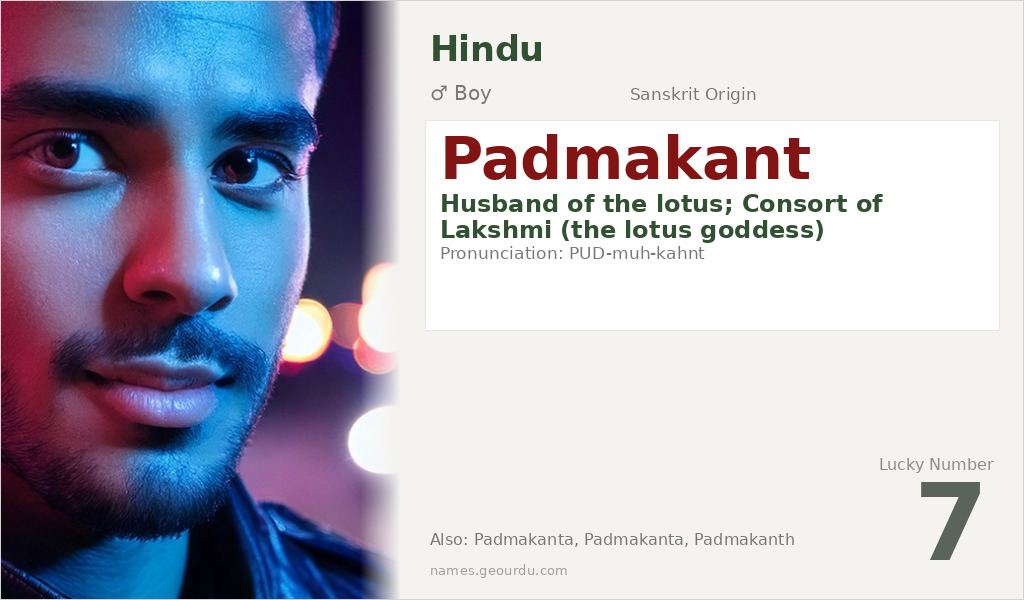
Padmakant derives from the Sanskrit words ‘padma’ (पद्म), meaning ‘lotus’, and ‘kant’ (कान्त), meaning ‘husband’, ‘beloved’, or ‘consort’. Thus, the name translates to ‘husband of the lotus’, symbolically referring to someone cherished like the sacred lotus. In Hindu mythology, the lotus is a powerful symbol of purity, beauty, and spiritual awakening, often associated with Lakshmi, the goddess of wealth and prosperity, who is herself called ‘Padma’. As such, Padmakant can imply ‘consort of Lakshmi’, linking it to Vishnu, her divine partner. This etymological construction is common in Sanskrit names, reflecting poetic and devotional themes. The name’s meaning is well-documented in Sanskrit lexicons and religious texts, emphasizing its enduring linguistic heritage.
| 📛 Name | Padmakant |
| 💎 Meaning | Husband of the lotus; Consort of Lakshmi (the lotus goddess) |
| 👤 Gender | Boy |
| 🕌 Religion | Hindu |
| 🌍 Origin | Sanskrit |
| 🗣 Pronunciation | PUD-muh-kahnt |
| ✍️ Urdu | پدماکانت |
| ✍️ Arabic | بادماكانت |
| 🔢 Numerology | 7 |
| ✨ Spellings | Padmakanta, Padmakanta, Padmakanth |
Origin & Cultural Significance
Padmakant originates from Sanskrit, the ancient liturgical language of Hinduism, with roots tracing back to classical Indian literature and Vedic traditions. It is predominantly used within Hindu communities in India and among the diaspora, reflecting the cultural importance of lotus symbolism in art, religion, and philosophy. The name embodies the Hindu concept of divine union, as seen in the pairing of Vishnu and Lakshmi, making it a choice that conveys spiritual devotion and auspiciousness. While not extremely common, it appears in historical and modern contexts, often among families valuing traditional Sanskrit names. Its usage is specific to Hindu culture, without significant adoption in other religious or linguistic groups.
Personality Traits
Those named Padmakant are often associated with traits of serenity, creativity, and a strong moral compass, inspired by the lotus’s ability to thrive in muddy waters while remaining unstained. They may be drawn to artistic or spiritual pursuits, exhibiting patience and a nurturing nature. The name suggests a person who values harmony and beauty, potentially leading with compassion and wisdom in personal and professional realms.
Similar Names
If you like Padmakant, consider: Padmanabh, Padmakar, Kamalkant, Pushpakant, Vishnukant
Famous People Named Padmakant
- Padmakant Malviya — Indian classical vocalist and composer known for his contributions to Hindustani music
- Padmakant Gokhale — Indian scholar and author specializing in Sanskrit literature and philosophy
Frequently Asked Questions About Padmakant
What does Padmakant mean?
Padmakant means 'husband of the lotus' in Sanskrit, symbolically referring to the consort of Lakshmi or someone beloved like the lotus, a sacred flower in Hinduism.
Is Padmakant a boy or girl name?
Padmakant is traditionally a boy's name in Hindu culture, derived from masculine Sanskrit grammar and mythological references to male deities like Vishnu.
What is the origin of Padmakant?
Padmakant originates from Sanskrit, an ancient Indian language, and is deeply rooted in Hindu mythology, particularly associated with Vishnu and Lakshmi symbolism.





