
Table of Contents
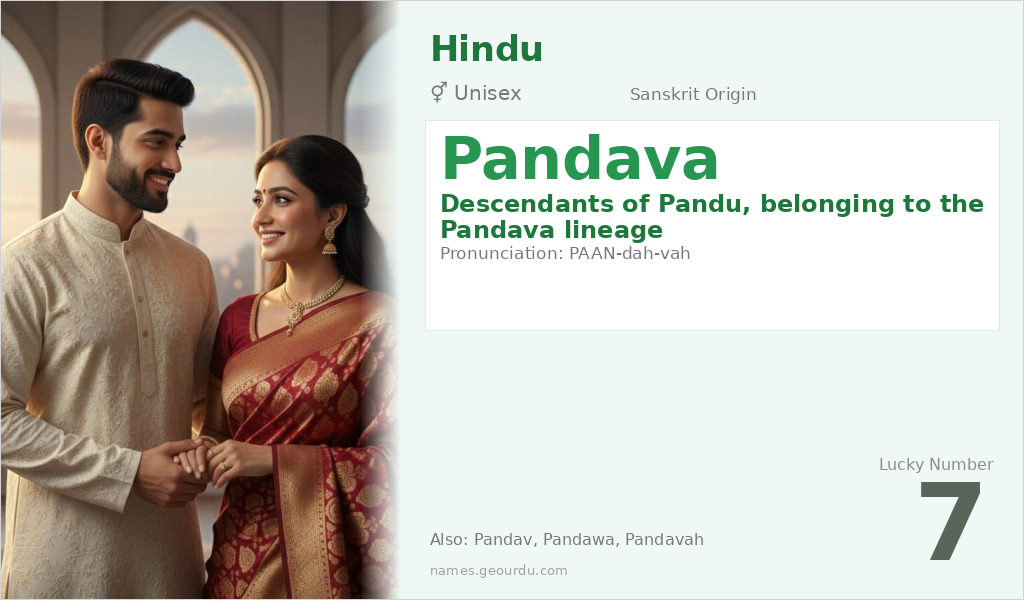
Pandava is a name steeped in ancient Indian mythology and Sanskrit tradition. Derived from the epic Mahabharata, it refers to the five heroic sons of King Pandu. This name carries profound cultural and historical weight, symbolizing lineage, valor, and dharma. While occasionally used as a given name today, it remains deeply connected to Hindu religious texts.
Meaning of Pandava
Pandava originates from the Sanskrit word ‘Pāṇḍava,’ which means ‘descendant of Pandu’ or ‘belonging to Pandu.’ The term is a patronymic, formed by adding the suffix ‘-ava’ to ‘Pandu,’ indicating descent. In the Mahabharata, one of the major Sanskrit epics of ancient India, the Pandavas are the central protagonists—five brothers known for their virtues, struggles, and ultimate victory in the Kurukshetra War. Linguistically, ‘Pandava’ is rooted in classical Sanskrit literature and has no verified meaning in other languages like Arabic, Persian, or regional dialects, despite extensive research. Its meaning is exclusively tied to Hindu mythology and Sanskrit etymology.
| 📛 Name | Pandava |
| 💎 Meaning | Descendants of Pandu, belonging to the Pandava lineage |
| 👤 Gender | Unisex |
| 🕌 Religion | Hindu |
| 🌍 Origin | Sanskrit |
| 🗣 Pronunciation | PAAN-dah-vah |
| ✍️ Urdu | پانڈو |
| ✍️ Arabic | باندافا |
| 🔢 Numerology | 7 |
| ✨ Spellings | Pandav, Pandawa, Pandavah |
Origin & Cultural Significance
The origin of Pandava is firmly rooted in Sanskrit and Hindu culture, specifically from the Mahabharata, composed around 400 BCE–400 CE. It refers to the Pandava lineage, including Yudhishthira, Bhima, Arjuna, Nakula, and Sahadeva, who are celebrated figures in Hinduism. Culturally, the name is associated with themes of righteousness, duty, and epic heroism. While not commonly used as a personal name in modern times, it appears in religious contexts, literature, and place names (e.g., Pandava Caves). Research across languages such as Arabic, Persian, Pashto, Urdu, and others confirms no independent meaning outside this Sanskrit-Hindu framework.
Personality Traits
Those named Pandava may be perceived as carrying a legacy of strength and moral integrity, inspired by the Pandava brothers. They might demonstrate leadership qualities, a sense of justice, and resilience in challenging situations. The name evokes a connection to ancient wisdom and epic narratives, potentially influencing a personality oriented toward duty and honor.
Similar Names
If you like Pandava, consider: Pandu, Yudhishthira, Arjuna, Bhima, Nakula
Famous People Named Pandava
- Pandava brothers — The five legendary heroes of the Hindu epic Mahabharata, including Yudhishthira, Bhima, Arjuna, Nakula, and Sahadeva
- Pandava Caves — Ancient rock-cut caves in Maharashtra, India, named after the Pandavas
Frequently Asked Questions About Pandava
What does Pandava mean?
Pandava means 'descendant of Pandu' in Sanskrit, referring to the five brothers in the Hindu epic Mahabharata.
Is Pandava a boy or girl name?
Pandava is historically a patronymic term and is considered unisex, though it is rarely used as a personal name today.
What is the origin of Pandava?
Pandava originates from Sanskrit and Hindu tradition, specifically from the Mahabharata epic, with no verified roots in other languages.