
Table of Contents
Paramesha is a powerful Sanskrit name that carries profound spiritual weight in Hindu tradition. Meaning ‘Supreme Lord’ or ‘Highest God’, this name has been used for centuries to denote divine authority and ultimate sovereignty. With roots in ancient Indian scriptures, Paramesha represents more than just a name—it embodies a concept of absolute divinity. This exploration delves into the rich etymology, cultural significance, and contemporary usage of this distinguished name.
Meaning of Paramesha
Paramesha derives from two Sanskrit elements: ‘parama’ (परम) meaning ‘supreme, highest, ultimate’ and ‘isha’ (ईश) meaning ‘lord, ruler, master’. The combination creates a compound that literally translates to ‘Supreme Lord’ or ‘Highest Ruler’. In Hindu theological context, this name specifically refers to the paramount deity, often associated with Shiva (as in Shiva Sahasranama where he is called Parameshvara) or Vishnu. The term appears in Vedic literature, Upanishads, and Puranic texts, consistently denoting the absolute, ultimate divine principle. Unlike generic divine titles, Paramesha emphasizes the superlative aspect of divinity—the highest among lords, the ultimate authority beyond all others.
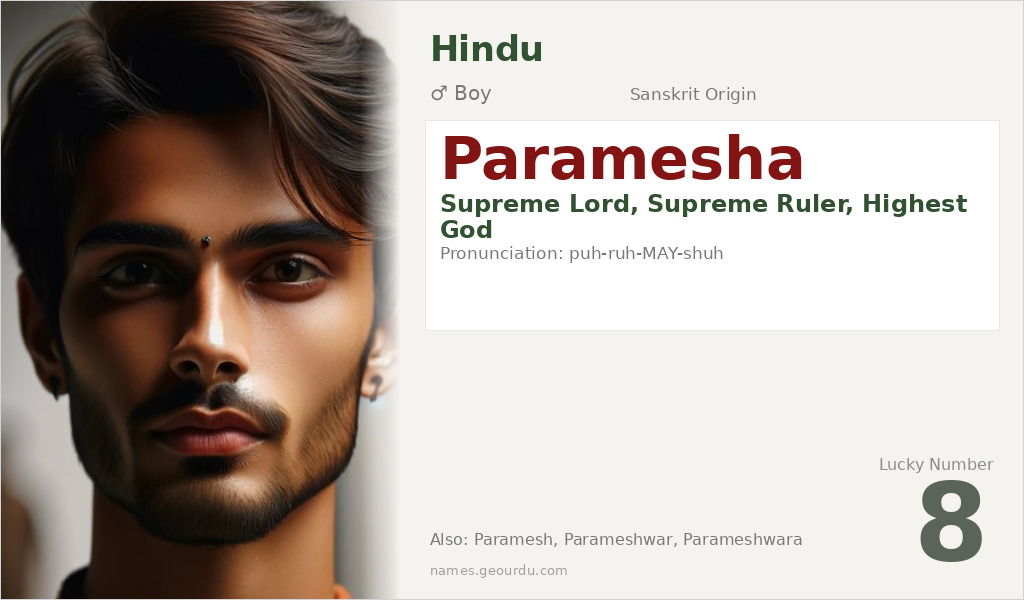
| 📛 Name | Paramesha |
| 💎 Meaning | Supreme Lord, Supreme Ruler, Highest God |
| 👤 Gender | Boy |
| 🕌 Religion | Hindu |
| 🌍 Origin | Sanskrit |
| 🗣 Pronunciation | puh-ruh-MAY-shuh |
| ✍️ Urdu | پرمیش |
| ✍️ Arabic | باراميشا |
| 🔢 Numerology | 8 |
| ✨ Spellings | Paramesh, Parameshwar, Parameshwara, Parameshvar |
Origin & Cultural Significance
Paramesha originates from classical Sanskrit, the liturgical language of Hinduism, with documented usage dating back to ancient Indian scriptures. The name is deeply embedded in Hindu philosophy, where it appears in texts like the Bhagavad Gita and various Puranas as an epithet for the supreme deity. Culturally, it represents the concept of paramātman (supreme soul) and ishvara (lord) combined into a single powerful designation. While primarily used in Hindu communities, the name’s philosophical depth has made it recognizable in broader Dharmic traditions. Historically, variations like Parameshvara have been used as titles for kings and spiritual leaders, reflecting the name’s association with supreme authority.
Personality Traits
Those named Paramesha are often associated with leadership qualities, spiritual depth, and authoritative presence. The name suggests someone who naturally commands respect and embodies higher principles. They may be perceived as wise, decisive individuals with a strong sense of purpose and moral direction. While these associations stem from the name’s meaning rather than psychological studies, they reflect cultural perceptions of how such a powerful name might influence personality development.
Similar Names
If you like Paramesha, consider: Parameshwara, Parameshwar, Mahesha, Ishvara, Paramesh
Famous People Named Paramesha
- Parameshvara — 14th century Indian mathematician and astronomer from Kerala who made significant contributions to the Kerala school of astronomy and mathematics
- Parameshwara — Founder of the Malacca Sultanate in the 15th century, though this is a title/name adaptation rather than a birth name
Frequently Asked Questions About Paramesha
What does Paramesha mean?
Paramesha means 'Supreme Lord' or 'Highest God' in Sanskrit, combining 'parama' (supreme) and 'isha' (lord).
Is Paramesha a boy or girl name?
Paramesha is exclusively a masculine name in Hindu tradition, reflecting its meaning as 'Supreme Lord' which carries masculine grammatical gender in Sanskrit.
What is the origin of Paramesha?
Paramesha originates from Sanskrit, the classical language of ancient India, with deep roots in Hindu scriptures and philosophy dating back thousands of years.





