
Table of Contents
Paramesha is a profound Sanskrit name that carries immense spiritual weight in Hindu tradition. Meaning ‘Supreme Lord’ or ‘Highest God’, this name has been used for centuries to denote ultimate divinity and sovereignty. Unlike many modern names, Paramesha comes directly from ancient Hindu scriptures and philosophical texts. It represents not just any deity, but the absolute ruler of the universe in Hindu theology.
Meaning of Paramesha
Paramesha derives from two Sanskrit roots: ‘parama’ (परम) meaning ‘supreme, highest, ultimate’ and ‘isha’ (ईश) meaning ‘lord, ruler, master, or god’. When combined, they create a compound that signifies the absolute sovereign deity. In Hindu texts, this name specifically refers to the supreme being, often identified with Shiva in Shaivism or Vishnu in Vaishnavism. The ‘parama’ prefix is crucial—it elevates the concept beyond ordinary lordship to the highest possible divine authority. This name appears in Vedic literature and Puranas, maintaining consistent theological meaning across centuries. Unlike generic divine names, Paramesha specifically denotes the pinnacle of divine hierarchy.
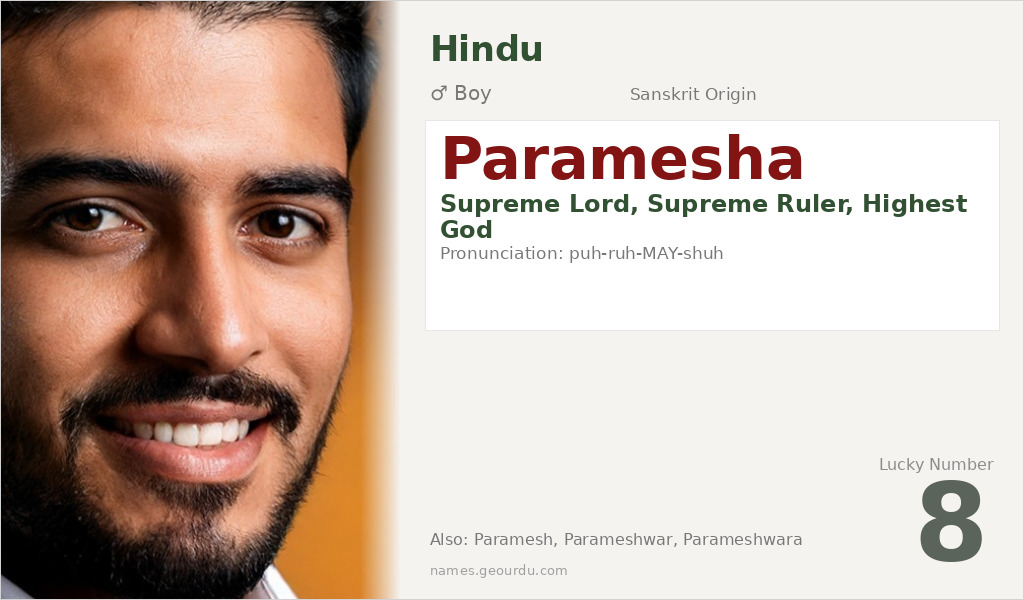
| 📛 Name | Paramesha |
| 💎 Meaning | Supreme Lord, Supreme Ruler, Highest God |
| 👤 Gender | Boy |
| 🕌 Religion | Hindu |
| 🌍 Origin | Sanskrit |
| 🗣 Pronunciation | puh-ruh-MAY-shuh |
| ✍️ Urdu | پرمیش |
| ✍️ Arabic | باراميشا |
| 🔢 Numerology | 8 |
| ✨ Spellings | Paramesh, Parameshwar, Parameshwara, Parameshvar |
Origin & Cultural Significance
Paramesha originates from classical Sanskrit, the liturgical language of Hinduism, with its earliest appearances in Vedic and post-Vedic scriptures. The name reflects core Hindu philosophical concepts about the nature of divinity and cosmic order. Culturally, it has been used both as a proper name and as an epithet for deities in religious texts. While primarily associated with Hindu tradition, the name has traveled to Southeast Asia through cultural exchange, appearing in historical contexts like the Malacca Sultanate. Its usage as a personal name signifies parents’ spiritual aspirations and reverence for divine sovereignty, making it more common in deeply religious families.
Personality Traits
Those named Paramesha often embody qualities associated with leadership and spiritual depth. The name suggests someone with natural authority, strong moral principles, and a protective instinct toward others. They may be perceived as wise beyond their years, with a tendency to seek higher understanding and purpose. While the name carries weighty connotations, bearers often grow into its expectations, developing integrity and vision that commands respect.
Similar Names
If you like Paramesha, consider: Parameshwara, Parameshwar, Mahesha, Ishvara, Paramesh
Famous People Named Paramesha
- Parameshvara — 14th century Indian mathematician and astronomer from Kerala who made significant contributions to the Kerala school of astronomy and mathematics
- Parameshwara — Founder and first ruler of the Malacca Sultanate in the 15th century, though this is a title/name adaptation in Southeast Asian context
Frequently Asked Questions About Paramesha
What does Paramesha mean?
Paramesha means 'Supreme Lord' or 'Highest God' in Sanskrit, combining 'parama' (supreme) and 'isha' (lord) to denote ultimate divine sovereignty.
Is Paramesha a boy or girl name?
Paramesha is exclusively a masculine name in Hindu tradition, reflecting its meaning as 'Supreme Lord' which grammatically and culturally aligns with male divinity in Sanskrit.
What is the origin of Paramesha?
Paramesha originates from classical Sanskrit, the ancient liturgical language of Hinduism, with documented usage in Vedic scriptures and Hindu philosophical texts dating back millennia.





