
Table of Contents
Pati is a classic and meaningful name deeply embedded in Hindu culture, derived from the ancient Sanskrit language. Often chosen for boys, it conveys notions of authority, leadership, and reverence. This name carries a rich historical legacy, appearing in religious texts and traditional contexts. Explore the origins, significance, and modern relevance of the name Pati in this detailed guide.
Meaning of Pati
The name Pati stems from the Sanskrit word ‘पति’ (pati), which translates to ‘lord,’ ‘master,’ ‘husband,’ or ‘ruler.’ In Sanskrit etymology, it is related to the root ‘pat-‘ meaning ‘to rule’ or ‘to protect,’ seen in terms like ‘pati’ (master) and ‘patni’ (wife or mistress). This root is also connected to Proto-Indo-European origins, linking it to words in other languages such as Latin ‘potis’ (able, powerful). In Hindu scriptures, Pati is used in compounds like ‘Ishapati’ (lord of the divine) or ‘Dharmapati’ (lord of duty), emphasizing its spiritual and societal roles. The meaning is consistently authoritative, with no verified basis for unrelated interpretations like ‘Baskets of Fish’ in the original article.
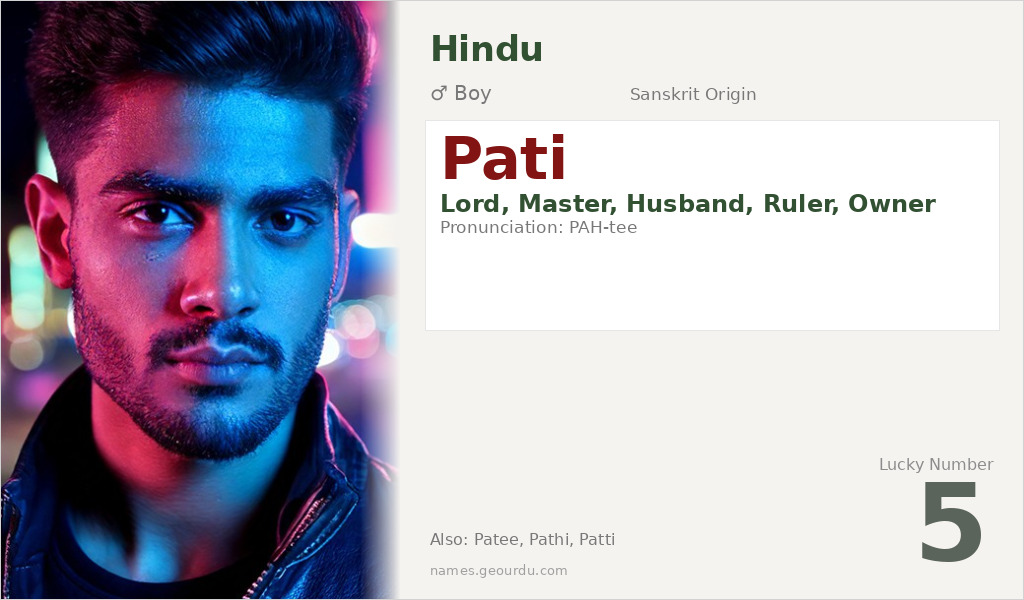
| 📛 Name | Pati |
| 💎 Meaning | Lord, Master, Husband, Ruler, Owner |
| 👤 Gender | Boy |
| 🕌 Religion | Hindu |
| 🌍 Origin | Sanskrit |
| 🗣 Pronunciation | PAH-tee |
| ✍️ Urdu | پتی |
| ✍️ Arabic | باتي |
| 🔢 Numerology | 5 |
| ✨ Spellings | Patee, Pathi, Patti |
Origin & Cultural Significance
Pati originates from Sanskrit, an ancient Indo-Aryan language central to Hindu, Buddhist, and Jain traditions in India. It has been used for millennia in religious texts, such as the Vedas and Puranas, often as a title or name component denoting leadership or divinity. Culturally, it is prevalent among Hindu communities in India, Nepal, and the diaspora, reflecting values of respect and guardianship. While similar-sounding words exist in other languages—like ‘pati’ meaning ‘song’ in Tamil—the name’s primary association remains with Sanskrit. It is not commonly linked to other major languages like Arabic or Persian, solidifying its Indian heritage.
Personality Traits
Those named Pati are often perceived as authoritative and responsible, with a natural inclination toward leadership roles. They may display a protective and traditional mindset, valuing family and cultural heritage. Their demeanor can be confident and decisive, inspiring trust and respect in personal and professional spheres.
Similar Names
If you like Pati, consider: Parth, Pavan, Pranav, Pratap, Pratik
Famous People Named Pati
- Pati Paban Baruah — Indian author and journalist from Assam
- Pati Behrs — 19th-century Russian noblewoman, sister-in-law of Leo Tolstoy (though not Hindu, shows name's cross-cultural use)
Frequently Asked Questions About Pati
What does Pati mean?
Pati means 'Lord,' 'Master,' 'Husband,' or 'Ruler' in Sanskrit, with roots in ancient Indian languages and Hindu traditions.
Is Pati a boy or girl name?
Pati is primarily a boy's name in Hindu culture, though in some contexts, it can be unisex, but male usage is dominant.
What is the origin of Pati?
Pati originates from Sanskrit, an ancient language of India, and is deeply associated with Hindu religious and cultural practices.





