
Table of Contents
Phanibhushan is a distinctive Sanskrit name rich with mythological significance and divine connotations. Primarily used in Hindu communities, particularly in India and Nepal, this name carries the weight of ancient tradition while remaining meaningful today. As a compound name, it beautifully combines imagery from Hindu iconography with linguistic elegance.
Meaning of Phanibhushan
Phanibhushan derives from classical Sanskrit, combining ‘Phani’ (फणि), meaning serpent or specifically the hood of a serpent, with ‘Bhushan’ (भूषण), meaning adornment or ornament. The complete name therefore translates to ‘adorned with serpents’ or ‘one who wears serpent ornamentation’. This is a direct reference to Lord Shiva, who in Hindu iconography is frequently depicted with serpents coiled around his neck and body, symbolizing his mastery over death and the cyclical nature of existence. The name appears in various Hindu texts and traditions as an epithet for Shiva, emphasizing this particular aspect of his divine representation. Unlike many names that have evolved or changed meaning over time, Phanibhushan has maintained its specific theological reference throughout centuries of usage.
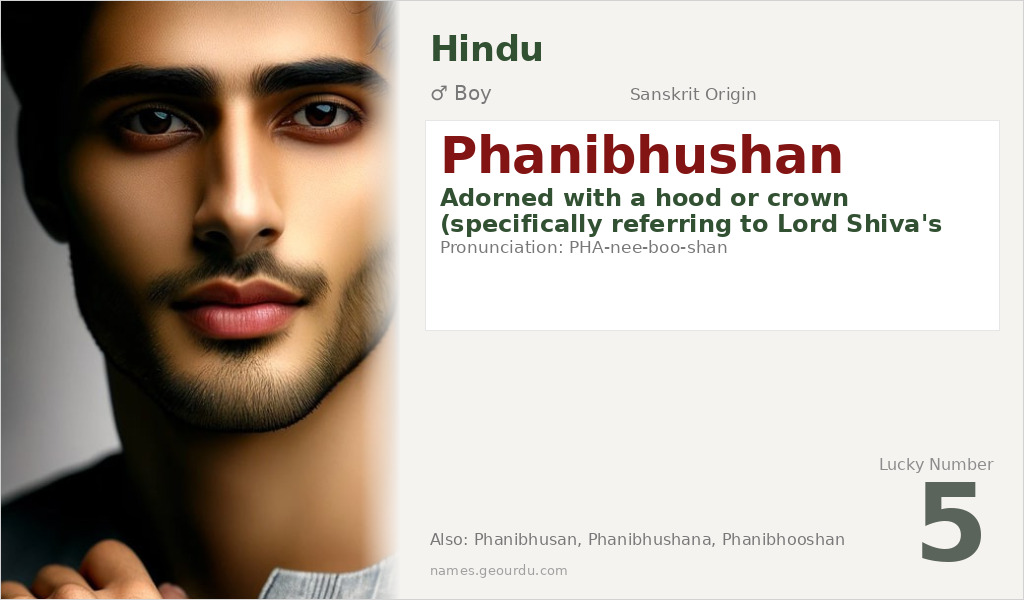
| 📛 Name | Phanibhushan |
| 💎 Meaning | Adorned with a hood or crown (specifically referring to Lord Shiva's serpent hood) |
| 👤 Gender | Boy |
| 🕌 Religion | Hindu |
| 🌍 Origin | Sanskrit |
| 🗣 Pronunciation | PHA-nee-boo-shan |
| ✍️ Urdu | پھنی بھوشن |
| ✍️ Arabic | فاني بوشان |
| 🔢 Numerology | 5 |
| ✨ Spellings | Phanibhusan, Phanibhushana, Phanibhooshan |
Origin & Cultural Significance
Phanibhushan originates from Sanskrit, the ancient liturgical language of Hinduism, and has been used primarily within Hindu communities across the Indian subcontinent for centuries. The name finds its roots in Hindu mythology and scriptures where serpents (nagas) hold significant symbolic value, representing both danger and protection, mortality and immortality. Culturally, the name is most prevalent in regions with strong Shaivite traditions, particularly in parts of India like West Bengal, Odisha, and Nepal where Shiva worship has deep historical roots. While not among the most common names, it has maintained consistent usage among families seeking names with direct mythological connections and spiritual significance. The name represents a specific aspect of Hindu theonymy where divine attributes become personal names.
Personality Traits
Those named Phanibhushan often carry an air of spiritual depth and traditional values, reflecting the name’s divine origins. They may exhibit protective qualities and a certain solemn dignity, much like the serpent adornments of Shiva which symbolize both danger and guardianship. The name suggests someone who balances strength with wisdom, potentially showing leadership abilities tempered with introspection. While personality varies individually, the mythological associations provide a cultural framework that may influence how bearers of this name perceive themselves and are perceived within their communities.
Similar Names
If you like Phanibhushan, consider: Nagabhushan, Sheshabhushan, Vasuki, Nagendra, Shiva
Famous People Named Phanibhushan
- Phanibhushan Vidyabinod — Early 20th century Bengali writer and journalist
- Phanibhushan Chakravarti — Indian mathematician and academic
Frequently Asked Questions About Phanibhushan
What does Phanibhushan mean?
Phanibhushan means 'adorned with a serpent's hood' in Sanskrit, specifically referring to Lord Shiva who is depicted with serpent ornamentation in Hindu iconography.
Is Phanibhushan a boy or girl name?
Phanibhushan is exclusively a boy's name in Hindu naming traditions, derived from masculine Sanskrit roots and referring to the male deity Shiva.
What is the origin of Phanibhushan?
Phanibhushan originates from Sanskrit, the classical language of Hinduism, and has been used for centuries within Hindu communities, particularly those with Shaivite traditions in India and Nepal.





