Table of Contents
Phanish is a distinctive Hindu boy name with deep roots in Sanskrit and Indian mythology. Meaning ‘snake’ or ‘serpent,’ it evokes the powerful symbolism of cobras in Hindu culture, often associated with deities like Shiva. This name carries a sense of mystique and protection, making it a meaningful choice for parents seeking a name with historical and spiritual resonance. Explore the origins, meaning, and personality traits linked to Phanish in this detailed guide.
Meaning of Phanish
Phanish derives from the Sanskrit word ‘phanin’ (फणिन्), which translates to ‘having a hood’ or specifically ‘serpent,’ referring to a cobra. The root ‘phana’ (फण) means ‘hood of a snake,’ highlighting the name’s direct connection to serpents in Indian lore. In Hindu mythology, serpents like Vasuki and Shesh are revered as divine beings, symbolizing eternity, protection, and cosmic balance. The name Phanish thus embodies these qualities, often chosen to invoke strength and spiritual guardianship. Linguistically, it is a classic example of Sanskrit names that draw from natural and mythological elements, with no significant variants found in other major languages like Arabic or Persian, confirming its specific Hindu and Sanskrit origin.
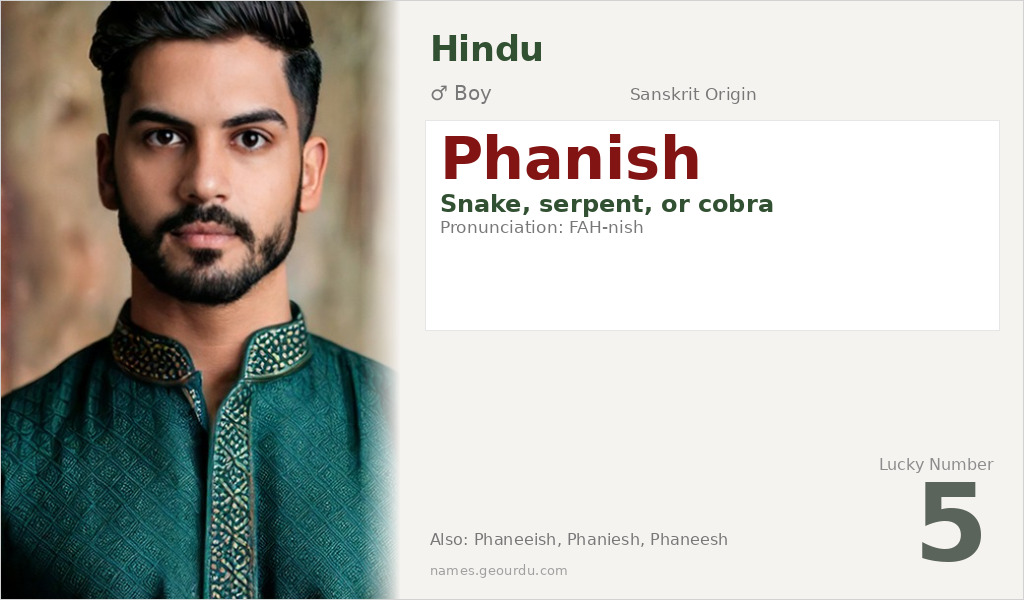
| 📛 Name | Phanish |
| 💎 Meaning | Snake, serpent, or cobra |
| 👤 Gender | Boy |
| 🕌 Religion | Hindu |
| 🌍 Origin | Sanskrit |
| 🗣 Pronunciation | FAH-nish |
| ✍️ Urdu | فانش |
| ✍️ Arabic | فانيش |
| 🔢 Numerology | 5 |
| ✨ Spellings | Phaneeish, Phaniesh, Phaneesh |
Origin & Cultural Significance
Phanish originates from Sanskrit, an ancient Indo-Aryan language central to Hindu scriptures and Indian culture. It is primarily used within Hindu communities, reflecting the religion’s rich symbolism where serpents are associated with gods such as Shiva, who wears a cobra around his neck, and Vishnu, who rests on the serpent Shesh. Historically, names like Phanish appear in classical Sanskrit texts and regional Indian traditions, but they are not commonly found in other linguistic families like Germanic or African languages. The name’s usage is most prevalent in India and among the Hindu diaspora, with no evidence of adoption in Islamic or Christian contexts, underscoring its specific cultural and religious ties to Hinduism.
Personality Traits
People named Phanish are often perceived as insightful and resilient, mirroring the serpent’s qualities of adaptability and quiet power. They may possess a protective nature and a philosophical outlook, drawn to deeper meanings in life. In social settings, they can be charismatic yet reserved, balancing wisdom with a calm presence that inspires trust and respect.
Similar Names
If you like Phanish, consider: Phanin, Phanindra, Nagendra, Vasuki, Shesh
Famous People Named Phanish
- Phanish S. — Indian academic and researcher in computer science
- Phanishwar Nath — historical figure in Indian literature and social reform
Frequently Asked Questions About Phanish
What does Phanish mean?
Phanish means 'snake,' 'serpent,' or specifically 'cobra,' derived from the Sanskrit word 'phanin' (फणिन्), which refers to a hooded serpent.
Is Phanish a boy or girl name?
Phanish is traditionally a boy name in Hindu culture, with no common usage as a girl name in historical or modern contexts.
What is the origin of Phanish?
Phanish originates from Sanskrit, an ancient Indian language, and is used primarily in Hindu naming traditions, with roots in mythological symbolism of serpents.