
Table of Contents
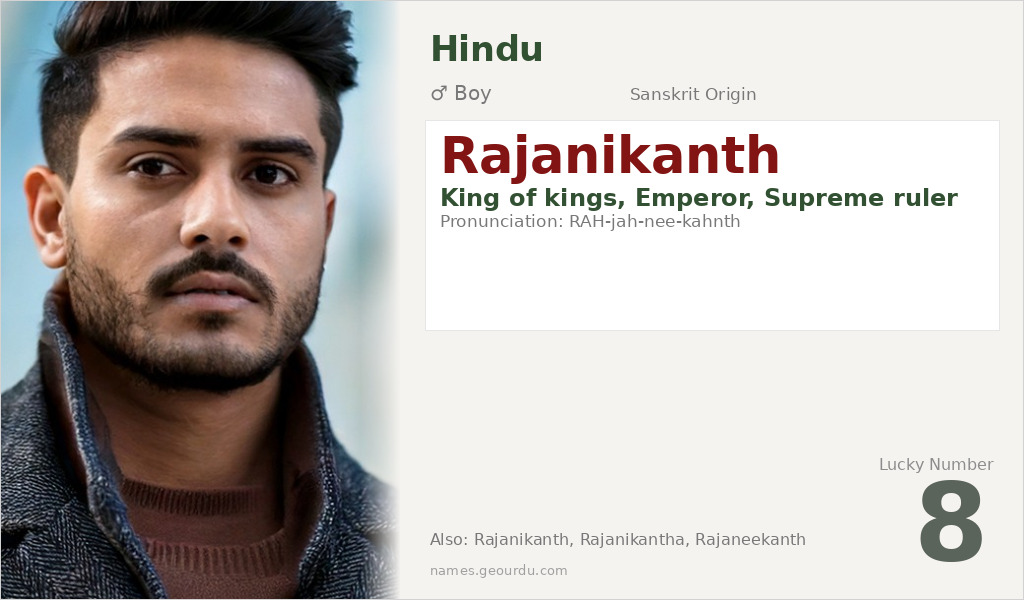
Rajanikanth is a majestic Sanskrit name that carries the weight of royalty and supreme authority. With roots in ancient Indian tradition, this name has gained modern prominence through cultural icons while maintaining its classical significance. Meaning ‘king of kings’ or ‘supreme ruler’, Rajanikanth embodies leadership, power, and regal dignity that has appealed to generations of parents seeking a name with historical depth and commanding presence.
Meaning of Rajanikanth
Rajanikanth derives from classical Sanskrit, combining ‘Rājānī’ (राजानी), meaning ‘queen’ or ‘royalty’, with ‘Kantha’ (कण्ठ), meaning ‘throat’, ‘voice’, or ‘beloved’. The literal translation is ‘beloved of royalty’ or ‘voice of the queen’, but culturally it has evolved to signify ‘king of kings’ or ’emperor’. This compound structure follows traditional Sanskrit naming conventions where ‘kanth/kantha’ serves as an honorific suffix denoting excellence or endearment. The name appears in historical texts as both a personal name and an honorific title for rulers and deities, particularly in South Indian contexts where Sanskrit names have deep cultural roots. Its royal connotations make it a name associated with leadership, authority, and noble character.
| 📛 Name | Rajanikanth |
| 💎 Meaning | King of kings, Emperor, Supreme ruler |
| 👤 Gender | Boy |
| 🕌 Religion | Hindu |
| 🌍 Origin | Sanskrit |
| 🗣 Pronunciation | RAH-jah-nee-kahnth |
| ✍️ Urdu | راجانی کنتھ |
| ✍️ Arabic | راجانيكانث |
| 🔢 Numerology | 8 |
| ✨ Spellings | Rajanikanth, Rajanikantha, Rajaneekanth, Rajani Kanth |
Origin & Cultural Significance
Rajanikanth originates from Sanskrit, the classical language of ancient India that has influenced naming traditions across South Asia for millennia. As a compound name, it reflects the sophisticated linguistic structures of Sanskrit where meaningful elements combine to create layered significance. The name has particular resonance in Hindu culture, where royal titles and divine epithets often incorporate ‘raja’ (king) elements. While the name appears in historical records, its modern popularity surged in the 20th century, particularly in South India, influenced by cultural figures and the film industry. Today, it remains primarily used in Hindu communities across India and the diaspora, maintaining its connection to traditional Sanskrit naming while adapting to contemporary contexts.
Personality Traits
Those named Rajanikanth are often associated with leadership qualities, confidence, and a commanding presence. They tend to be natural authority figures who combine strategic intelligence with emotional intelligence. The name suggests someone who is both respected and beloved—a leader who rules not just through power but through connection and wisdom. These individuals typically exhibit strong determination, organizational skills, and the ability to inspire others toward common goals.
Similar Names
If you like Rajanikanth, consider: Rajendra, Rajan, Kanth, Rajkumar, Rajanigandha
Famous People Named Rajanikanth
- Rajinikanth (born Shivaji Rao Gaekwad) — Legendary Indian film actor known as 'Superstar' in Tamil cinema, one of the most influential actors in India
- Rajanikanth (politician) — Various Indian politicians and public figures bearing this name
Frequently Asked Questions About Rajanikanth
What does Rajanikanth mean?
Rajanikanth means 'King of kings' or 'Supreme ruler' in Sanskrit. It's a compound name combining 'Rājānī' (royalty/queen) and 'Kantha' (beloved/voice), literally translating to 'beloved of royalty' but culturally signifying supreme authority.
Is Rajanikanth a boy or girl name?
Rajanikanth is exclusively a masculine name in all cultural contexts where it is used. The name's components and historical usage are consistently male-oriented, particularly in Hindu naming traditions.
What is the origin of Rajanikanth?
Rajanikanth originates from Sanskrit, the classical language of ancient India. It follows traditional Sanskrit compound naming patterns and has been used historically in Hindu communities, particularly in South India where Sanskrit names have deep cultural roots.





