
Table of Contents
Rangamoorthi is a profound Sanskrit name with deep roots in Hindu tradition and iconography. Primarily given to boys, this name carries artistic, spiritual, and divine connotations that reflect the colorful manifestations of the divine. As a compound name combining ‘ranga’ (color) and ‘moorthi’ (form), it represents the embodiment of cosmic diversity and beauty. Discover the rich meaning, origin, and cultural significance of this distinctive name.
Meaning of Rangamoorthi
Rangamoorthi derives from two Sanskrit words: ‘ranga’ (रङ्ग) meaning ‘color, dye, tint, or hue’ and ‘moorthi’ (मूर्ति) meaning ‘form, image, embodiment, or manifestation’. Together, they create the meaning ‘colored form’ or ‘manifestation of color’. In Hindu theology, this specifically refers to Lord Shiva in his various colorful manifestations, particularly as Nataraja—the cosmic dancer whose dance creates, sustains, and dissolves the universe. The name symbolizes how the formless divine takes on colorful forms to interact with creation, representing the spectrum of existence from pure consciousness to material diversity. This concept is central to Hindu iconography where deities are depicted with specific colors symbolizing their attributes.
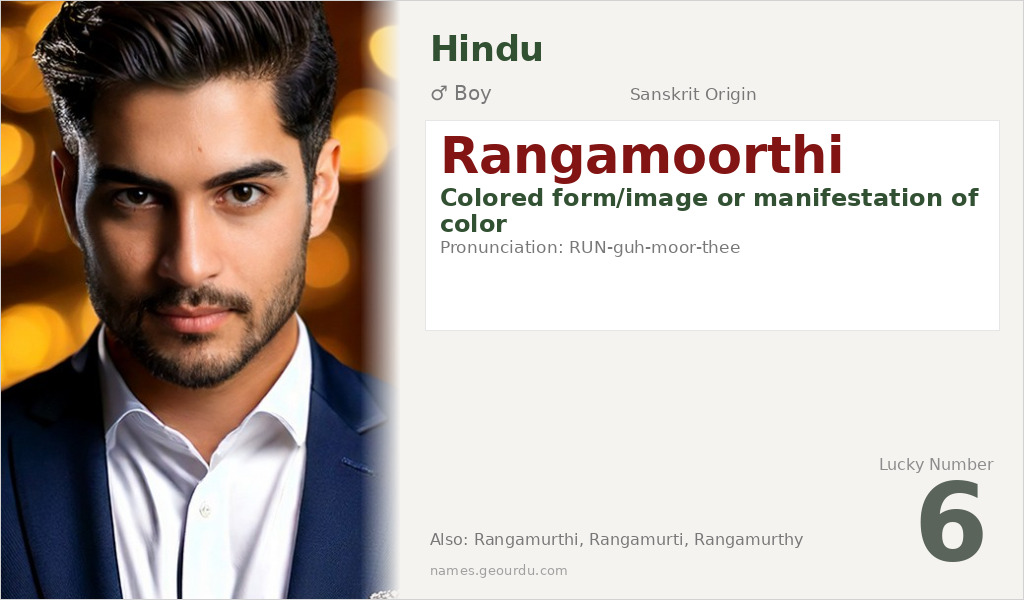
| 📛 Name | Rangamoorthi |
| 💎 Meaning | Colored form/image or manifestation of color |
| 👤 Gender | Boy |
| 🕌 Religion | Hindu |
| 🌍 Origin | Sanskrit |
| 🗣 Pronunciation | RUN-guh-moor-thee |
| ✍️ Urdu | رنگ مورتی |
| ✍️ Arabic | رانجامورتي |
| 🔢 Numerology | 6 |
| ✨ Spellings | Rangamurthi, Rangamurti, Rangamurthy |
Origin & Cultural Significance
Rangamoorthi originates from classical Sanskrit, the ancient liturgical language of Hinduism. It emerged within South Indian Hindu communities, particularly in Tamil Nadu and Karnataka, where devotion to Shiva has deep historical roots. The name reflects the philosophical concept of ‘saguna brahman’—the divine with attributes—as opposed to ‘nirguna brahman’ (the formless absolute). Culturally, it connects to temple traditions where colorful murthis (idols) of deities are worshipped, and to classical dance forms like Bharatanatyam that depict Shiva’s cosmic dance. While primarily used by Hindu families, the name’s linguistic components appear across Indian languages with similar meanings.
Personality Traits
Those named Rangamoorthi often exhibit creative, artistic tendencies with a spiritual foundation. The ‘color’ element suggests vibrancy, expressiveness, and appreciation for beauty in all forms, while ‘form’ indicates practicality and manifestation abilities. They may balance artistic sensitivity with structured thinking, embodying the harmony between creativity and discipline. Their connection to Shiva’s Nataraja aspect suggests potential for graceful movement, whether in physical arts or metaphorical navigation of life’s complexities.
Similar Names
If you like Rangamoorthi, consider: Ranganath, Rangarajan, Murugan, Shivam, Nataraj
Famous People Named Rangamoorthi
- Rangamoorthi Purushothaman — Indian classical dancer and choreographer specializing in Bharatanatyam
- Rangamoorthi M. — South Indian film director known for Tamil cinema contributions
Frequently Asked Questions About Rangamoorthi
What does Rangamoorthi mean?
Rangamoorthi means 'colored form' or 'manifestation of color' in Sanskrit, specifically referring to Lord Shiva's colorful divine forms, particularly as Nataraja (the cosmic dancer).
Is Rangamoorthi a boy or girl name?
Rangamoorthi is traditionally a masculine name given to boys in Hindu communities, though its components could theoretically be adapted. There are no documented feminine uses in historical or contemporary records.
What is the origin of Rangamoorthi?
Rangamoorthi originates from Sanskrit, the classical language of Hinduism, combining 'ranga' (color) and 'moorthi' (form). It has particular significance in South Indian Hindu traditions devoted to Shiva.





