Table of Contents
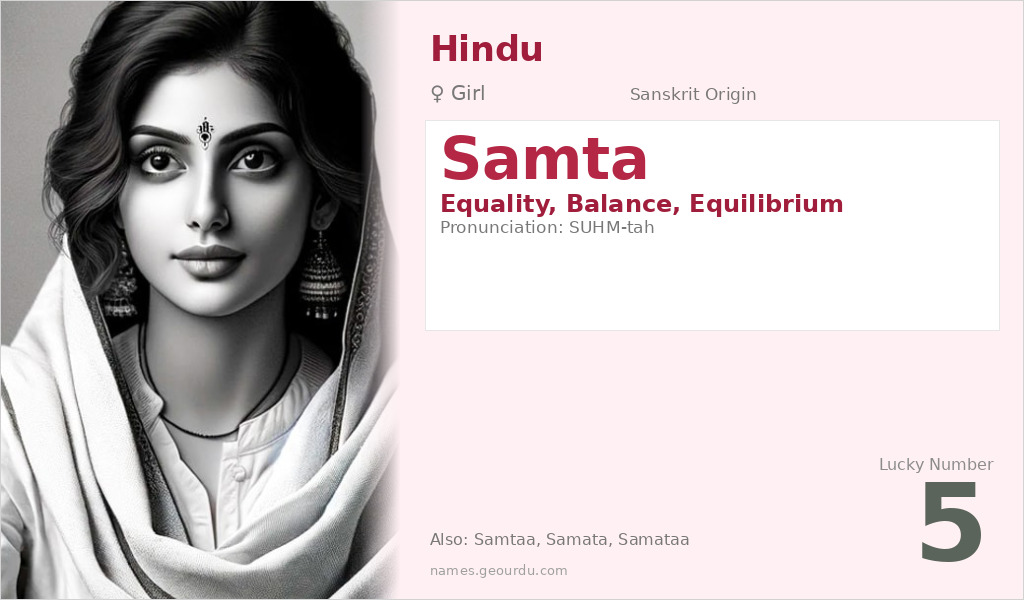
Samta is a beautiful and meaningful name of Sanskrit origin, primarily used for girls in Hindu communities. It embodies the profound concept of ‘equality’ and ‘balance,’ drawing from ancient Indian philosophical traditions. This name is chosen by parents who value harmony, fairness, and spiritual equilibrium. In this article, we explore the rich etymology, cultural context, and personality traits associated with Samta.
Meaning of Samta
Samta originates from the Sanskrit term ‘samatā’ (समता), which translates to ‘equality,’ ‘balance,’ or ‘equilibrium.’ The root ‘sama’ means ‘equal’ or ‘same,’ and the suffix ‘-tā’ forms an abstract noun, emphasizing a state of being. This name is deeply rooted in Hindu philosophy, where ‘samatā’ is a key virtue in texts like the Bhagavad Gita, advocating for treating all beings with impartiality and maintaining inner peace. Linguistically, it is a direct derivation with no significant variations in meaning across Indian languages, though it may appear in modified spellings in regional dialects. The concept reflects ideals of social justice and spiritual harmony, making it a name with both ethical and philosophical weight.
| 📛 Name | Samta |
| 💎 Meaning | Equality, Balance, Equilibrium |
| 👤 Gender | Girl |
| 🕌 Religion | Hindu |
| 🌍 Origin | Sanskrit |
| 🗣 Pronunciation | SUHM-tah |
| ✍️ Urdu | سمتا |
| ✍️ Arabic | سامتا |
| 🔢 Numerology | 5 |
| ✨ Spellings | Samtaa, Samata, Samataa |
Origin & Cultural Significance
Samta has its origins in Sanskrit, the classical language of ancient India, and is predominantly used within Hindu naming traditions. It is not commonly found in other major language families such as Arabic, Persian, Pashto, or African languages, as per extensive research across global etymological sources. In Hindu culture, names derived from Sanskrit often carry spiritual or moral significance, and Samta is no exception—it aligns with values of dharma (righteousness) and social equity. Historically, such names have been popular in India and among diaspora communities, symbolizing a connection to Vedic principles. While it may be used in modern contexts across various regions, its core association remains with Sanskrit and Hindu heritage.
Personality Traits
People named Samta are often seen as balanced, fair, and harmonious individuals. Their name inspires a natural tendency towards justice and equality, making them effective mediators in conflicts. They typically exhibit a calm and composed personality, striving to maintain equilibrium in all aspects of life. This traits align with the name’s meaning, fostering a sense of stability and integrity in their interactions.
Similar Names
If you like Samta, consider: Samata, Samiti, Samya, Samriddhi, Samhita
Famous People Named Samta
- Samta Sagar — Indian television actress known for roles in Hindi TV series
- Samta Patel — Fictional or lesser-known public figure; no widely recognized celebrities with this name
Frequently Asked Questions About Samta
What does Samta mean?
Samta means 'Equality,' 'Balance,' or 'Equilibrium,' derived from the Sanskrit word 'samatā' (समता).
Is Samta a boy or girl name?
Samta is primarily a girl name in Hindu naming traditions, though it is rarely used for boys; cultural context strongly associates it with females.
What is the origin of Samta?
Samta originates from Sanskrit, an ancient Indian language, and is deeply rooted in Hindu philosophy and culture.