Table of Contents
Sankarsana is a profound Sanskrit name with rich mythological roots in Hinduism. Primarily known as an epithet of Balarama, the elder brother of Lord Krishna, this name carries deep philosophical and agricultural symbolism. Meaning ‘the one who draws together’ or ‘the plougher’, Sankarsana represents unity, cultivation, and consciousness in Hindu tradition. Discover the fascinating etymology and cultural significance of this classical Indian name.
Meaning of Sankarsana
Sankarsana is a compound Sanskrit name formed from ‘sam’ (meaning ‘together’ or ‘completely’) and ‘karsana’ (meaning ‘drawing’, ‘pulling’, or ‘ploughing’). The complete meaning translates to ‘one who draws together’ or ‘the unifier’. In agricultural context, it specifically means ‘the plougher’, reflecting Balarama’s association with farming and cultivation. Philosophically, in Vaishnava theology, Sankarsana represents the aspect of consciousness that draws individual souls toward the divine. The name appears in ancient texts like the Mahabharata and Puranas, where it denotes both Balarama and a cosmic principle of unification.
| 📛 Name | Sankarsana |
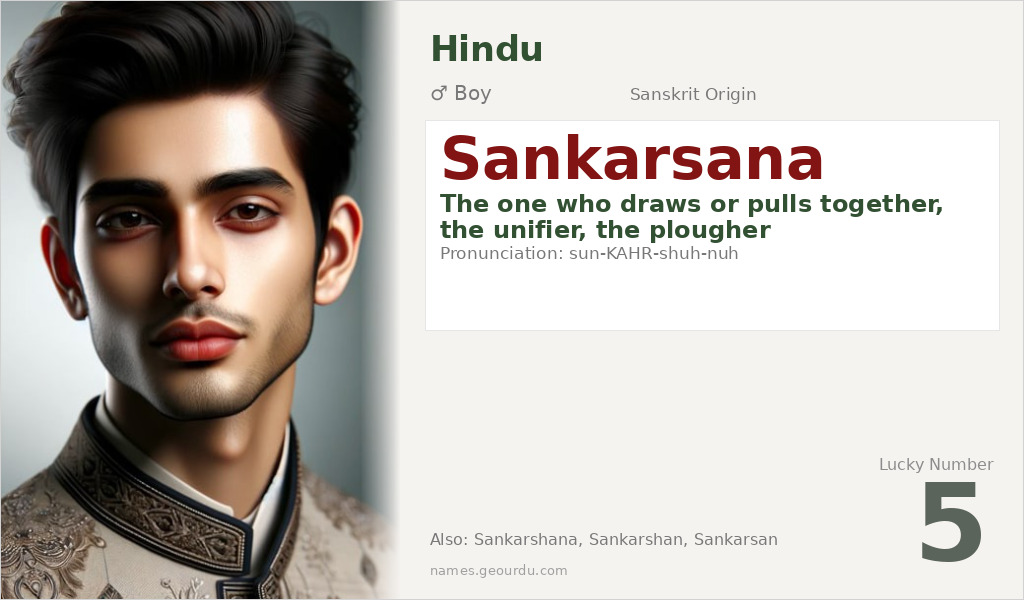
| 💎 Meaning | The one who draws or pulls together, the unifier, the plougher |
| 👤 Gender | Boy |
| 🕌 Religion | Hindu |
| 🌍 Origin | Sanskrit |
| 🗣 Pronunciation | sun-KAHR-shuh-nuh |
| ✍️ Urdu | سنکرشن |
| ✍️ Arabic | سانكارسانا |
| 🔢 Numerology | 5 |
| ✨ Spellings | Sankarshana, Sankarshan, Sankarsan |
Origin & Cultural Significance
Sankarsana originates from classical Sanskrit literature and Hindu mythology, dating back to at least the early centuries CE. It is most prominently associated with Balarama, who is considered the eighth avatar of Vishnu in some traditions and an incarnation of the serpent Shesha. The name appears extensively in Puranic literature, particularly the Bhagavata Purana and Vishnu Purana. In Pancharatra theology, Sankarsana is one of the four vyuha (emanations) of Vishnu, representing the mind and individual consciousness. The name’s agricultural symbolism connects to ancient Indian agrarian society, where ploughing was both a practical activity and spiritual metaphor.
Personality Traits
Those named Sankarsana often embody the unifying and cultivating qualities suggested by their name’s meaning. They tend to be natural peacemakers who bring harmony to groups and situations. With roots in agricultural symbolism, they often display patience, practicality, and a connection to natural rhythms. Their personality combines strength with nurturing qualities, making them reliable leaders who work steadily toward long-term goals and community wellbeing.
Similar Names
If you like Sankarsana, consider: Balarama, Baladeva, Halayudha, Samkarsana, Krishna
Famous People Named Sankarsana
- Balarama (Sankarsana) — Elder brother of Krishna in Hindu mythology, considered an avatar of Shesha, the serpent deity
- Sankarsana (philosophical concept) — In Pancharatra theology, one of the four vyuha forms of Vishnu representing individual consciousness
Frequently Asked Questions About Sankarsana
What does Sankarsana mean?
Sankarsana means 'the one who draws together' or 'the plougher' in Sanskrit. It comes from 'sam' (together) and 'karsana' (drawing/ploughing), symbolizing unification and cultivation.
Is Sankarsana a boy or girl name?
Sankarsana is exclusively a boy's name in Hindu tradition. It is an epithet of the male deity Balarama and has never been used for females in historical or contemporary usage.
What is the origin of Sankarsana?
Sankarsana originates from Sanskrit and Hindu mythology. It is primarily associated with Balarama, the elder brother of Krishna, and appears in ancient texts like the Mahabharata and Puranas as both a divine name and philosophical concept.