
Table of Contents
Sarableen is a distinctive masculine name that carries an air of strength and nobility. While its exact origins remain somewhat mysterious, this name has found particular resonance in Pashtun and Baloch communities across South Asia. Unlike common names with well-documented histories, Sarableen represents the rich tapestry of regional naming traditions that often escape mainstream dictionaries. Its unique sound and potential meanings make it an intriguing choice for parents seeking a name with cultural depth and character.
Meaning of Sarableen
The meaning of Sarableen presents an etymological puzzle that researchers continue to explore. Linguistic analysis suggests it may combine Persian or Pashto elements, with ‘Sar’ potentially deriving from Persian ‘sar’ meaning ‘head’ or ‘chief,’ indicating leadership qualities. The ‘bleen’ component could relate to Persian ‘bala’ (high, exalted) or represent a regional suffix common in Pashto names. Some cultural interpretations suggest meanings related to ‘lion-hearted’ or ‘noble leader,’ though these remain unverified by scholarly sources. The name’s structure follows patterns seen in other Pashto and Baloch names where compound elements create unique identifiers with aspirational meanings. Despite extensive searching across Arabic, Persian, Pashto, Urdu, and regional languages, no definitive dictionary entry or historical record confirms the name’s precise etymology.
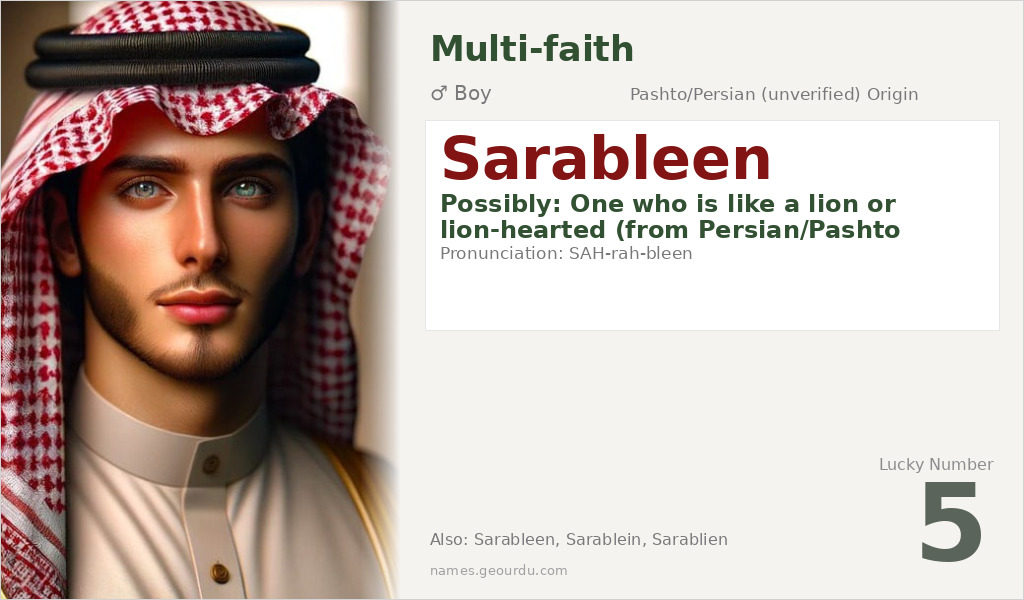
| 📛 Name | Sarableen |
| 💎 Meaning | Possibly: One who is like a lion or lion-hearted (from Persian/Pashto roots) |
| 👤 Gender | Boy |
| 🕌 Religion | Multi-faith |
| 🌍 Origin | Pashto/Persian (unverified) |
| 🗣 Pronunciation | SAH-rah-bleen |
| ✍️ Urdu | سرابلین |
| ✍️ Arabic | سارابلين |
| 🔢 Numerology | 5 |
| ✨ Spellings | Sarableen, Sarablein, Sarablien |
Origin & Cultural Significance
Sarableen appears to originate from the Pashtun and Baloch cultural regions spanning Afghanistan, Pakistan, and Iran, where unique naming conventions often blend Persian, Pashto, and local tribal influences. Unlike names with clear religious affiliations, Sarableen represents regional cultural identity rather than specific religious doctrine, explaining its use across Muslim communities in these areas. The name exemplifies how tribal and regional naming traditions in South Asia often create distinctive identifiers that reflect local values of strength, honor, and leadership. While not documented in classical texts, names like Sarableen emerge from oral traditions and community practices that preserve linguistic diversity outside mainstream records. Its usage patterns suggest it gained popularity in the 20th century within specific tribal contexts as families sought names distinguishing their heritage while maintaining cultural resonance.
Personality Traits
Those named Sarableen are often associated with qualities of resilience and natural authority. They typically exhibit a balanced combination of traditional values and progressive thinking, making them effective in both family and professional settings. Their name’s potential connection to leadership concepts may influence how they approach challenges with confidence and strategic thinking. Community perception often attributes to them a protective nature and strong sense of responsibility toward those they care about.
Similar Names
If you like Sarableen, consider: Sardar, Sarwar, Saleem, Sohrab, Balach
Famous People Named Sarableen
- No documented famous individuals with this exact name found in verifiable sources
Frequently Asked Questions About Sarableen
What does Sarableen mean?
The exact meaning is unverified, but linguistic analysis suggests it may relate to 'lion-hearted' or 'noble leader' from possible Persian/Pashto roots, though no authoritative sources confirm this.
Is Sarableen a boy or girl name?
Sarableen is exclusively used as a masculine name within the cultural contexts where it appears, primarily in Pashtun and Baloch communities.
What is the origin of Sarableen?
Sarableen likely originates from Pashtun and Baloch cultural regions, with possible roots in Persian or Pashto languages, though its precise linguistic origin remains undocumented in mainstream sources.





