Table of Contents
Soudabeh is a beautiful and historically rich Persian name that carries the weight of epic literature. Derived from Ferdowsi’s monumental Shahnameh (Book of Kings), this name belongs to one of Persian mythology’s most complex female characters. While primarily used in Persian-speaking communities, the name has gained recognition internationally through Persian literature and diaspora communities. Discover the fascinating story behind this legendary name and its enduring cultural significance.
Meaning of Soudabeh
Soudabeh is a Persian name with deep literary roots in the Shahnameh, the national epic of Iran written by Ferdowsi around 1000 CE. The name refers specifically to Queen Soudabeh, wife of King Kay Kāvus and stepmother to Prince Siyāvash, whose story forms a crucial part of the epic’s narrative. Linguistically, the name is believed to combine Persian elements meaning ‘burning’ or ‘fiery’ (souda) with ‘good’ or ‘better’ (beh), though scholars debate the exact etymology within the epic context. Unlike many Persian names with clear dictionary meanings, Soudabeh derives its significance primarily from its literary and mythological associations rather than a straightforward lexical meaning. The character of Soudabeh represents one of the Shahnameh’s most psychologically complex figures, making the name carry connotations of beauty, intelligence, ambition, and tragedy.
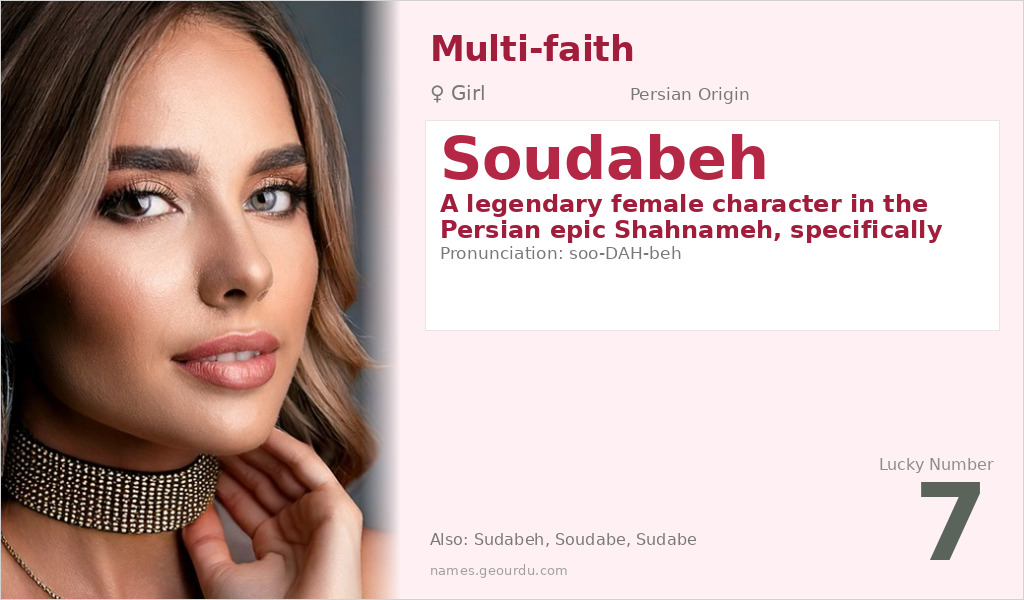
| 📛 Name | Soudabeh |
| 💎 Meaning | A legendary female character in the Persian epic Shahnameh, specifically the wife of King Kay Kāvus and mother of Prince Siyāvash |
| 👤 Gender | Girl |
| 🕌 Religion | Multi-faith |
| 🌍 Origin | Persian |
| 🗣 Pronunciation | soo-DAH-beh |
| ✍️ Urdu | سودابہ |
| ✍️ Arabic | سودابه |
| 🔢 Numerology | 7 |
| ✨ Spellings | Sudabeh, Soudabe, Sudabe, Soodabeh |
Origin & Cultural Significance
Soudabeh originates from Persian literature and mythology, specifically from the Shahnameh (Book of Kings), which chronicles the history of Persia from mythical times to the Arab conquest. The name first appears in this epic masterpiece composed by the poet Ferdowsi between 977 and 1010 CE. Culturally, the name is used primarily in Persian-speaking regions including Iran, Afghanistan, and Tajikistan, as well as among diaspora communities worldwide. While the character appears in pre-Islamic Persian mythology, the name has been adopted by Persian-speaking Muslims, Zoroastrians, and others, making it a multi-faith name with strong cultural rather than religious associations. The name’s usage reflects the enduring influence of Persian literary heritage across centuries and religious boundaries.
Personality Traits
Those named Soudabeh often carry the legacy of their namesake’s complex character from Persian epic literature. They may exhibit intelligence, strategic thinking, and strong determination, much like the queen who played a pivotal role in Shahnameh’s narrative. The name suggests someone with depth, passion, and the ability to make significant impacts in their personal and professional lives. While individual personalities vary, the literary association lends an air of sophistication and historical consciousness to bearers of this distinctive name.
Similar Names
If you like Soudabeh, consider: Shirin, Tahmineh, Roxana, Farangis, Gordafarid
Famous People Named Soudabeh
- Soudabeh Fazaeli — Iranian actress known for roles in Persian cinema and television
- Soudabeh Salem — Contemporary Persian poet and writer
Frequently Asked Questions About Soudabeh
What does Soudabeh mean?
Soudabeh is the name of a legendary queen in the Persian epic Shahnameh (Book of Kings). The name refers specifically to this literary character rather than having a conventional dictionary meaning, though it may derive from Persian elements meaning 'fiery good' or similar.
Is Soudabeh a boy or girl name?
Soudabeh is exclusively a girl's name, as it refers to a female character in Persian mythology and literature. The name has been used for girls in Persian-speaking cultures for centuries.
What is the origin of Soudabeh?
Soudabeh originates from Persian literature, specifically from the Shahnameh (Book of Kings) epic written by Ferdowsi around 1000 CE. It is a Persian name with cultural significance across Persian-speaking communities regardless of religious affiliation.