
Table of Contents
Standish is a distinguished English name with centuries of history, most famously borne by Pilgrim military leader Myles Standish. Derived from a Lancashire place name, it carries the meaning ‘stone enclosure’ or ‘stony park’ from Old English roots. This surname-turned-given-name evokes images of strength, permanence, and English heritage. While uncommon as a first name, it maintains recognition through historical figures and literary references.
Meaning of Standish
The name Standish has a clear, well-documented meaning originating from Old English. It combines ‘stan’ (stone) with ‘edisc’ (enclosure, park, or pasture), literally translating to ‘stone enclosure’ or ‘stony park’. This refers to a fenced or bounded area characterized by stone features, possibly indicating a fortified settlement or rocky terrain. The name first appeared as a surname derived from the village of Standish in Lancashire, England. As a toponymic name, it follows the common medieval practice of identifying people by their place of origin. The ‘stone’ element suggests durability and permanence, while ‘enclosure’ implies protection and boundaries.
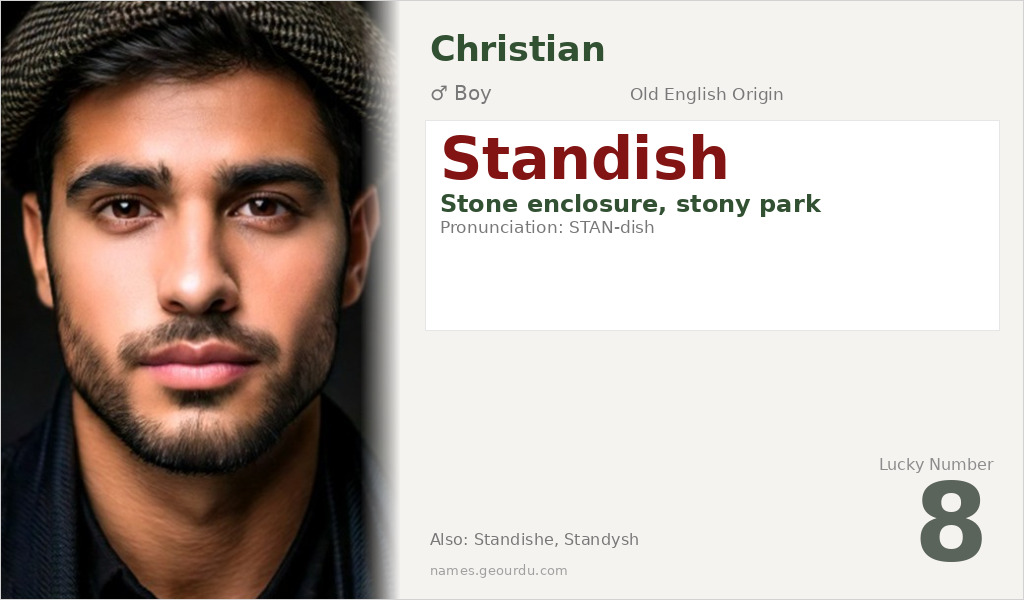
| 📛 Name | Standish |
| 💎 Meaning | Stone enclosure, stony park |
| 👤 Gender | Boy |
| 🕌 Religion | Christian |
| 🌍 Origin | Old English |
| 🗣 Pronunciation | STAN-dish |
| ✍️ Urdu | اسٹینڈش |
| ✍️ Arabic | ستانديش |
| 🔢 Numerology | 8 |
| ✨ Spellings | Standishe, Standysh |
Origin & Cultural Significance
Standish originated as a locational surname from Standish, Lancashire, England, with records dating back to the 13th century. The village name itself appears in the Domesday Book (1086) as ‘Stanedis’. During the Middle Ages, as surnames became hereditary, individuals from Standish adopted it as their family name. The most famous bearer, Myles Standish, brought the name to America with the Pilgrims in 1620. While primarily English in origin, the name has no verified connections to Arabic, Persian, South Asian, or African languages despite extensive research across linguistic traditions. Its usage as a given name emerged later, particularly in English-speaking countries with appreciation for historical and surname names.
Personality Traits
The ‘stone’ element in Standish’s etymology suggests qualities of strength, reliability, and endurance. Those named Standish are often associated with traditional values, practical thinking, and a grounded approach to life. The ‘enclosure’ component implies someone who values security, establishes clear boundaries, and creates stable environments. Historically, bearers like Myles Standish demonstrated leadership, courage, and loyalty—traits that continue to be associated with the name today.
Similar Names
If you like Standish, consider: Stanley, Stanford, Stanton, Stan, Ashley
Famous People Named Standish
- Myles Standish (c. 1584-1656) — English military officer hired by the Pilgrims as military advisor for the Plymouth Colony, prominent figure in early American history
- John Standish (1917-2008) — British Anglican bishop who served as Bishop of Sodor and Man
Frequently Asked Questions About Standish
What does Standish mean?
Standish means 'stone enclosure' or 'stony park' from Old English 'stan' (stone) and 'edisc' (enclosure/park). It originated as a place name in Lancashire, England.
Is Standish a boy or girl name?
Standish is traditionally and almost exclusively a masculine name. It originated as a surname and has been used as a given name for boys, particularly in English-speaking countries with historical naming traditions.
What is the origin of Standish?
Standish has English origins, specifically from Old English. It began as a locational surname from the village of Standish in Lancashire, England, with the earliest records dating to the 13th century.





