
Table of Contents
Takshaka is a name steeped in ancient Indian tradition, carrying both a practical occupational meaning and profound mythological weight. While literally translating to ‘carpenter’ or ‘woodworker’ from Sanskrit, it is most famously associated with the powerful serpent king in Hindu epics. This dual significance makes Takshaka a name that bridges the mundane and the divine, offering rich cultural resonance for parents seeking a name with historical depth.
Meaning of Takshaka
The name Takshaka derives from the Sanskrit root ‘takṣ’ (तक्ष्), which means ‘to carve, fashion, or hew wood.’ This gives it the primary literal meaning of ‘carpenter’ or ‘woodworker,’ referring to someone skilled in crafting with wood. In Hindu mythology, however, Takshaka takes on a much grander significance as the king of the Nagas (serpent beings) who plays a crucial role in the Mahabharata. According to the epic, Takshaka was responsible for killing King Parikshit, leading to the famous snake sacrifice performed by Janamejaya. This mythological association has made the name synonymous with serpent royalty and divine power in Indian tradition, creating a fascinating duality between its earthly occupational meaning and its supernatural mythological identity.
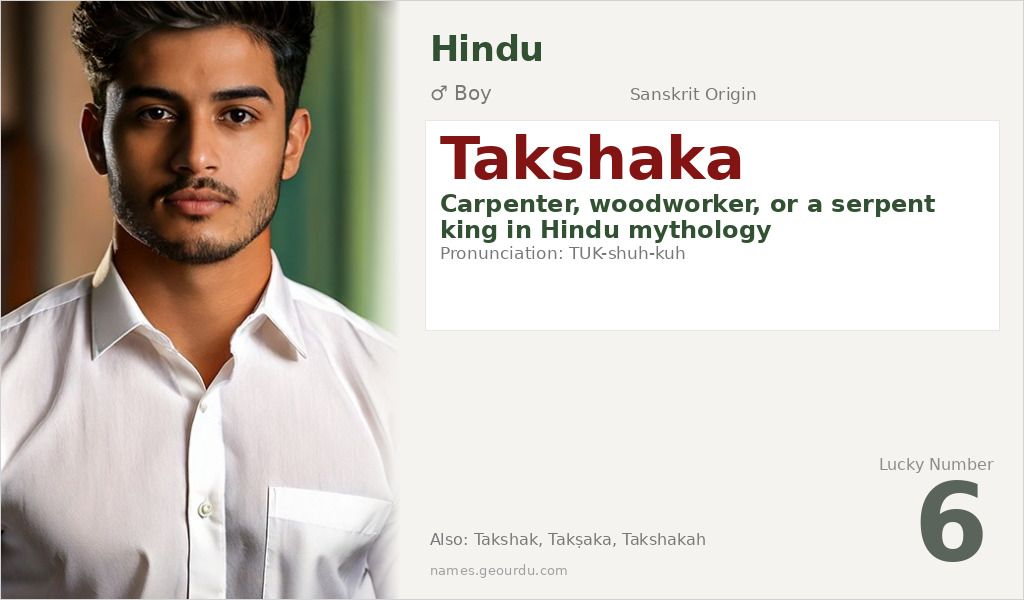
| 📛 Name | Takshaka |
| 💎 Meaning | Carpenter, woodworker, or a serpent king in Hindu mythology |
| 👤 Gender | Boy |
| 🕌 Religion | Hindu |
| 🌍 Origin | Sanskrit |
| 🗣 Pronunciation | TUK-shuh-kuh |
| ✍️ Urdu | تکشک |
| ✍️ Arabic | تاكشاكا |
| 🔢 Numerology | 6 |
| ✨ Spellings | Takshak, Takṣaka, Takshakah |
Origin & Cultural Significance
Takshaka originates from classical Sanskrit, one of the oldest languages of the Indian subcontinent with roots dating back to at least 1500 BCE. The name appears in numerous ancient Hindu texts, most prominently in the Mahabharata (circa 400 BCE-400 CE), where Takshaka is depicted as a powerful Naga king living in the forest near the Kuru kingdom. Some scholars suggest the name may have geographical connections to the ancient city of Taxila (Takshashila), which was an important center of learning in ancient India. In Hindu tradition, Nagas like Takshaka are considered semi-divine beings associated with water, fertility, and protection, often serving as guardians of treasures and sacred knowledge.
Personality Traits
Those named Takshaka often embody a blend of creative craftsmanship and strategic power. The carpenter meaning suggests practical skills, attention to detail, and the ability to transform raw materials into something beautiful and functional. Meanwhile, the mythological association with the serpent king implies leadership qualities, wisdom, and a certain mystique. This combination can result in individuals who are both hands-on creators and natural leaders, capable of building tangible results while navigating complex situations with cunning and grace.
Similar Names
If you like Takshaka, consider: Vasuki, Shesha, Karkotaka, Ananta, Nagendra
Famous People Named Takshaka
- Takshaka — Mythological serpent king in the Mahabharata who killed King Parikshit and played a key role in the Kurukshetra War aftermath
- Takshaka — Historical figure referenced in ancient Indian texts as a Naga ruler, sometimes associated with Taxila region
Frequently Asked Questions About Takshaka
What does Takshaka mean?
Takshaka has two primary meanings: literally 'carpenter' or 'woodworker' from Sanskrit, and mythologically as the name of a powerful serpent king in Hindu tradition from the Mahabharata.
Is Takshaka a boy or girl name?
Takshaka is exclusively a boy's name in Hindu naming tradition, as it refers to a male mythological figure and follows masculine grammatical forms in Sanskrit.
What is the origin of Takshaka?
Takshaka originates from Sanskrit, an ancient Indo-Aryan language of India, with documented usage in Hindu scriptures dating back over two millennia.





